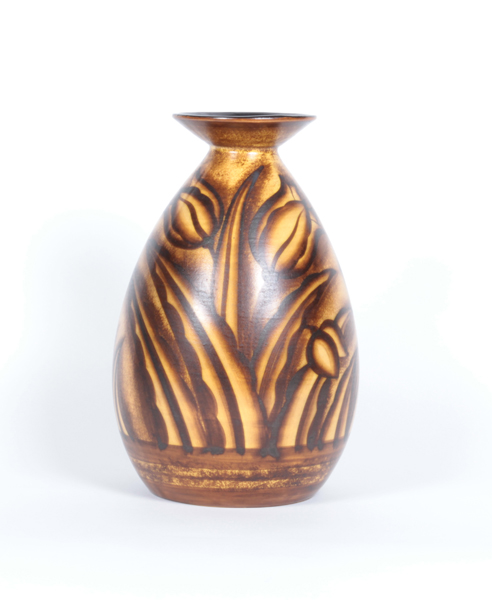
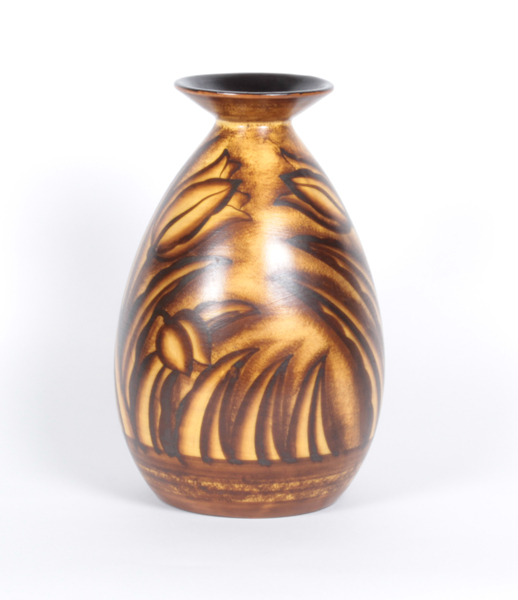
Charles Catteau / Boch Freres Keramis Belgium Glazed pottery vase c. 1930
More Information
Charles Catteau / Boch Freres Keramis Belgium Glazed pottery vase c. 1930
CHARLES CATTEAU (1880-1966)
BOCH FRERES KERAMIS La Louviere Belgium
Tulip vase c. 1930
Glazed earthenware
Marks: “Keramis” Made in Belgium , D. 2524 B, 945
H: 10 1/4″ x D: 6 1/2″
Charles Catteau could be regarded as one of the most versatile ceramic artists of his generation, especially for the style of Art Deco. Catteau advanced the forms, techniques and decoration of modern ceramics, creating an exceptionally original, new and decorative genre.
Hired as a ceramic decorator in Ecole Nationale de Sèvres from 1903 to 1904, he began producing designs that were rather traditional, based on the observation of nature, and showing the influence of Japonisme, characterized by pure lines and meticulous details. From 1904 to 1906, he worked in Nymphenburg Porzellan Manufaktur near Munich, a factory specializing in new hand painting procedures under a slip, as well as Art Nouveau.
In 1907 he finally moved to Louvière in Belgium where he was promoted to head of the decoration department at Boch Freres Keramis at the age of 27. This is where most of his exceptional talent came to the fore especially during the period between the two World Wars. Influenced by the great creative art movements of the time (Africanism, Japonisme, Cubism, Abstraction) and his observation of nature gave him inspiration for his designs, with the integration of plants, stylized animals and geometric motifs. The international avant-garde movements were also an influence leading to his use of purely abstract, geometric designs and intense colors. Charles Catteau was incredibly resourceful and explored various harmonies of form, techniques, designs, colors, shades, topics, variants and influences. In this way Catteau became a representative par excellence of Art Deco designs, giving it his personal touch. He was instrumental in introducing technical innovations during the 20’s and 30’s to aid mass production of ceramic products and expand availability of affordable products. During difficult times in Europe, he created vivid, colorful, original and uplifting ceramic wares.
Charles Cotteau motto was “Art for All” and he also taught decorative painting at the School of Industrial in Louvière. In 1925 he obtained international recognition in the exhibition of Decorative Arts in Paris. which helped raise the profile of Boch Freres. He remained at the company until he retired to Nice in 1946 .
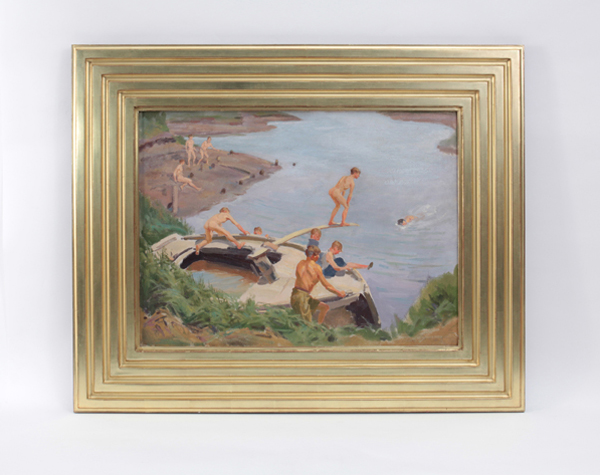
Edmund F. Ward “The Swimming Hole” Oil on canvas c. 1930
EDMUND F. WARD (b. 1892 – 1991) USA
“The Swimming Hole” c. 1930
Oil on canvas
Marks: signed Edm. F. Ward (lower right); partial labels verso:Westchester Arts and Crafts Guild; 4 Edmund F. Ward
For more information on the artist see: Who Was Who in American Art,Peter Hastings Falk, ed. (Madison, Conn.: Sound View Press, 1985), p. 658.
Canvas H: 18” x W: 24”
Framed H: 27 9/16” x W: 33 9/16”
Price: $14,000
Ward studied at the Arts Student’s League with Edward Dufner, George Bridgeman, and Thomas Fogarty. He was an illustrator for several national magazines and books. In 1925, Ward exhibited an award winning work at the Art Institute of Chicago. He is perhaps best known for his WPA mural in the Federal Building, White Plains, New York.
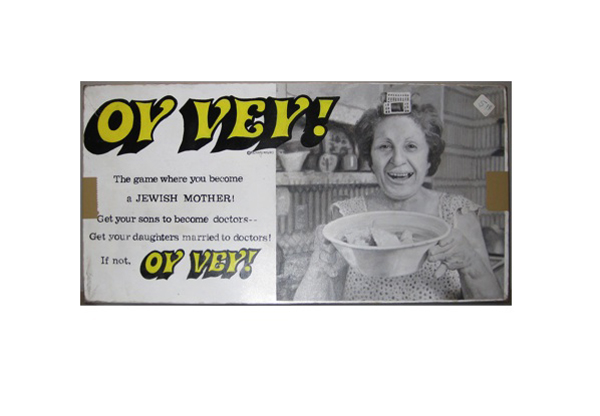
Tim Liddy Oy Vey (1979) The game where you become a JEWISH MOTHER! Get your sons to become doctors—Get your daughters married to doctors! If not, OY VEY! 2008 Oil and enamel on copper, plywood back
TIM LIDDY
“Oy Vey” (1979) The game where you become a JEWISH MOTHER! Get your sons to become doctors—Get your daughters married to doctors! If not, OY VEY! 2008
Oil and enamel on copper, plywood back
Signed in script: Tim Liddy, red circular ring, “circa 1979”, 2008
Provenance: William Shearburn Gallery, St. Louis, MO
H: 10 ¼” x W: 20 ½” x D: 1 ¾”
With his recent paintings, Liddy has both reasserted the construct of hyperrealist painting and developed a thoroughly unique advancement of that mode by extending the cultural reality of the indexed original. Based on the illustrated box lids of vintage board games, Liddy has recontextualized a subject, which evokes the underlying rules of life. Painted on copper or steel in the precise dimensions of the original, the metal is then manipulated to demonstrate the exact rips and tears from years of usage and includes trompe-l’oeil renditions of the scotch tape that might be holding the cardboard box together, the assorted stains, or the various graffiti of time. Liddy leaves no possibility of ambivalence, these works speak to a concurrent understanding of their original object identity and to themselves as works of art engaged in historical and psychological dialogue.
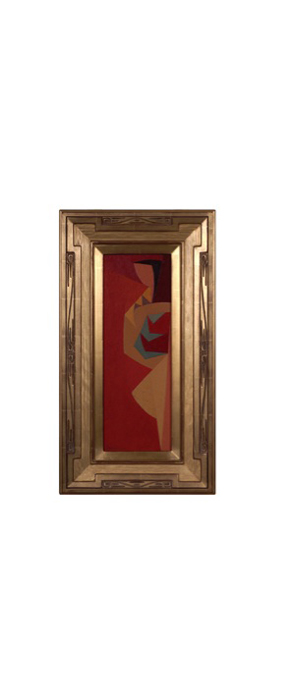
Karl Benjamin, “Geo-metricized figure”, Oil on canvas 1954
KARL BENJAMIN (1925-2012) USA
Geometricized figure 1954
Oil on canvas
Signed: Benjamin 54 (lower left)
For more information see: Dictionnaire des Peintres, Sculpteurs, Dessinateurs et Graveurs, Vol. 1 to 10, E. Bénézit (Paris: Librairie Gründ, 1976).
Canvas: H: 17″ x W: 6″
Framed: H: 24 1/2″ x W: 13 1/2″
Karl Benjamin was born in Chicago, IL in 1925. He received his BA from the University of Redlands, CA and his MFA at Claremont Graduate School, CA. Benjamin belonged to the Hard Edge group of West Coast painters led by John McLaughlin during the 1950s, 60s and early 70s. He was awarded the National Endowment for the Arts Grant for Visual Arts in both 1983 and 1989. His work has been featured in numerous museum exhibitions and is included in the public collections of the Los Angeles County Museum of Art; Museum of Contemporary Art, Los Angeles; Museum of Modern Art, Israel; Oakland Museum, Oakland, CA; San Francisco Museum of Modern Art, CA; Seattle Art Museum, WA; and the Whitney Museum of American Art, NY, among others. For many years, Benjamin taught painting at Pomona College and Claremont Graduate School, and currently is Professor Emeritus. He lived in Claremont, CA.
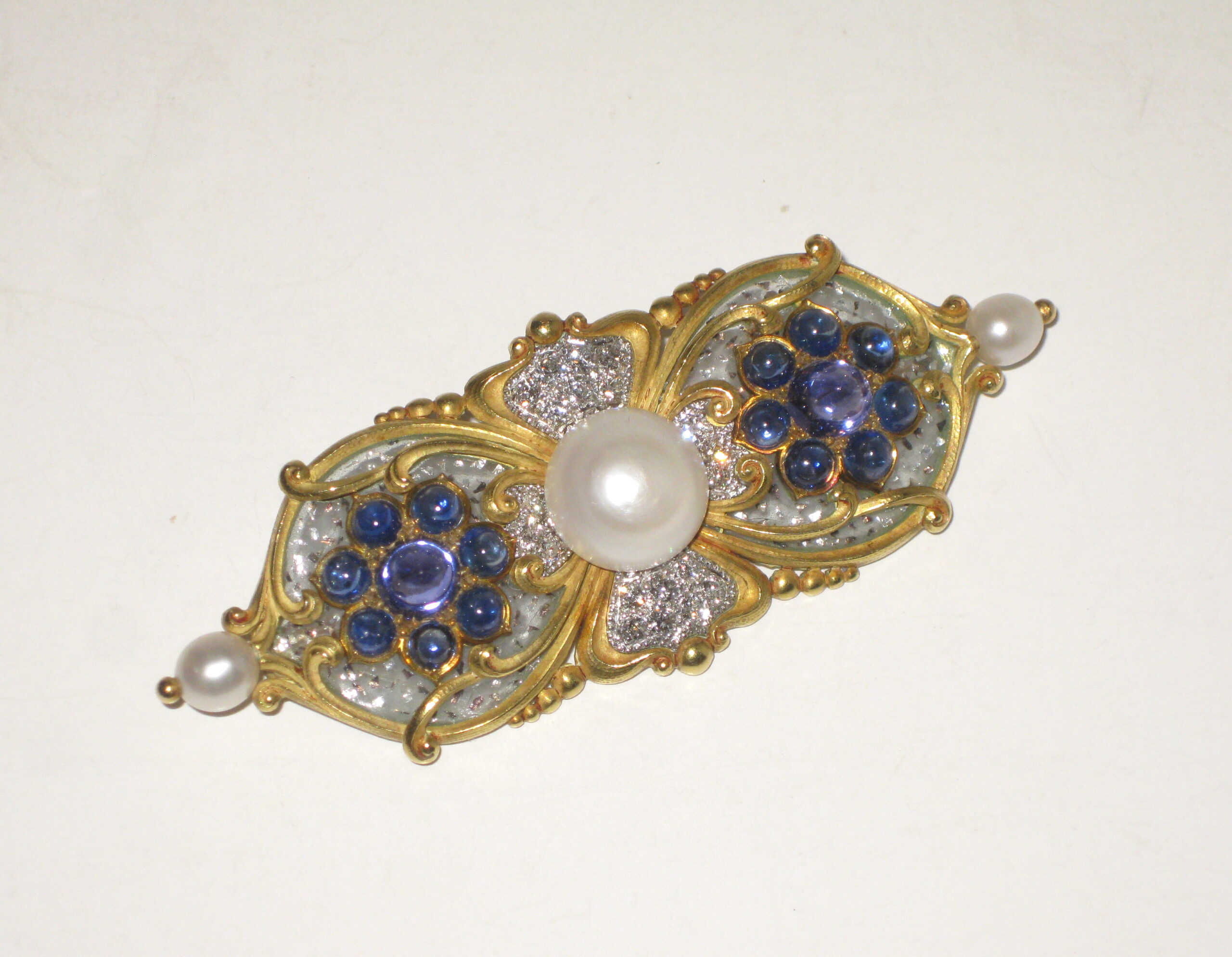
Marcus & Co. Art Nouveau brooch, “Tibula” shaped 18k yellow gold brooch set with three natural pearls, the natural center button pearl approx. 10 mm in diameter (G.I.A. certificate, 3 natural freshwater pearls, weight 24.90 grams, measurement range from 5.46 to 12.26mm), 16 sugarloaf cabochon sapphires, the two large and high dome middle sapphires with a purple hue, 20 pave set round diamonds all surrounded with clear plique-a-jour further trapped with platinum flakes, signed c. 1897





 @hd_jewels