Product Description
Boucheron “Renaissance Revival” cuff / bracelet, attributed to a design by Paul Legrand and made by Tissot, highly sculptural gold inlay, damascene steel set with an intricately agate carved cameo c. 1878

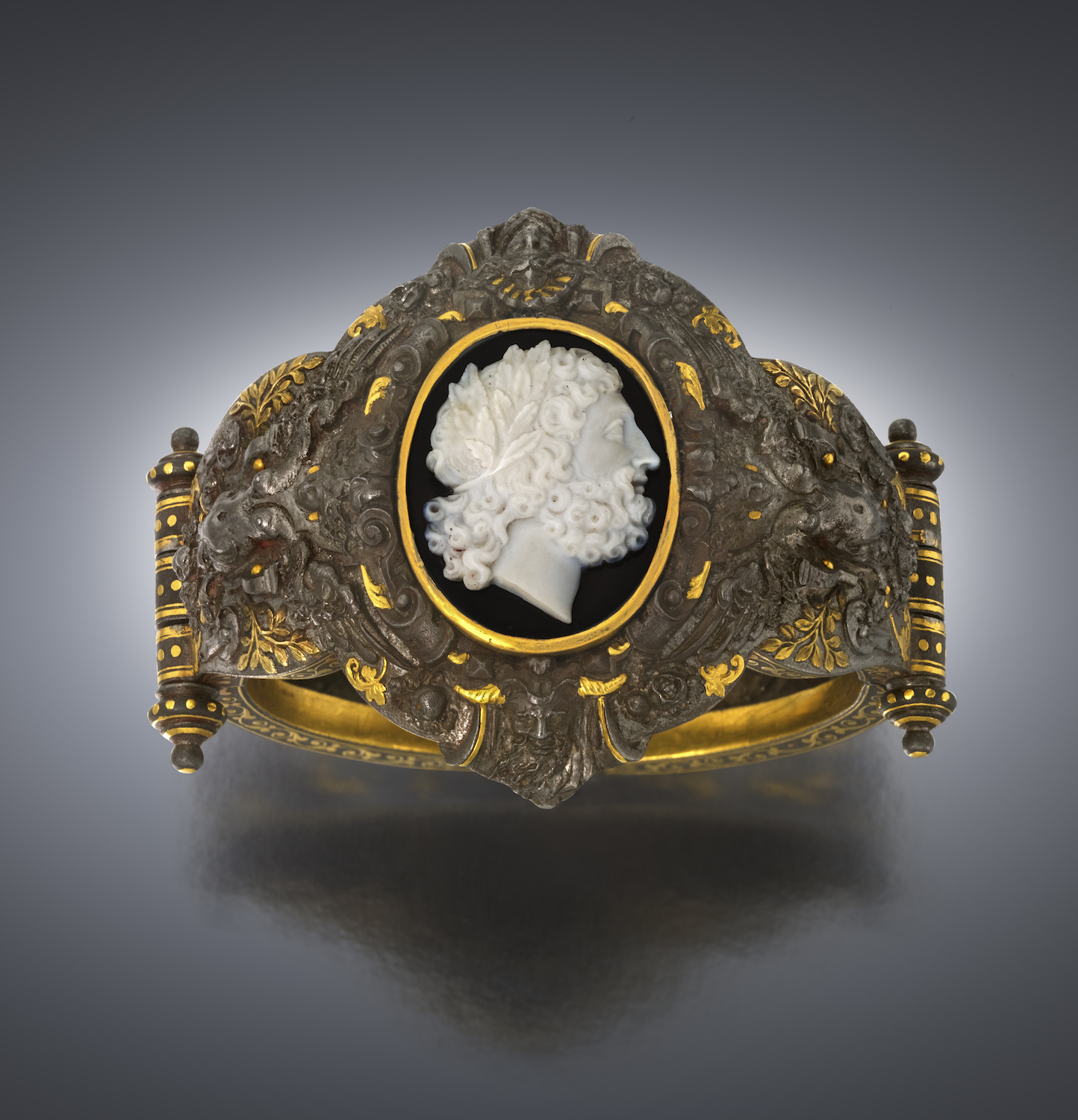
Boucheron “Renaissance Revival” cuff / bracelet, attributed to a design by Paul Legrand and made by Tissot, highly sculptural gold inlay, damascene steel set with an intricately agate carved cameo c. 1878
A goldsmith and jeweler, Louis Wiese (Berlin 1818 – Paris 1890) began his career in Berlin where he served his apprenticeship before moving to Paris to work for J.V. Morel and then more significantly with F.D. Froment-Meurice, with whom he established a close bond. Weise opened his first atelier rue Jean-Pain-Molet in 1844 and worked exclusively for Froment-Meurice, as ever a supporter of Wiese’s work, he pushed for Wiese to receive the collaborator’s medal at the Exposition of 1849. Jules Wiese eventually worked for many of the top manufacturing jewelers and went on to win a first-class medal at the 1855 Exposition and a medal of honor at the 1862 Exhibition in London. M. Magne was quoted as follows when discussing Jules Wiese in light of the 1855 Exposition, “fine goldsmith and jeweler with an already distinguished reputation which can only be enhanced by his display. The importance of his pieces and his brave experiments reveal, even in the most modest work, an awareness of art and beauty which deserves to be encouraged by the jury.” Louis, Jules’ son, took over the company in 1880, continuing the reputation for fine craftsmanship and artistry that his father had established.
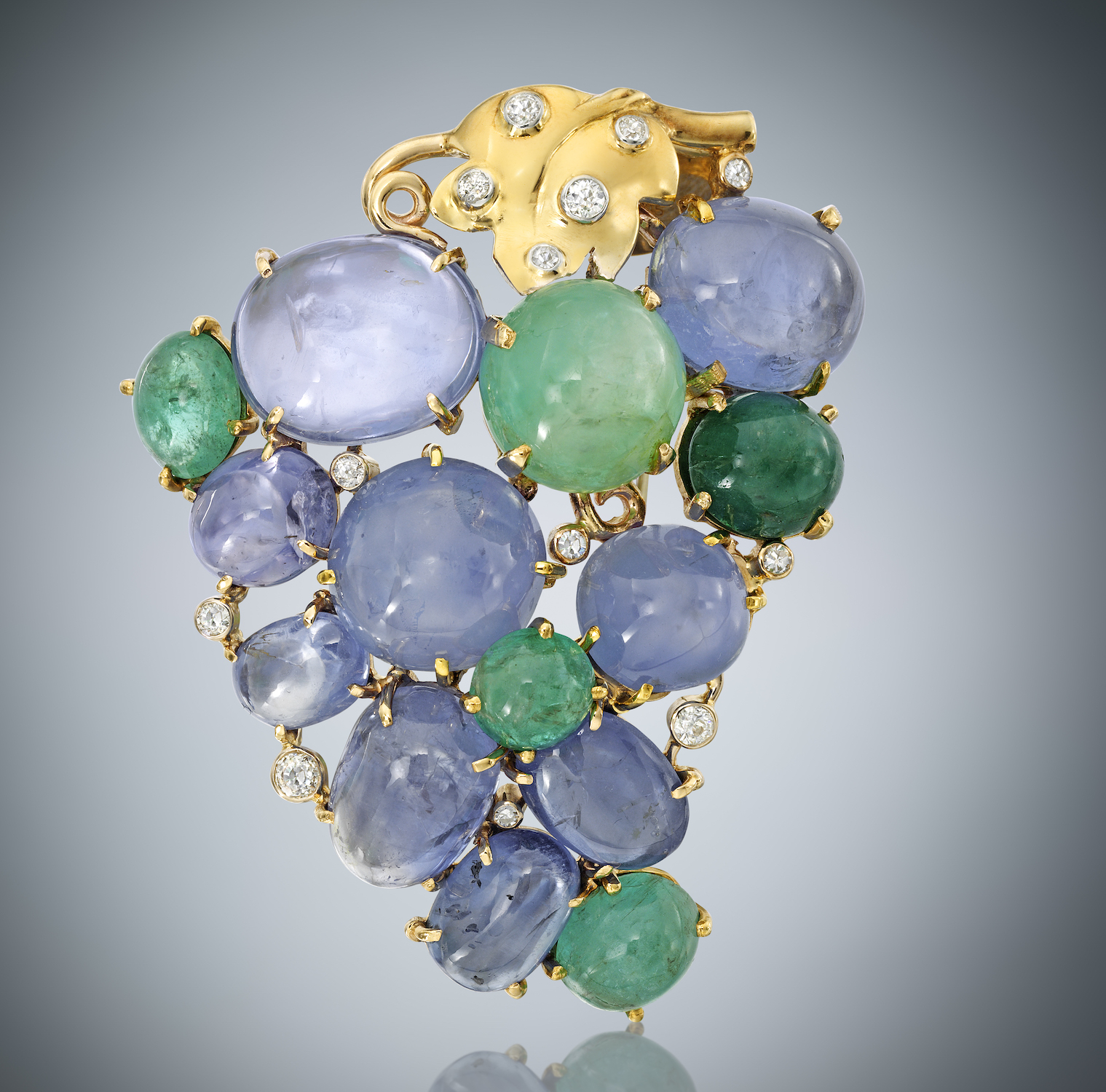
***This is a closely related “Grape” cluster clip/brooch model that Seaman Schepps made on commission for the eminent socialite Doris Duke (Collection Seaman Schepps, but there is a predominance of dark blue and purple cabochon sapphires in the DD brooch as opposed to the predominance of larger and more translucent cabochon sapphires as well as cabochon emeralds in this example
MARIO CEROLI (b. 1938) Italy
“Cavallino” 2004
Brown bottle glass in the shape of a horse with wood composition and framing
Signed: Ceroli
H: 21” x W: 21” x D: 2 3/4″
Price: $30,000
Mario Ceroli has been universally acclaimed at the age of 27, when he was awarded in 1966 wih the Sculpture Prize at the Venice Biennale for his wooden «Cassa Sistina» (a tribute to the Sixtine Chapel). Ceroli has realised important works for several prestigious institutions (such as the equestrian sculpture for the RAI, which has become the national broadcasting channel trademark; the central square, the Church and the theater in Porto Rotondo; a monumental sculpture in FIumicino Airport Rome…), prominent collectors (Agnelli and Barilla among the others), and he has been responsible for the conception of the stage sets of world renowned theaters such as la Fenice-Venice, La Scala-Milan, the Bolchoi-Moscow, the Arenas of Verona and the Opera of Rome in the last thirty years. Since the 1960’s Ceroli’s work has made its mark by using natural wood in particular Russian pinewood, that he assembles with a variety of materials; burnt wood, lead glass, in line with the philosophy of the Arte Povera. In the 1960’s while the artists of Pop Art were reinterpreting the daily life images, Mario Ceroli paid homage to the great classics of the history of art ( Homage to Leonardo da Vinci, Sixtine Chapel, Paolo Uccello, Piero della Francesca, Andrea Mantegna) and reinterpreted his contemporaries like Giorgio De Chirico. The term Arte Povera was used for the first time in September 1967, one year after Mario Ceroli received his prize at the Venice Biennale. One can find nevertheless, the roots of the principal aspects of this movement during the group show that took place at la Tartaruga gallery in Rome in 1965 that included Ceroli, Boetti, Pascali and other artists then all renamed as poveristi.