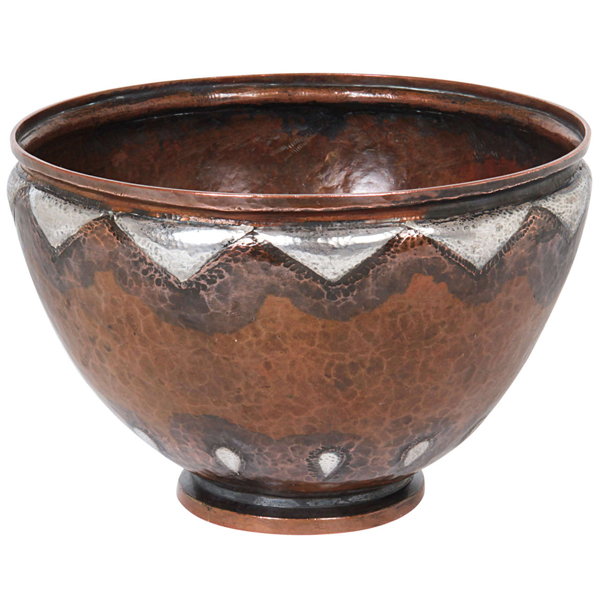
Jean Serriere Rare French Art Deco Dinanderie Bowl c. 1925
More Information
Jean Serriere Rare French Art Deco Dinanderie Bowl c. 1925
Jean Serrrière (1893-1968) France
A. Hebrard (closed 1937) Paris
Footed dinanderie bowl, circa 1925
Hand wrought copper with silver incrustations in a repeating triangular motif and contrasting black patination on a rich brown ground.
Marks: JS (artists monogram) A. Hebrard, Paris
For more information see: Art et Décoration Revue Mensuelle D’Art Moderne, Tome XLVII. (Paris: Librairie Centrale Des Beaux-Arts) p.217; Silver of a New Era: International Highlights of Precious Metalwork from 1880 to 1940, (Rotterdam: Museum Boymans van-Beuningen, 1992) p.68, cat.no. 61; La Dinanderie Française 1900-1950, Dominique Forest and Marie-Cécile Forest (Paris: Les Éditions de l’Amateur, 1995) p.231-233.
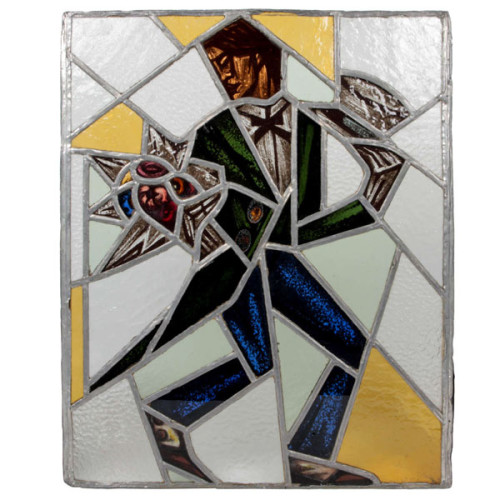
Reinhold Klaus / Carl Geyling Atelier Vienna “Cubist Man with top hat and flowers” stained glass window c. 1930
REINHOLD KLAUS (1881-1963) Vienna, Austria
CARL GEYLING ATELIER (founded 1841) Vienna, Austria
Man with tophat and flowers c. 1930
Window of stained and hand-painted leaded glass
Provenance: Estate of Carl Geyling (1814-1880), Vienna
H: 17 3/4″ x W: 14 1/2″
Reinhold Klaus studied from 1898-1902 with Alfred Roller at the Kaiserlich-Königliche Kunstgewerbeschule in Vienna. In 1914 Klaus married into the Carl Geyling family and became extensively involved with with stained glass painting. As early as 1918 Klaus worked on a stained glass window for the Siegestempel am Bisamberg in Vienna. In 1934 he became a professor of stained glass painting at the Kunstgewerbeschule, as well as creative director of the C. Geylings Erben glass painting company. Reinhold Klaus, a member of the Künstlerhaus since 1924 received many prizes and honors. He worked on commissions for the St. Veits cathedral in Prague, the St. Stephan cathedral in Vienna and many others.
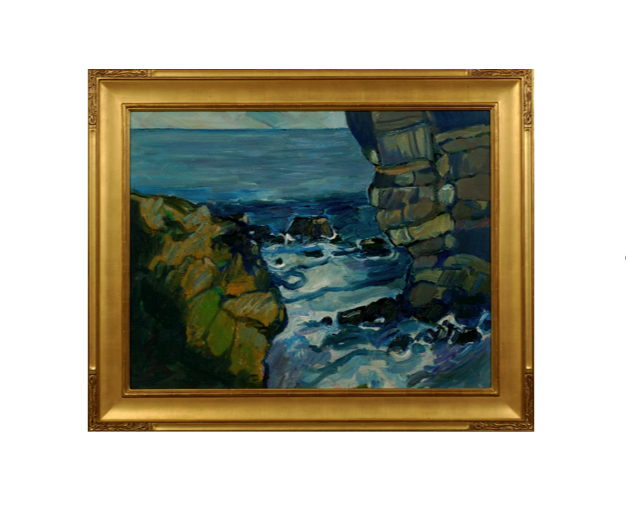
Peter Canty received his BA in art from the Chouniard Art Institute, Los Angeles (now California Institute of the Arts) and an MA from the University of California, Santa Cruz in 1969. Heavily influenced by the Post-Impressionist masters Van Gogh, Gauguin and Cezanne, in his own he words he describes his interest in landscapes, believing they are, “the best vehicle for motion, force, and color dynamics.” Although his work reference realistic subjects, Canty’s imagery is drawn strictly from his own imagination.
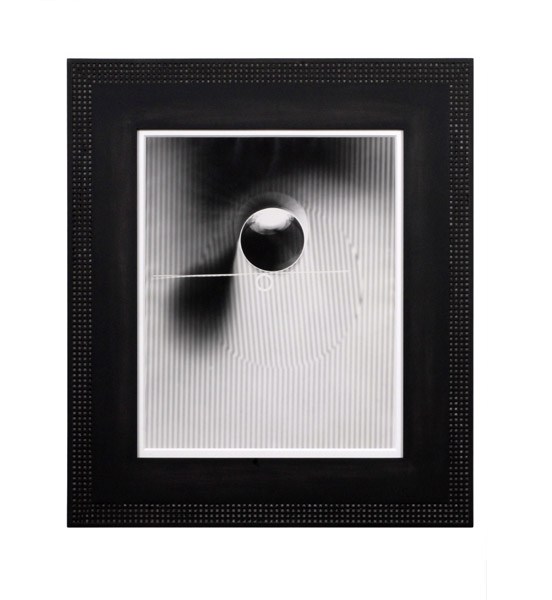
György Kepes, Abstraction, Gelatin silver print, 1942
GYÖRGY KEPES (1906-2001) Hungary/USA
Abstraction 1942
Silver gelatin print
Signed: 9 (in a circle, on back); Gyorgy Kepes 1942 (in ink on back)
György Kepes was a Hungarian-born painter, designer, educator and art theorist. After emigrating to the U.S. in 1937, he taught design at the New Bauhaus (later the School of Design, then Institute of Design, then Illinois Institute of Design or IIT) in Chicago. In 1947 He founded the Center for Advanced Visual Studies at the Massachusetts Institute of Technology (MIT) where he taught until his retirement in 1974.



 @hd_jewels