Product Description
Wiener Werkstaette brass bound book “Bilder Aus Karlsbad”, Art Nouveau brass embossed front and back panels decorated with stylized flowers and scrolling branches by Josef Hoffmann, c. 1910

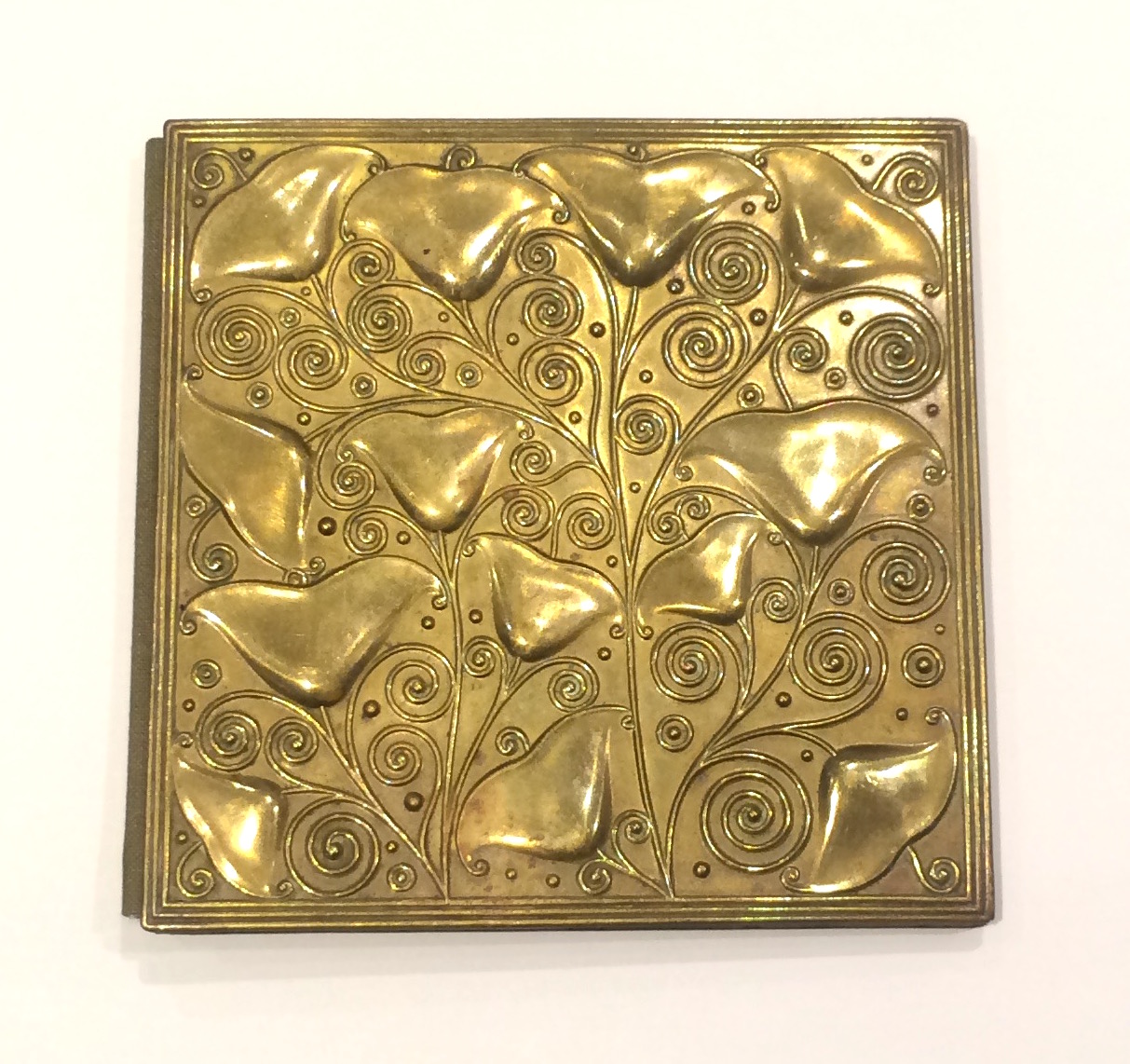
Wiener Werkstaette brass bound book “Bilder Aus Karlsbad”, Art Nouveau brass embossed front and back panels decorated with stylized flowers and scrolling branches by Josef Hoffmann, c. 1910
JOSEF HOFFMANN (1870-1956) Austria
WIENER WERKSTÄTTE (1903-1932) Vienna
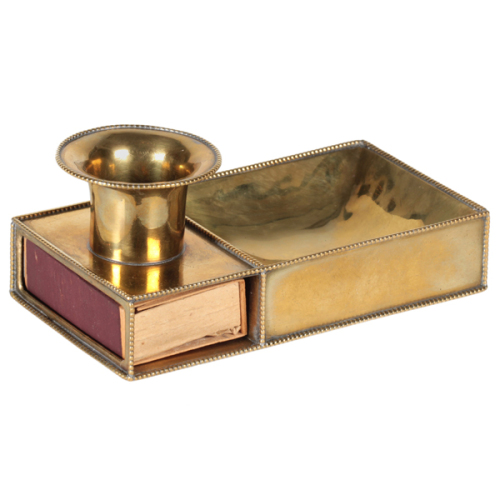
Candlestick holder and match safe 1906
Hand wrought brass with beading around the perimeter of the edges
Marks: JH monogram, WIENER/WERK/STÄTTE, rosemark
Model illustrated: Österreichische Werkkultur, Max Eisler (Vienna: Österreichischer Werkbund, 1916). (slipcovered); Wiener Werkstätte G. M. B. H. catalog (December 1923), p. 114
H: 1 3/4″ x D: 2 5/16″ x W: 4 1/2″
Price: $4,500
MITZI OTTEN-FRIEDMANN (1884-1955) Austria
WIENER WERKSTÄTTE (1903-1932)
Brooch c. 1915
Reverse-painted glass depicting a couple set in a silver frame / back
Marks: M. OTTEN-FRIEDMANN on the front (right), the reverse stamped: WW, Vienna assay mark for 900 silver
D: 2 3/8”
Rosalia Marie Friedmann-Otten (“Mitzi”) * November 28, 1884 Vienna, † May 5, 1955 New York, NY
Student at the School of Applied Arts in Vienna (with Oskar Strnad), Friedmann-Otten participated in numerous exhibitions (including art shows in 1908, 1920; Neukunstgruppe 1909; German Women’s Art in 1925; Werkbundausstellung 1930). Member of the Austrian Werkbund, the Wiener Werkstätte and the Neukunstgruppe. One of the most versatile artists (commercial art, metalwork, jewelry, fashion, starting from 1920 mainly enamel works, including large-scale email pictures), Friedmann-Otten had to flee in 1938 to the United States.
HENRI MATISSE (1869-1954) France
“Pasiphae” 1944
Limited edition No. 48/250.
Published by Martin Fabiani, Paris.
Dimensions:
Book: H: 13 3/16” x W: 10 3/8”
Custom leather box: H: 15 1/4” x W: 11 11/16” x D: 2 5/8”
Custom cloth slipcase: H: 16 1/8” x W: 12 3/16” x D: 3”
Signed by Matisse on the justification page.
Matisse’s Pasiphae is a singularly thrilling work and the plates were destroyed after the printing of this edition.
“A Contemporary retelling of the story of Parisphae and the Minoan bull was the impetus for one of Matisse’s most intensive printmaking experiences. Working with linoleum, a fairly easy material to use, Matisse cut many blocks of each image to achieve the perfect flow of line and relationship of forms. Intent on matching the spirit and ambience of the classical tale, Matisse took as his model ancient Greek playground vase painting”.
W.C. HANDY ed. (1973-1958) USA
“Blues – An Anthology” 1926
180pp. bound in blue cloth with original dust jacket. Very scarce work, considered the most famous blues collection in history, it includes historical notes, tunes and arrangements, notes for each song, a bibliography, and a chart of guitar chords.
With an introduction and notes by Abbe Niles
Illustrations by Miguel Covarrubias
Published by Albert & Charles Boni, New York
Dimensions:
Book: H: 11 ¾” x W: 9 1/8” x D: 1”
Custom leather box 2008: H: 13 13/16” x W: 10 3/8” x D: 2 7/16”
Custom silk slipcase: H: 15” x W: 11 1/8” x D: 3 3/8”
William Christopher Handy was a composer, musician and a music publisher. He was sometimes called the “Father of the Blues” and was credited with helping popularize blues music. Handy was a seminal figure in the development of American songwriting. His compositions assimilated folk tunes, blues, spirituals, minstrel songs, and elements of European music and forged a new sound in American popular commercial music. Born in Florence, Alabama, Handy began arranging music when in grade school. By the turn of the century, he had toured or was touring with a number of minstrel acts and bands. He became a leading bandleader in Memphis, Tennessee, and eventually wrote such classics as “The Memphis Blues” (1912), “The St. Louis Blues” (1914), and “Beale Street Blues” (1916). In addition to his songwriting, Handy also founded an important and influential music publishing concern, the Pace and Handy Music Company, in 1913. Finally, Handy’s books and writings, such as his autobiography, Father of the Blues (1941), and Blues: An Anthology (1926), comprise an important contribution to American culture. In 1979, New York City joined the list of institutions and municipalities to honor Handy by naming a stretch of West 52nd Street in Manhattan “W.C. Handy Place.”