Product Description
Marsh & Co. San Francisco, “Paisley” brooch with a blackened steel dramatic outline on an elaborate 18k gold frame and back in the shape of a paisley pave set with full cut round diamonds, c. 1950’s


G.T. Marsh was established in 1876 in San Francisco, CA as one of the first purveyors of Japanese art and antiques. In the early 30’s Marsh, with the help of his Italian bench jeweler settled on a unique style that will always be indicative of the firm. Instead of using gold or platinum, the jeweler, who was interested in gun-smithing, created a line of jewels using sandblasted steel finished with gun bluing. This resulted in a rich dark mat black finish. Chased or milegrained white gold or platinum offset pearls, jade or diamonds set against the black ground of the steel. Movement also played a part in the design. Hinged pearls or gemstones added yet another distinct element to the work or exceptionally strong contrasting graphics. The use of diamonds on a grander scale with the dramatic outline of a classic paisley form, places this brooch mid-century and at a time when Marsh’s Jewelry boutique was particularly flourishing in the Bay area.
Marsh & Co. San Francisco, “Paisley” brooch with a blackened steel dramatic outline on an elaborate 18k gold frame and back in the shape of a paisley pave set with full cut round diamonds, c. 1950’s

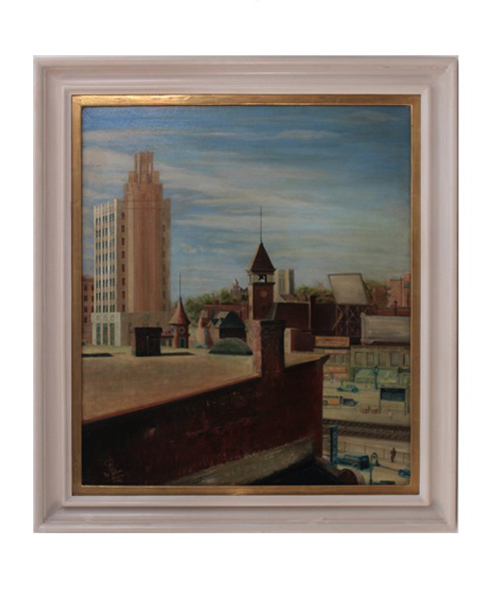
ARRIGO VARETTONI DE MOLIN (1902-1985)
Passaic Rooftops 1932
Oil on canvas
Signed: A V de Molin ’32
Listed: Who’s Who in America, Series II, no. 11 (November 1, 1941) p. 6.
Exhibited: New Jersey State Annual, Montclair Art Museum, 1934
Canvas: H: 39” x W: 35”
REINHOLD KLAUS (1881-1963) Vienna, Austria
CARL GEYLING ATELIER (founded 1841) Vienna, Austria
Man with tophat and flowers c. 1930
Window of stained and hand-painted leaded glass
Provenance: Estate of Carl Geyling (1814-1880), Vienna
H: 17 3/4″ x W: 14 1/2″
Reinhold Klaus studied from 1898-1902 with Alfred Roller at the Kaiserlich-Königliche Kunstgewerbeschule in Vienna. In 1914 Klaus married into the Carl Geyling family and became extensively involved with with stained glass painting. As early as 1918 Klaus worked on a stained glass window for the Siegestempel am Bisamberg in Vienna. In 1934 he became a professor of stained glass painting at the Kunstgewerbeschule, as well as creative director of the C. Geylings Erben glass painting company. Reinhold Klaus, a member of the Künstlerhaus since 1924 received many prizes and honors. He worked on commissions for the St. Veits cathedral in Prague, the St. Stephan cathedral in Vienna and many others.
TIM LIDDY
“Who Can Beat Nixon” (1970) Presidential Sweepstakes 2006
Oil and enamel on copper, plywood back
Signed in script: Tim Liddy “circa 1970” 2006, red circular ring
Provenance: William Shearburn Gallery (St. Louis, MO)
H: 11 ¾” x W: 9” x D: 2”
With his recent paintings, Liddy has both reasserted the construct of hyperrealist painting and developed a thoroughly unique advancement of that mode by extending the cultural reality of the indexed original. Based on the illustrated box lids of vintage board games, Liddy has recontextualized a subject, which evokes the underlying rules of life. Painted on copper or steel in the precise dimensions of the original, the metal is then manipulated to demonstrate the exact rips and tears from years of usage and includes trompe-l’oeil renditions of the scotch tape that might be holding the cardboard box together, the assorted stains, or the various graffiti of time. Liddy leaves no possibility of ambivalence, these works speak to a concurrent understanding of their original object identity and to themselves as works of art engaged in historical and psychological dialogue.