Ane Christensen Contemporary British Sterling Silver Bowl 1999
More Information
Ane Christensen Contemporary British Sterling Silver Bowl 1999
ANE CHRISTENSEN (b.1972) born in Copenhagen, Denmark/ based in London, UK
Bowl 1999
Sterling silver
Marks: AKC, 925, Z, British hallmarks
H: 2 ½” x L: 12”
Price: $5,950
The starting point for all of metalworker Ane Christensen’s tableware is a single sheet of metal. Her aim is to develop a three dimensional object from a flat sheet without adding or removing any elements. Japanese paper packaging influences Ane’s work, but a more important influence is the half finished or half demolished structures of building sites that she says can hold unexpected sculptural qualities.
Ane graduated from the Royal College of Art and has since been involved in exhibitions in London, Denmark and Copenhagen, including more recently at Collect, V&A.
Ane makes pieces in a variety of metals including silver, stainless steel and powder coated copper.
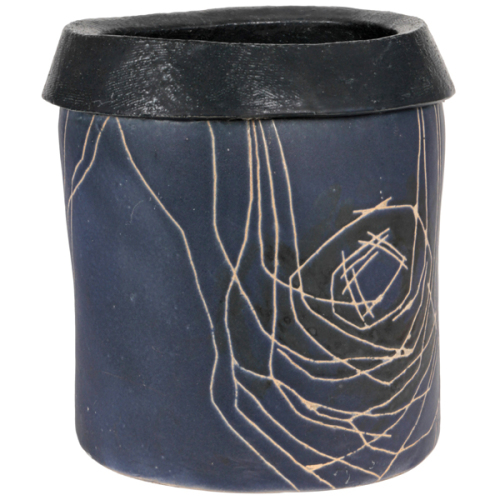
Luke Lietzke, Large Glazed Hand Thrown Stoneware Floor Vase c.1955
LUKE LIETZKE (1906-2000), USA
LIETZKE DESIGNS Mogodore, Ohio
Large floor vessel c. 1955-1960
Blue glazed stoneware cylindrical vessel which has been shaped at the top into an elliptical form; the black glazed lip is rolled over with a flaring collar-like edge and the body is decorated with an abstract incised sgraffito line decoration.
Signed on bottom: Lietzke (inscribed in oval)
H: 15″ x W: 14″ x D: 13″
Price: $17,500
Luke Lietzke studied art at Michigan State University and the Art Institute of Chicago. At Michigan State she met her husband and life-long partner in design, Rolland. They moved to Ohio when Rolland accepted a job with Goodyear Aerospace and in 1942, when Rolland took a job with Firestone, they moved to Akron, Ohio. It was there that Luke volunteered at the Akron Art Museum. This position quickly developed into a design curator’s position created especially for her. Her memorable exhibits included such notable artists as Charles Eames, George Nelson and Isamu Noguchi. In 1964 she left the Museum and for a short period worked as a design coordinator. In 1966, she and her husband created their own company where she functioned as an exhibition designer, an interior design consultant and most significantly: a designer craftsman. Her porcelain pieces consistently received exhibition awards since 1948 and are included in six museum collections. Her talents would often combine to develop special projects, such as the design for the Akron-Summit County Public Library. Both her pottery and jewelry reflect her wealth of knowledge as well as her exposure to the world of International art.
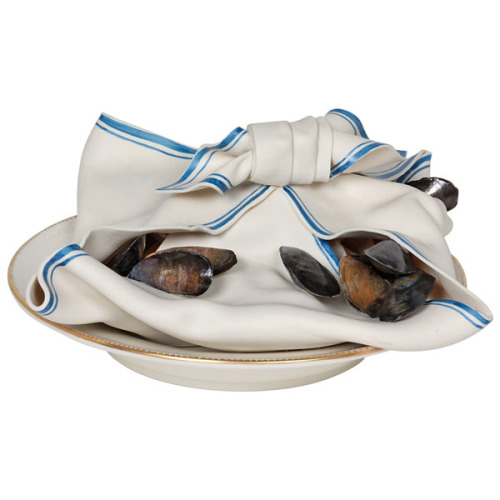
Didier Gardillou Trompe L’Oeil Porcelaine “Plat des moules et serviette” c. 2008
DIDIER GARDILLOU France
Trompe L’Oeil Porcelain “Plat des moules et serviette” c. 2008
High fired porcelain with a matte and shiny glaze, blue border detail on the napkin and realistically painted mussels.
Marks: DG (Didier Gardillou) monogram
H: 4 1/2″ x D: 10″ x W: 11″
Price: $5,450
Didier Gardillou is a master porcelain artist who creates Trompe L’Oeil masterpieces. He revived the antique craft of the porcelain florist. This technique and style first appeared in France in the 1740’s at the Manufactory of Vincennes, which in time would move and become known as the Royal Manufactory of Sèvres Porcelain.
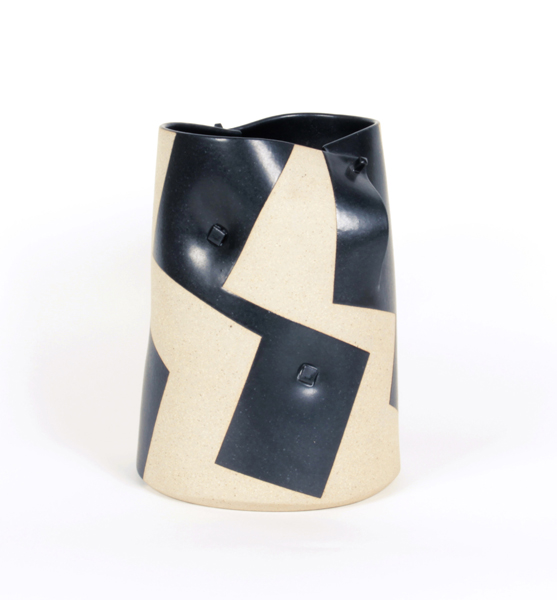
Black, randomly positioned rectangles on a cream / sandy base with a pinned overlap detail
Signed: GP 2000-68
H: 9 1/4″ x D: 6 1/2″
Price: $5,500
Gustavo Pérez makes vessels that are simple, smooth and symmetrical. Their elegance is due to the precision of the incised lines and other markings on the pots. While using the same clay body—sand colored stoneware—throughout his work, the artist achieves a wide range of form and pattern and includes slowly undulating walls beneath the subtly incised surfaces.
Gustavo Pérez works are incessantly experimental. There have been parallel lines, calligraphic traces, geometric cuts into the surface, minimalist vessels, recollections of pre-Hispanic vases and references to other ancient cultures.
The ceramics of Gustavo Pérez are distinguished by eliminating superfluous details, by synthesis of his elements. During the past two decades he has created a visual language that seems closely aligned with music. Pure in form, with a significant structure, completely abstract and without specific associations, his language of line, the bending of forms, and the definition of the vessel mark his work as a distinctive voice. The form is not just a container or a receptacle; it is architecture.





 @hd_jewels