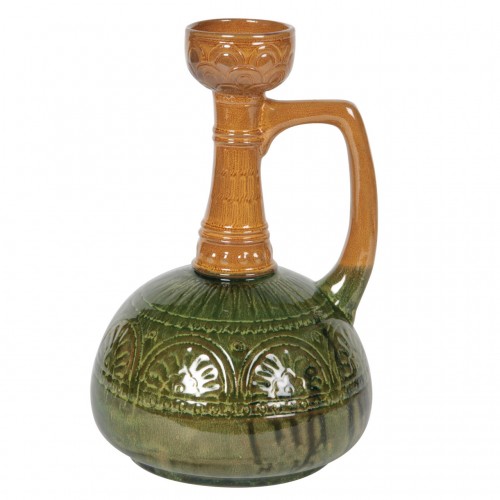
Christopher Dresser / Linthorpe Art Pottery Rare Aesthetic Movement "Gourd" Vase 1879-1882
More Information
Christopher Dresser / Linthorpe Art Pottery Rare Aesthetic Movement “Gourd” Vase 1879-1882
CHRISTOPHER DRESSER (1834-1904) UK
LINTHORPE ART POTTERY, Middlesbrough
HENRY TOOTH Artistic Manager Linthorpe (1842-1918) UK
“Gourd Vase” 1879-1882
Glazed Earthenware
***Extremely rare Dresser / Linthorpe model.
Marked: LINTHORPE, Chr. Dresser (facsimile signature) HT, no. 326
Illustrated: Christopher Dresser: Truth, Beauty, Power exh. cat. (New York: Historical Design, 1998) p.75; illustrated in two drawings for gourd vases in Dresser’s 1881 design and account book under heading “Aug. 29, 1881. Sent to J. Harrison Esq. 41 Designs for Linthorpe.”
H: 7 3/4″
The contrasts in Dresser’s designs for different materials showed how his approach to design was also shaped by the properties and nature of a material. In 1879 Dresser was appointed art director at the newly established Linthorpe pottery, near Middlesbrough. Founded by John Harrison, a local businessman, the pottery’s aim was to use local clay to provide jobs for local men. Dresser’s design for the moulds for the pottery were inspired by a wide range of cultures from Japan, Peru, Mexico, Morocco and Ancient British forms. These very striking pieces, with the metal oxides in the complex and innovative glazes providing the only decoration. All of his designs were impressed with a facsimile signature. When Linthorpe closed in 1889, its moulds were acquired by a rival, Ault Pottery in Derbyshire. In 1893, Dresser signed a contract with Ault for new designs specifying that each pot should be marked with his facsimile signature.
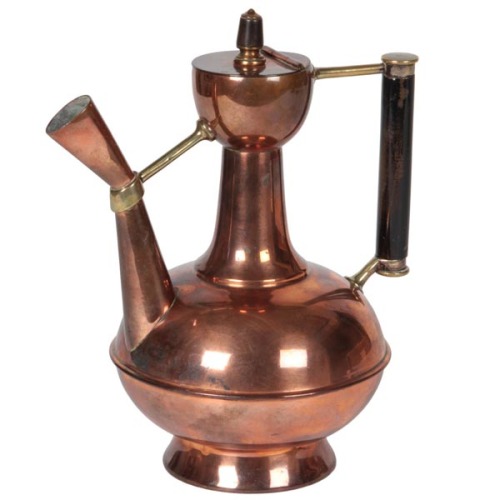
Christopher Dresser / Benham & Froud Rare Aesthetic Movement Copper coffee pot 1888
CHRISTOPHER DRESSER (1834-1904) UK
BENHAM & FROUD London, England
Coffee pot 1888
Copper, brass, wood handle and finial
***One of only two known models of this Dresser / Benham & Froud coffee pot.
Marks: maker’s cipher, Reg. no. 114566 for 1888
Only other model known illustrated: Christopher Dresser, by Widar Halén (Oxford: Phaidon, 1990), illus. 192, p. 170 (variant model); Truth, Beauty, Power: Dr. Christopher Dresser 1834-1904, exhib. cat. Historical Design, Inc. (New York, 1998) p. 66.
Christopher Dresser / Linthorpe, Rare Aesthetic Movement Persian jug 1879
CHRISTOPHER DRESSER (1834-1904) UK
LINTHORPE ART POTTERY, Middlesbrough
HENRY TOOTH Artistic Manager Linthorpe (1842-1918) UK
“Persian” jug 1879-1882
Glazed earthenware
Marks: LINTHORPE, Chr. Dresser (facsimile signature),
HT, no. 344
Illustrated: Truth, Beauty, Power: Dr. Christopher Dresser 1834-1904, exhibition catalogue Historical Design, Inc. (New York, 1998) p. 76.
H: 8 3/4″
Rare model.
The contrasts in Dresser’s designs for different materials showed how his approach to design was also shaped by the properties and nature of a material. In 1879 Dresser was appointed art director at the newly established Linthorpe pottery, near Middlesbrough. Founded by John Harrison, a local businessman, the pottery’s aim was to use local clay to provide jobs for local men. Dresser’s design for the moulds for the pottery were inspired by a wide range of cultures from Japan, Peru, Mexico, Morocco and Ancient British forms. These very striking pieces, with the metal oxides in the complex and innovative glazes providing the only decoration. All of his designs were impressed with a facsimile signature. When Linthorpe closed in 1889, its moulds were acquired by a rival, Ault Pottery in Derbyshire. In 1893, Dresser signed a contract with Ault for new designs specifying that each pot should be marked with his facsimile signature.




 @hd_jewels