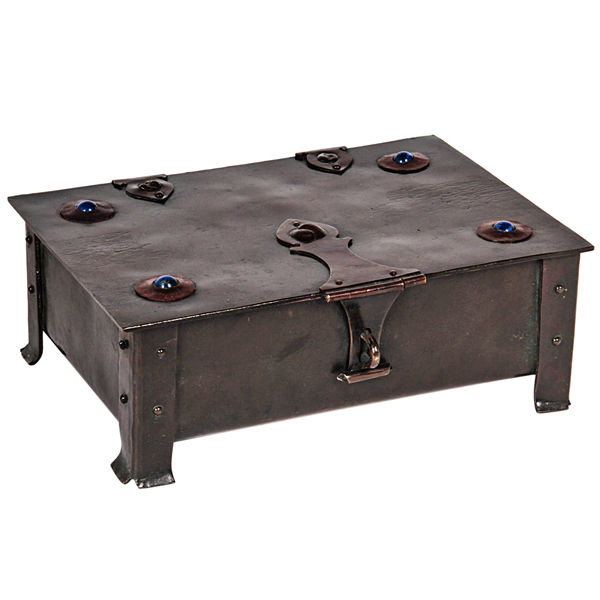
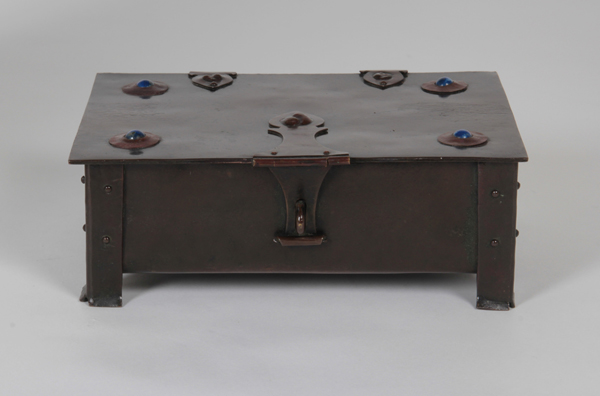
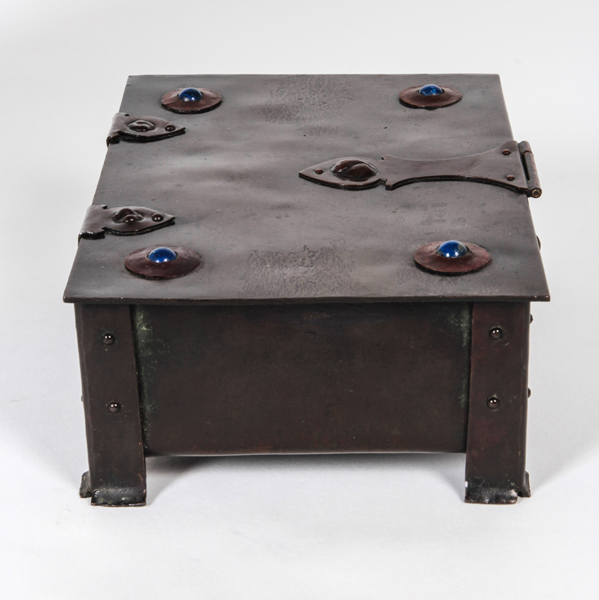
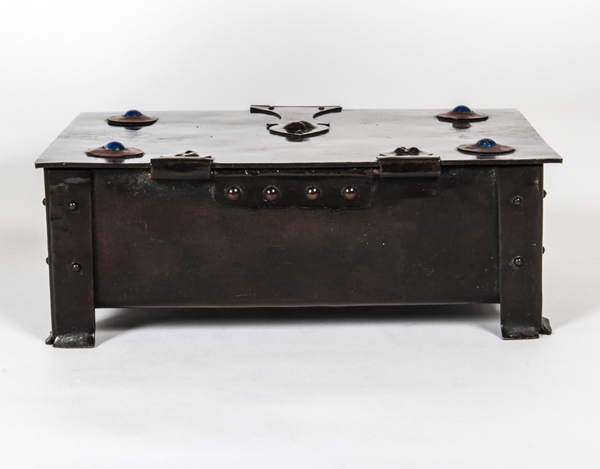
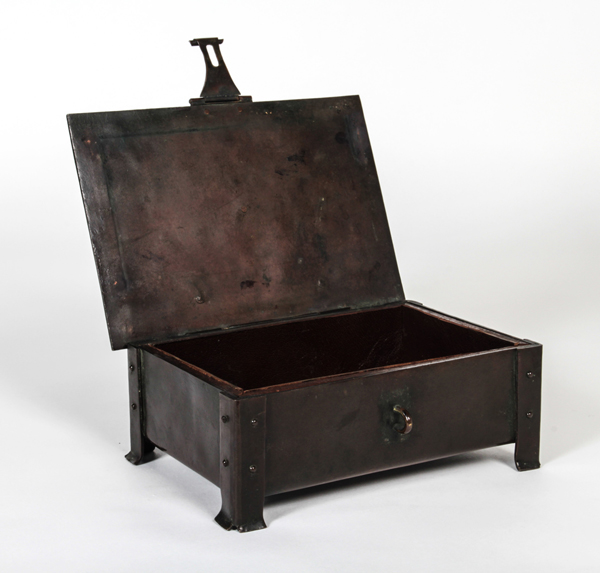
Albert Edward Jones British Arts & Crafts Copper and Lapis Lazuli Box c.1905
More Information
Albert Edward Jones British Arts & Crafts Copper and Lapis Lazuli Box c.1905
Albert Edward Jones (1879-1954) Birmingham, UK
British Arts & Crafts Movement
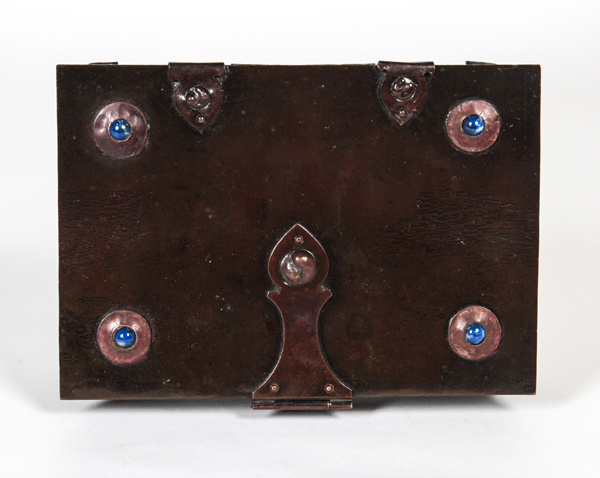
Footed box with hinged lid and hasp 1905
Hand wrought and patinated copper with riveted strap work and hasp, inset with 4 cabochons of lapis lazuli, brown leather and wood interior.
This box is a particularly handsome example of British arts & crafts metalwork by the famous designer / craftsman A.E. Jones. It retains its original deep, rich chocolate brown patina with the contrasting cobalt blue large round bezel-set cabochons of lapis lazuli.
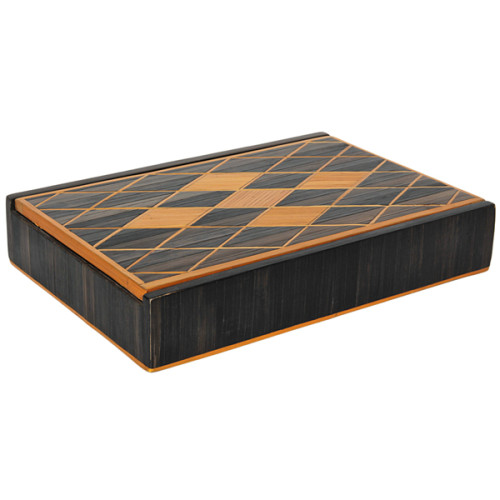
Andre Arbus (attr.) French Art Deco Straw Marquetry Box c. 1940
ANDRÉ ARBUS (attr.) (1903-1969) France
Straw marquetry box c. 1940
Natural gold and ebony stained straw inlaid in a design of a window pane diamond pattern on the hinged lid, original suede cloth/paper interior, wood frame
For more information see: André Arbus: architecture-décorateur des années 40, Yvonne Brunhammer (Paris: l’Editions NORMA, 1996).
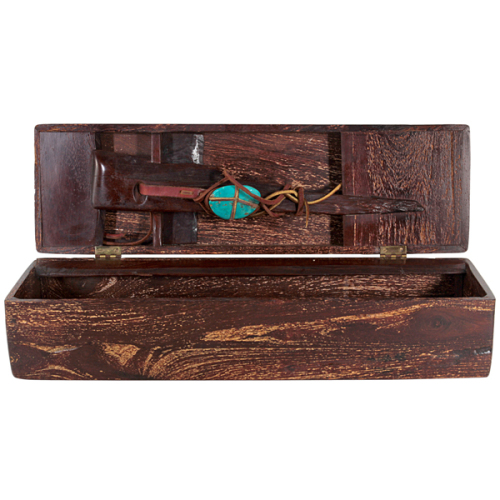
Jan de Swart hand carved Zebra wood Mystery box c. 1970
JAN DE SWART (1908-1987) Netherlands / USA
Mystery box c. 1970
Hand carved and assembled box form with a curiosity element of a large turquoise cabochon with raw hide wraps underneath the lid.
For more information see: Jan de Swart: A Day That Becomes a Lifetime, exhibition catalogue (California: Fine Arts Gallery at the San Fernando Valley State College, February 1972); Jan de Swart, Mike McGee and William G. Otton (Laguna Beach, California: Laguna Art Museum, 1986).
W: 16 1/2″ x H: 4 1/2″ x D: 5″
Price: $4,700
Constantly seeking and inventing new materials Jan de Swart was a true modernist. He was influenced by artists such as Isamu Noguchi, Harry Bertoia, Charles Eames, and later Sam Maloof and Wendell Castle. Although he had been creating small sculptures since his arrival in California from Holland in 1929, he had not been widely recognized until being introduced to John Entenza, publisher of Arts & Architecture magazine in 1947. Soon thereafter, he was able to create larger works and began collaborating with architects such as Whitney Smith and Victor Gruen on special commissions. His work is in the permanent collection of Los Angeles County Museum of Art, The Smithsonian, and the Ford Foundation. He was honored with the American Institute of Architects Gold Medal for Sculpture in 1965.


 @hd_jewels