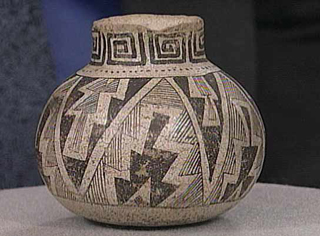
Julia Edna Mattson - Univ. of North Dakota American Art Pottery Vase circa 1913-20
More Information
Julia Edna Mattson – Univ. of North Dakota American Art Pottery Vase circa 1913-20
JULIA EDNA MATTSON (d.1967) Grand Forks, ND
UNIVERSITY OF NORTH DAKOTA Grand Forks, ND
Vase c. 1913-1920
Earthen-ware with blue-green glaze, incised with lime-green linear decoration
Marks: University of North Dakota, Made at School of Mines, Barclay, Grand forks, ND (Cobalt blue seal), JM (Julia Mattson)
For more information see: Barr, Paul E. North Dakota Artists. Grand Forks: University of North Dakota Library, 1954; Miller, Don. University of North Dakota Pottery: The Cable Years. Grand Forks: University of North Dakota Visual Arts Dept., 1999; Palmer, Bertha Rachael. Beauty Spots in North Dakota. Boston: Bruce Humphries, Inc., 1939
H: 3 5/8″ x Dia: 5 1/4″
Price: $3,250
Julia Edna Mattson worked as an instructor and later as Assistant Professor in the University of North Dakota’s Ceramic department between the years 1924-1963. Her designs reflect an interest in the Arts and Crafts movement in America and American Indian pottery. Early UND pottery is characteristic of the Arts and Crafts and Art Nouveau movement. The decoration of this vessel recalls the graphic designs found on Indian basketry as well as the Prairie School windows of Frank Lloyd Wright.
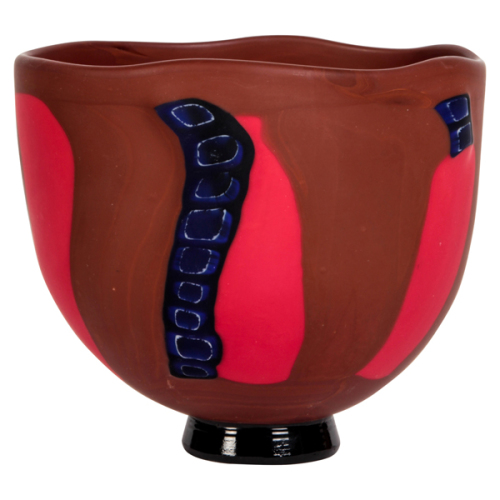
Overall matte finish art glass vase with an elaborate mosaic technique inset with red rectangular patchwork sections and blue murrina jewels all on a chocolate brown body with a black glass foot
Marks: Tsuchida Yasuhiko 99, 77
For more information see: Tsuchida Yasuhiko, exh. cat., Franco Schiavon (Murano, Italy: Palazzo del Vetro, 2000).
Provenance: Pauly & Co. Venice
H: 4 3/4″ x Dia: 5 1/8″
Price: $5,450
Yasuhiko Tsuchida was born in Osaka, Japan in 1969. In 1988, soon after graduating TSUJI Culinary Institute, he left Japan to explore food and art in Paris. Since 1992, he has lived in Venice, Italy. Tsuchida has been making glass work in Murano Island since 1995, and next year assumed the office of art director at Schiavone Glass Co. Ltd. In 1996 he presented a glass sculpture entitled “Bamboo Collection” with Japanese motif of bamboo. The work was highly acclaimed, which gave him a chance to start to hold solo exhibitions around the world. In 2000, Tsuchida became a member of the board of directors at Venetian Glass Institute, and a chief director there in 2003. In 2004, he won Honorary Technique Prize in Düsseldorf, Germany, and in 2008, received Award of Contribution to Cultural Promotion from Grosseto city, Toscana. In the same year, he represented Japan at International Open Exhibition of Sculpture, and won the Grand-Prix. In 2010, Tsuchida was invited to the Issei Miyake “IM10” Project Competition, and held a solo exhibition at Lorusso Gallery, Andria, Italy. Tsuchida continues to exhibit in many solo shows around the world.
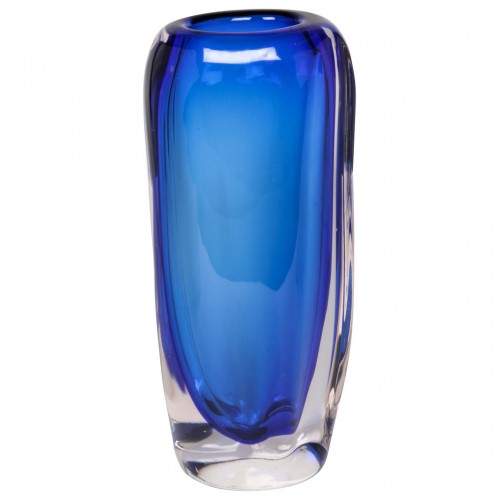
Flavio Poli / Seguso Vetri d’Arte Murano Mid-Century Modern art glass vase c. 1950’s
FLAVIO POLI (1900-1984) Italy
SEGUSO VETRI D’ARTE Italy
Vase c. 1950’s
Blue and clear Murano glass
H: 10″ x D: 3″ x W: 4 1/2″
Price: $1,850
Designer, businessman, ceramic artist. Born in Chioggia, he attended the Istituto d’Arte di Venezia and began work as a designer in ceramics. in 1929 he switched to glass and for Libero Vitali’s I.V.A.M. he designed animals, splendid Novecento-style nude figures in massiccio glass, as well as bowls and urns with figures resting on the inside, on lids or as handles. He subsequently collaborated with the Compagnia di Venezia e Murano, with the furnace of Mario and Lino Nason and with the engraver Gino Francesconi. in 1934 he accepted the artistic direction of Barovier, Seguso & Ferro, later to become Seguso Vetri d’Arte, and became partner three years later. Together with the master of the principal team Archimede Seguso, Poli was the author of grandiose lighting installations, of corroded vessels, of sculptures in bulicante glass, of animals in massiccio glass shaped while hot, productions which represented a milestone in the development of Murano glass. At the height of his artistic maturity, in the years between 1950 and 1960 he designed a series of sommerso glass pieces in a Nordic style, essential forms and sharp cold colors, which were awarded prestigious prizes (Compasso d’Oro). After leaving Seguso in 1963, between 1964 and 1966 he organized the artistic glass division at the Societˆ Veneziana di Conterie e Cristallerie.
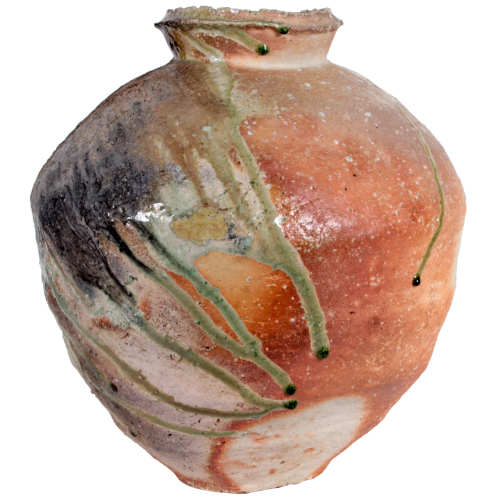
Kishimoto Kennin Japan Hand Thrown Monumental “Iga” Stoneware Vase, c. 1995
KISHIMOTO KENNIN (b. 1934), Japan.
Monumental “Iga” vase, circa 1995.
Hand thrown and handbuilt stoneware vase with a natural ash glaze in rich salmon rust, celadon, grey and black glaze
H: 20″ x Dia: 22″
Price: $20,000
1934 born in Nagoya 1953–1955 attends college in Nagoya 1960 moves to Mino, Gifu Prefecture 1965 establishes his own studio 1970 builds an anagama in Mikuni-Sanroku, where he lives and works until today 1976 appointed member of the Japan Crafts Association (Nihon kôgei-kai) Group exhibitions 1967 Asahi Ceramics Exhibition (Asahi tôgei-ten) 1968 Exhibition of Japanese Ceramics (Nihon tôgei-ten) 1970 International Exhibition of Chûnichi Ceramics (Chûnichi kokusai tôgei-ten) 1972–75 Japan Traditional Crafts Exhibition (Nihon dentô kôgei-ten)
One man shows:
1979 Takashimaya Gallery, Tôkyô; since then again in 1981, 1983, 1985, 1987, 1990.
1982 Hankyû Gallery, Ôsaka; since then again in 1983, 1984, 1985, 1986, 1987.
1984 Maru’ei Gallery, Nagoya; again in 1986.




 @hd_jewels