Aztec AD 1325-1475 Important stone carved sculpture of a coiled serpent
More Information
Aztec AD 1325-1475 Important stone carved sculpture of a coiled serpent
AZTEC AD 1325-1475 Mexico.
Important stone carved sculpture of a coiled serpent, AD 1325-1475 Mexico.
***Two scientific authentication reports are available with this sculpture.
H: 10″ x D: 8″
The serpent played a very important role in Aztec religion and was represented in a variety of forms. The majority of the serpents represented in Aztec sculpture are rattlesnakes.
Mexican mythology indicates the snake is a symbol of veneration, worship and honor. Often a symbol of great power, resurrection and rebirth, the snake continues to be a powerful emblem of renewal and transition.
Further, the snake is recognized as a symbol of humanity as a whole. Interestingly, the Mexican perspective provides hope for mankind to aspire to great heights as it correlates the shedding of the serpent’s skin to man’s ability to change his own circumstances and overcome adversity.
The Aztecs build an impressive empire in the valley of Mexico. This thriving area, known as Tenochitlan, was the cultural, religious and trading center of Mesoamerica. Aztecs were the Native American people who dominated northern Mexico at the time of the Spanish conquest led by Hernan Cortez in the early 16th century. According to their own legends, they originated from a place called Aztlan, somewhere in north or northwest Mexico. At that time the Aztecs (who referred to themselves as the Mexica, or Tenochca) were a small, nomadic, Nahuatl-speaking aggregation of tribal peoples living on the margins of civilized Mesoamerica. Sometime in the 12th century they embarked on a period of wandering and in the 13th century settled in the central basin of México. Continually dislodged by the small city-states that fought one another in shifting alliances, the Aztecs finally found refuge on small islands in Lake Texcoco where, in 1325, they founded the town of Tenochtitlan (modern-day Mexico City). The term Aztec, originally associated with the migrant Mexica, is today a collective term, applied to all the peoples linked by trade, custom, religion, and language to these founders. Warriors and pragmatic builders, the Aztecs created an empire during the 15th century that was surpassed in size in the Americas only by that of the Incas in Peru. As early texts and modern archaeology continue to reveal, beyond their conquests and many of their religious practices, the Aztecs had many positive achievements: the formation of a highly specialized and stratified society and an imperial administration, the expansion of a trading network as well as a tribute system, the development and maintenance of a sophisticated agricultural economy (which was carefully adjusted to the land) and the cultivation of an intellectual and religious outlook that held society to be an integral part of the cosmos.
Peter Canty received his BA in art from the Chouniard Art Institute, Los Angeles (now California Institute of the Arts) and an MA from the University of California, Santa Cruz in 1969. Heavily influenced by the Post-Impressionist masters Van Gogh, Gauguin and Cezanne, in his own he words he describes his interest in landscapes, believing they are, “the best vehicle for motion, force, and color dynamics.” Although his work reference realistic subjects, Canty’s imagery is drawn strictly from his own imagination.
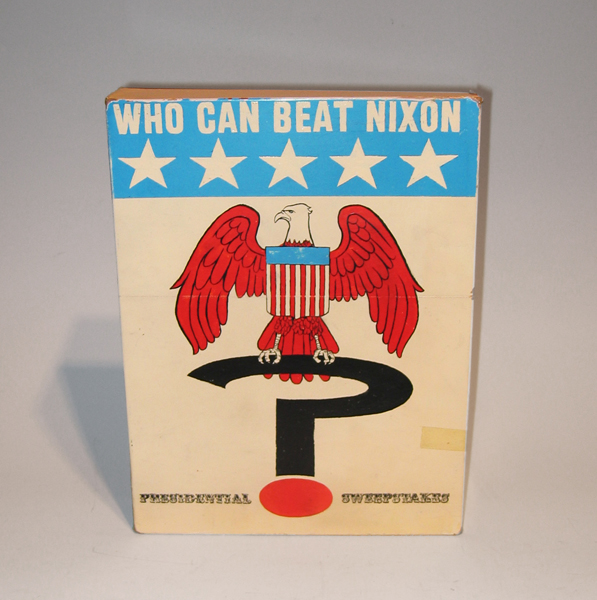
Tim Liddy Who Can Beat Nixon (1970) Presidential Sweepstakes 2006 Oil and enamel on copper, plywood back
TIM LIDDY
“Who Can Beat Nixon” (1970) Presidential Sweepstakes 2006
Oil and enamel on copper, plywood back
Signed in script: Tim Liddy “circa 1970” 2006, red circular ring
Provenance: William Shearburn Gallery (St. Louis, MO)
H: 11 ¾” x W: 9” x D: 2”
With his recent paintings, Liddy has both reasserted the construct of hyperrealist painting and developed a thoroughly unique advancement of that mode by extending the cultural reality of the indexed original. Based on the illustrated box lids of vintage board games, Liddy has recontextualized a subject, which evokes the underlying rules of life. Painted on copper or steel in the precise dimensions of the original, the metal is then manipulated to demonstrate the exact rips and tears from years of usage and includes trompe-l’oeil renditions of the scotch tape that might be holding the cardboard box together, the assorted stains, or the various graffiti of time. Liddy leaves no possibility of ambivalence, these works speak to a concurrent understanding of their original object identity and to themselves as works of art engaged in historical and psychological dialogue.









 @hd_jewels