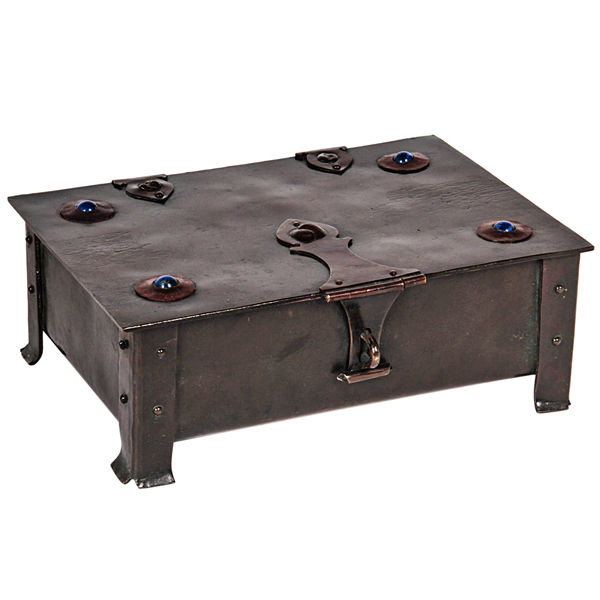
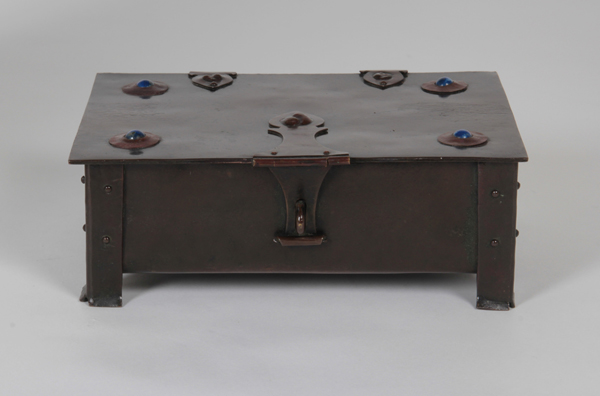
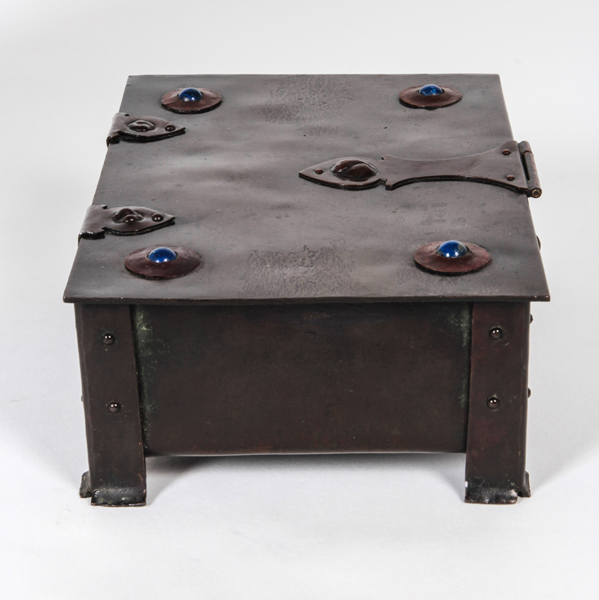
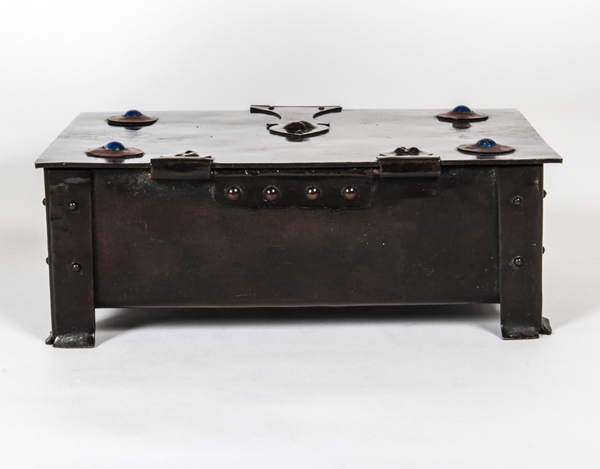
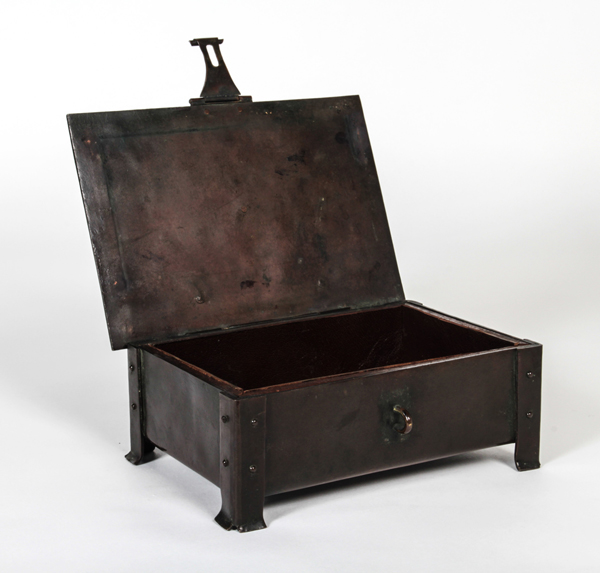
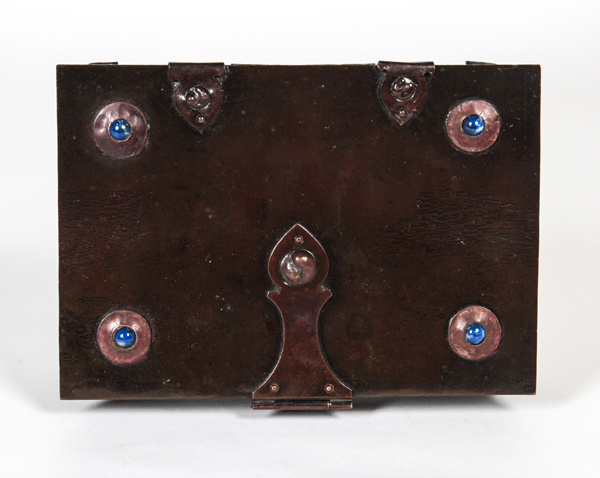
Albert Edward Jones British Arts & Crafts Copper and Lapis Lazuli Box c.1905
More Information
Albert Edward Jones British Arts & Crafts Copper and Lapis Lazuli Box c.1905
Albert Edward Jones (1879-1954) Birmingham, UK
British Arts & Crafts Movement
Footed box with hinged lid and hasp 1905
Hand wrought and patinated copper with riveted strap work and hasp, inset with 4 cabochons of lapis lazuli, brown leather and wood interior.
This box is a particularly handsome example of British arts & crafts metalwork by the famous designer / craftsman A.E. Jones. It retains its original deep, rich chocolate brown patina with the contrasting cobalt blue large round bezel-set cabochons of lapis lazuli.
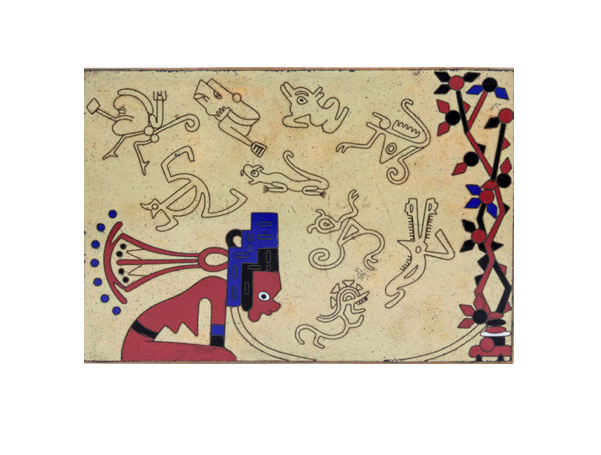
Cloisonne enamel in a fantasy of archaic Chinese motifs in red, royal blue, black white and sand colored abstract designs on a bronze body with a turquoise enameled underside and interior.
Hayno Focken / Modernist round covered copper box c. 1935
HAYNO FOCKEN (1905-1968) Germany
Round covered box c. 1935
Hand-wrought and hand-hammered copper with brass details
Marks under the foot: HF (conjoined monogram)
For other works by Hayno Focken see: Metallkunst: Vom Jugendstil zur Moderne (1889-1939), ed. Karl H. Bröhan (Berlin: Bröhan Museum, 1990), illus. 177, p. 183; Avantgarde Design 1880=1930,Torsten Bröhan & Thomas Berg (Köln, Benedict Taschen, 1994) p. 116; , (Berlin 1937) S. 43f, Abb. 37, Abb. S 128, S 146, Sl 243; Die Schaulade 15 Ausg. A (1939) Abb. S. 197, S. 204, S. 213; Die Schaulade 16 Ausg. A (1940) Abb. S. 44, S. 51., S. 54, S. 71, S. 83. S. 89; Die Kunst 84 (1941) S. 136, S. 139-39; Die Schaulade 17 (1941) Abb. S. 13, S. 41, S. 82, S. 229;
H: 4 ¼” x Dia: 4 7/8”
Hayno Focken (1905-1968) was an eminent German metal artist. He completed his training under Professor Karl Müller (1888-1972) at the design and arts school on Giebichenstein Castle in Halle (Saale), which was strongly tied to the ideals of the Deutsche Werkbund and the Bauhaus. In 1932 he established his own workshop in Lahr/Schwarzwald and continued his work until shortly before his death. His artistic work always stood out with a strong preference for large, organic forms, a similar manner of surface design and the same adherence to the principle of handicraft. Even his artist signet was modelled on the simple, square castle mark. In the 1950s he became one of those significant artists who had a major impact on contemporary metal design. The foundation of his creative work was a masterful understanding of proportions.
Illustrated: New Bauhaus, 50 Jahre: Bauhausnachfolge in Chicago (Berlin: Bauhaus-Archiv and Argon Verlag GmbH: 1987), p. 177
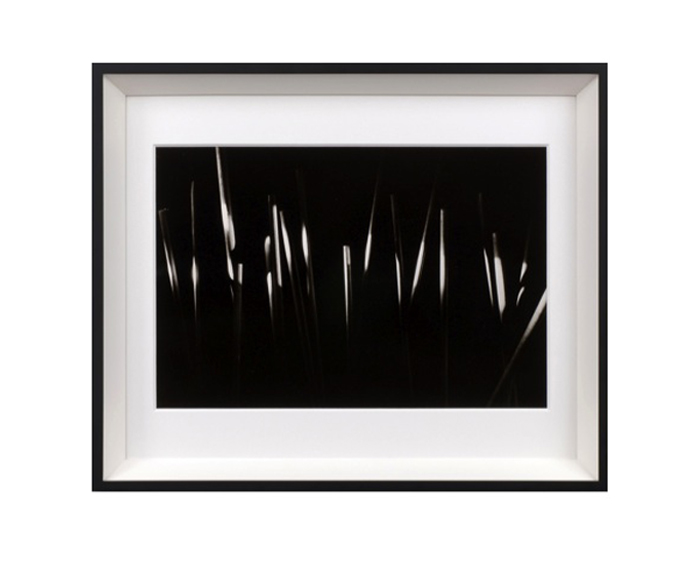
H: 18 5/8” x 22 ½” (framed)
Nathan Lerner’s long career was inextricably bound up in the history of visual culture in Chicago. Born in 1913 to immigrants from Ukraine, he began studying painting at the Art Institute of Chicago at the age of 16, taking up the camera to perfect his compositional skills. At 22 he began doing a kind of photojournalism, developing his well-known series on ”Maxwell Street,” an immigrant neighborhood hit hard by the Depression, and also photographing the southern Illinois mining area. In 1936 when the New Bauhaus was established in Chicago by Lazlo Moholy-Nagy, Lerner became one of its first scholarship students and turned increasingly to photographic experimentation. He began making semi-abstract, strongly Constructivist images involving luminous projections, solarization, photograms and other methods, and his interest in manipulating light led him to invent the first ”light box.” In 1939 he became the assistant of Gyorgy Kepes, head of the school’s light workshop; together, they wrote ”The Creative Use of Light” (1941). With Charles Niedringhaus in 1942 he developed a machine for forming plywood that was used in making most of the school’s furniture. After working as a civilian light expert for the Navy in New York during World War II, Lerner returned to the school, now called the Institute of Design, and was named education director after Moholy-Nagy’s death in 1946. He left in 1949, opening a design office that became nationally known for its furniture, building systems and glass and plastic containers (including bottles for Revlon and Neutrogena and the Honeybear honey container). In 1968 Lerner married Kiyoko Asia, a classical pianist from Japan, and over the next two decades made numerous trips to Japan, where he took his first color photographs, as well as Mexico. He had his first solo exhibition of photography in 1973 and thereafter exhibited regularly in galleries and museums in the United States, Europe and Japan. His work is included in photography and design collections around the world. (Roberta Smith, New York Times, February 15, 1997).
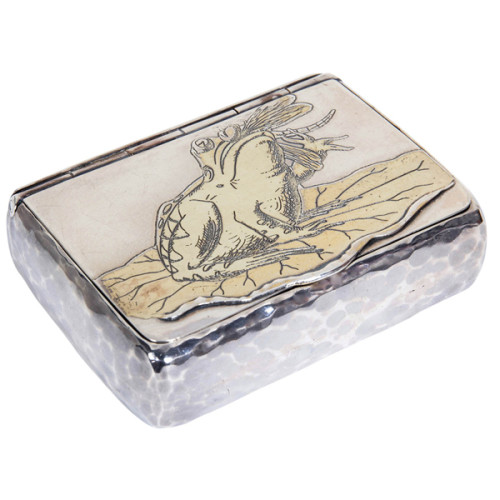
Tiffany & Co. / Art Nouveau “Frog on a lily pad” covered snuff box 1880
TIFFANY & CO. New York, NY
“Frog on a lily pad” cigarette case 1880
Hand wrought sterling silver with repoussé and chased gold design of a frog sitting on a lily pad with a dragonfly in it’s mouth, “lap over edge” and hand hammered details, gilt interior and spring action to the hinge when the sides are pressed
Tiffany Archive Illustration: Design for Cigarette Case No. 5804, No. 1019, 249, stamped Tiffany & Co. New York, February 26, 1880
Model and Archive illustration: Bejewelled by Tiffany 1837-1987 Clare Phillips (New Haven and London: Yale University Press, 2006)
For more information see: Tiffany Silver, Charles H. Carpenter, Jr. (New York: Dodd, Mead & Company, 1978); The Silver of Tiffany & Co., 1850-1987, Charles H. Carpenter, Jr. and Janet Zapata (Boston: Museum of Fine Arts, 1987).
Marks: Tiffany & Co., 5804, M, 2540, Sterling-Silver, 1019
H: 3/4” x W: 2 7/8” x D: 2 1/8”
The Frog and the Dragonfly
from The Lost Lagoon
by Reg Down, 2010
Once upon a time a dragonfly lived beside a lake high in the mountains. He flitted from bulrush to bulrush – and zipped after mosquitoes. He snapped them out of the air so quickly that no one could ever quite see what he was doing.
One day, as he was flying across the water, his beautiful wings glistening like rainbows, he came across a frog.
“Ribbit!” said the frog. “Come here, Mr. Dragonfly. I would like to have a better look at you.”
But the dragonfly was clever. In fact, he was so clever that his eyes were made up of hundreds of eyes all put together on the top of his head. And each one of those eyes said to him: “That frog wants to eat me!”
So he landed on top of a bulrush where the frog could not get him, and said, “Yes, Mr. Frog, I am close enough for you. What do you want?”
“Ribbit! Ribbit!” croaked the frog, “I think you should come closer because my eyes are not very good.”
So the dragonfly came a little closer. He flitted to a flower floating on the water—but still not close enough for the frog to grab him with his mouth.
“Yes, Mr. Frog, what do you want?” he asked.
“Oh, Mr. Dragonfly,” said the frog, “I have an itch on the end of my nose and my legs aren”t long enough to reach it. But your legs are scratchy—they will be able to scratch my itchiness much better that I ever could.”
The dragonfly found this quite funny. He thought, “That frog wants to eat me! I am sure that frog wants to eat me!” So he flew behind the frog and landed on his back.
The frog could feel the dragonfly crawling on his back, but he could not turn around to grab him. “Oh, Mr. Dragonfly,” he said, “you have to come closer to my nose. In fact, my lips are getting very itchy—please come closer.”
So the dragonfly went and sat between the frog”s eyes. Now the frog”s eyes were looking into the dragonfly”s eyes, and the frog saw that the dragonfly had far, far more eyes than he had. So he said, “Oh, Mr. Dragonfly, you are surely much, much more wise than I am. You have so many eyes that you can see the whole world!”
And the dragonfly replied, “Of course I can see the whole world! I have so many eyes that I am the wisest of all flies!”
“Well,” said the frog, “I have a little tickle in the bottom of my throat—what is happening there?”
And the dragonfly looked, and looked, and looked…….and Snap! the frog ate him up.



 @hd_jewels