Exhibited: The Twenty One (Millenium) Exhibition, Arzenal Gallery, Prague, 2000
For more information see: Sípek, Philippe Louguet, Dagmar Sedlická (Paris: Éditions Dis Voir, 1999); Borek Sipek and Christian Tortu: Collection Twentyone 2001 (Prague: Arzenal Edition, 2001)
H: 13″ x Dia: 4″
Price: $1,050
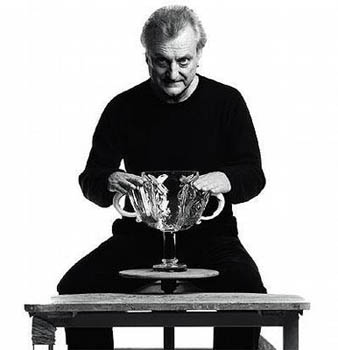
The Czech architect, furniture designer, and glass artist Borek Sípek was born in Prague in 1949. From 1964 to 1968 Borek Sípek studied furniture design at the Prague School for the Applied Arts. In 1969 he began to study architecture at the Hochschule für bildende Künste in Hamburg. In 1973 he studied philosophy at Stuttgart University. From 1977 until 1979 he was an academic assistant at the Hannover University Institute of Industrial Design. Borek Sípek took his degree in architecture at Delft Technical University. Then he taught design theory at Essen University until 1983. In 1983 Borek Sípek also opened an architecture and design practice in Amsterdam. He founded Alterego, a design business, with David Palterer. In the 1980s, Borek Sípek designed Postmodern furniture and glass objects, which brought him international renown. Borek Sípek’s designs are formally distinctive, both ingeniously conceived and sumptuous, and are often executed in unconventional materials and combinations of materials. Borek Sípek views design as an interpretation of culture. For this reason, he rejects the functional and rational approach to design and does not want striving for technical perfection to lead to disregard of individuality. In 1983 Borek Sípek designed “Bambi”, a fragile-looking tubular steel chair with brass fittings and a back covered in silk. In 1991 Borek Sípek designed the “PCSS” table with blue glass legs and metal fittings. Borek Sípek’s superlative glass objects are executed by glassblowers in Murano and Novy Bor. Borek Sipek is also known worldwide as an architect and has received prestigious commissions. Between 1993-2002 Borek Sípek worked on the Het Kruithuis Museum in ‘s Hertogenbosch (the Netherlands). In 1994 Borek Sípek designed the Kyoto Opera Houseentsteht das Opernhaus in Kyoto. In 1995 Borek Sípek designed a Paris boutique for Karl Lagerfeld. In 1990 Borek Sípek became a professor of architecture at the Academy for the Applied Arts in Prague, where he taught until 1998. Since 1999 he has taught at the Universität for angewandte Kunst in Vienna.
His works are included in major international museum and private collections throughout the US and Europe including Museum of Modern Art, Stedelijjk Museum, Denver Art Museum, The Corning Museum of Art, The Hauge Municipal Museum, Kunstmuseum in Düsseldorf and Design Museum in London.
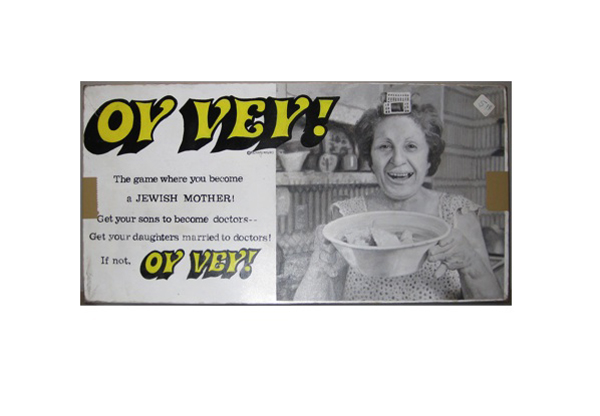
Tim Liddy Oy Vey (1979) The game where you become a JEWISH MOTHER! Get your sons to become doctors—Get your daughters married to doctors! If not, OY VEY! 2008 Oil and enamel on copper, plywood back
TIM LIDDY
“Oy Vey” (1979) The game where you become a JEWISH MOTHER! Get your sons to become doctors—Get your daughters married to doctors! If not, OY VEY! 2008
Oil and enamel on copper, plywood back
Signed in script: Tim Liddy, red circular ring, “circa 1979”, 2008
Provenance: William Shearburn Gallery, St. Louis, MO
H: 10 ¼” x W: 20 ½” x D: 1 ¾”
With his recent paintings, Liddy has both reasserted the construct of hyperrealist painting and developed a thoroughly unique advancement of that mode by extending the cultural reality of the indexed original. Based on the illustrated box lids of vintage board games, Liddy has recontextualized a subject, which evokes the underlying rules of life. Painted on copper or steel in the precise dimensions of the original, the metal is then manipulated to demonstrate the exact rips and tears from years of usage and includes trompe-l’oeil renditions of the scotch tape that might be holding the cardboard box together, the assorted stains, or the various graffiti of time. Liddy leaves no possibility of ambivalence, these works speak to a concurrent understanding of their original object identity and to themselves as works of art engaged in historical and psychological dialogue.
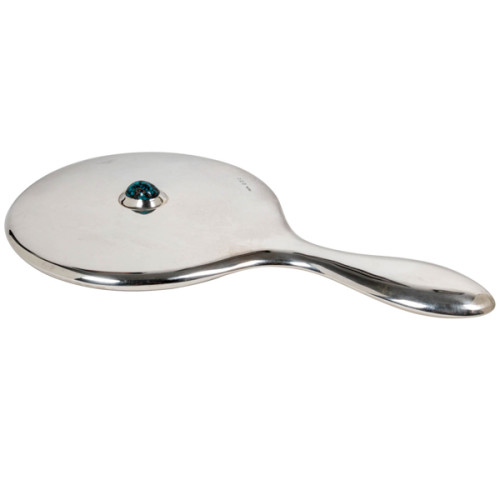
Archibald Knox / Liberty & Co. Sterling hand mirror 1908
ARCHIBALD KNOX (1864-1933) UK
LIBERTY & CO. London, UK
Hand mirror 1908
Sterling with large matrix cabochon turquoise
Marks: L & Co. cipher, Birmingham assay marks for 1908
Similar works with turquoise Illustrated: Archibald Knox, ed. by Stephen A. Martin (London: Academy Editions, 1995) ; Liberty Design 1874-1914, Barbara Morris (London: Pyramid Books, 1989) p. ; The Designs of Archibald Knox for Liberty & Co., A.J. Tilbrook (London: Ornament Press Ltd., 1976)
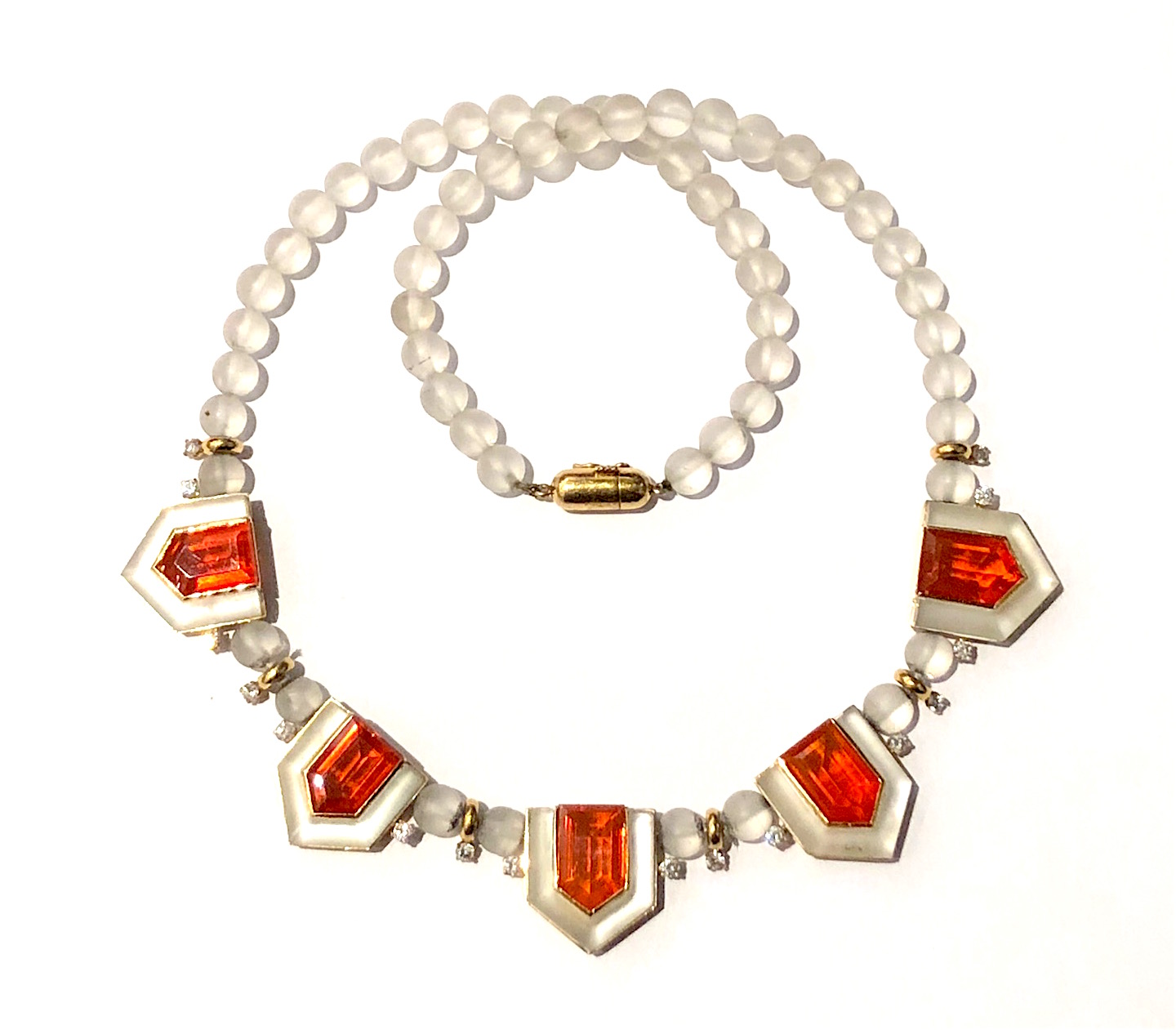
Art Deco “Fire Opal” necklace, frosted rock crystal round beads and four sided custom rock crystal bezels set in 18K yellow gold with 16 round–cut accent diamonds featuring five large natural fire opals (G.I.A certificate, dimension of each fire opal, 13.00 x 8.15 x 6.20mm for a TW of approx. 17.50 carats), c. 1940’s
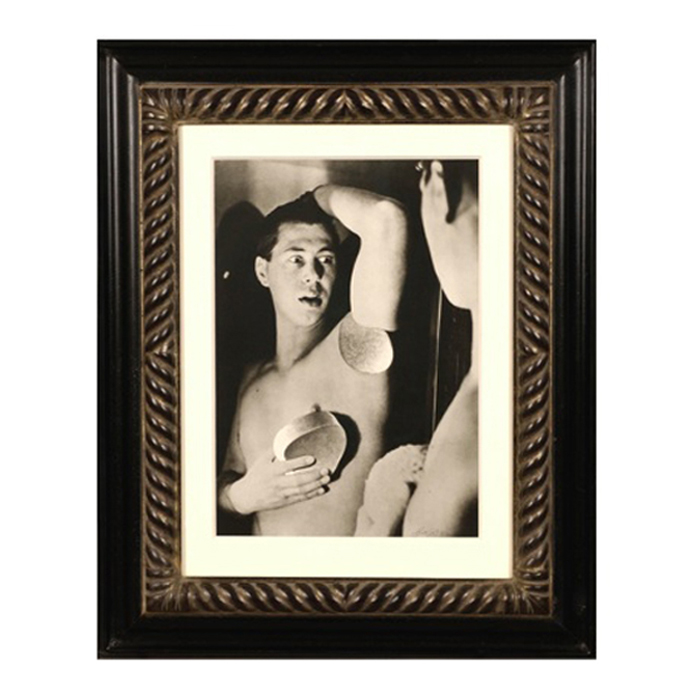
Herbert Bayer, Self Portrait, Gelatin silver print , 1932, printed later
HERBERT BAYER (1900-1985) Austria
Self portrait 1932 (printed later)
Silver gelatin print
Edition: 28/40
Signed: bayer 32 (in ink on bottom right corner)
Provenance: Kennedy Gallery, New York
H: 13 7/16” x W: 9 ½”
Framed size: H: 21 ½” x W: 17 ½”
Price: $16,000
Herbert Bayer (1900 – 1985) was an Austrian graphic designer, painter, photographer, and architect. Bayer apprenticed under the artist Georg Schmidthammer in Linz. Leaving the workshop to study at the Darmstadt Artists’ Colony, he became interested in Walter Gropius’s Bauhaus manifesto. After Bayer had studied for four years at the Bauhaus under such teachers as Wassily Kandinsky and László Moholy-Nagy, Gropius appointed Bayer director of printing and advertising. In the spirit of reductive minimalism, Bayer developed a crisp visual style and adopted use of all-lowercase, sans serif typefaces for most Bauhaus publications. Bayer is one of several typographers of the period including Kurt Schwitters and Jan Tschichold who experimented with the creation of a simplified more phonetic-based alphabet. Bayer designed the 1925 geometric sans-serif typeface, universal, now issued in digital form as Architype Bayer that bears comparison with the stylistically related typeface Architype Schwitters.
In 1928, Bayer left the Bauhaus to become art director of Vogue magazine’s Berlin office. He remained in Germany far later than most other progressives. In 1936 he designed a brochure for the Deutschland Ausstellung, an exhibition for tourists in Berlin during the 1936 Olympic Games. In 1938 he left Germany and settled in New York City where he had a long and distinguished career in nearly every aspect of the graphic arts. In 1946 Bayer relocated again. Hired by industrialist and visionary Walter Paepcke, Bayer moved to Aspen, Colorado as Paepcke promoted skiing as a popular sport. Bayer’s architectural work in the town included co-designing the Aspen Institute and restoring the Wheeler Opera House, but his production of promotional posters identified skiing with wit, excitement, and glamour. Bayer would remain associated with Aspen until the mid-1970s. Bayer gave the Denver Art Museum a collection of around 8,000 of his works. In 1959, he designed his “fonetik alfabet”, a phonetic alphabet, for English. It was sans-serif and without capital letters. He had special symbols for the endings -ed, -ory, -ing, and -ion, as well as the digraphs “ch”, “sh”, and “ng”. An underline indicated the doubling of a consonant in traditional orthography.




 @hd_jewels