Product Description
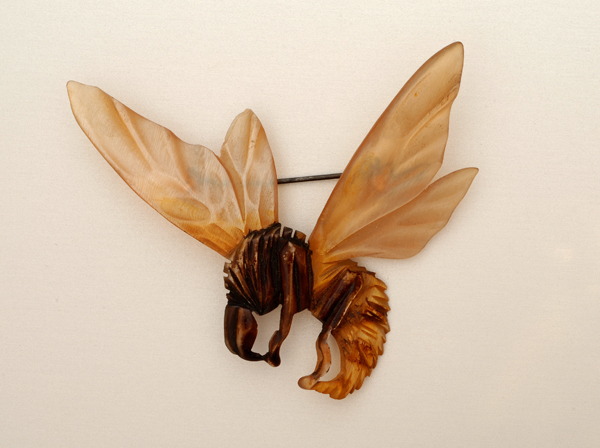
Elizabeth Bonte, French Art Nouveau “Hornet” brooch, carved horn c. 1900

Elizabeth Bonte, French Art Nouveau “Hornet” brooch, carved horn c. 1900
JOHN PEARSON (19th century) UK
Tea caddy c. 1900
Handwrought copper with rivets, repoussé lid with 4 heart-shaped leaves, rich red brown original patina
Marked: JP in an oval cartouche (on bottom)
H: 4 1/2″ x D: 4 1/4″
For more information on Pearson see: CR Ashbee: architect, designer & romantic socialist, Alan Crawford (New Haven, CT: Yale University Press, 1985), pp. 32-33, 46, 313-316; Reflections: arts and crafts metalwork in England and the United States (New York: Kurland – Zabar, 1990), pp. 32-33.
Pearson was an original member of CR Ashbee’s Guild of Handicraft starting in 1888. He later resigned to join the Newlyn Industrial Class. He also worked for the designer & ceramicist William De Morgan which is where many of his fanciful themes in repousse are inspired. He is considered one of the finest repousse metalsmiths of the period. His shop remained active until after the turn of the century, most pieces are dated.
MITZI OTTEN-FRIEDMANN (1884-1955) Austria
WIENER WERKSTÄTTE (1903-1932)
Brooch c. 1915
Reverse-painted glass depicting a couple set in a silver frame / back
Marks: M. OTTEN-FRIEDMANN on the front (right), the reverse stamped: WW, Vienna assay mark for 900 silver
D: 2 3/8”
Rosalia Marie Friedmann-Otten (“Mitzi”) * November 28, 1884 Vienna, † May 5, 1955 New York, NY
Student at the School of Applied Arts in Vienna (with Oskar Strnad), Friedmann-Otten participated in numerous exhibitions (including art shows in 1908, 1920; Neukunstgruppe 1909; German Women’s Art in 1925; Werkbundausstellung 1930). Member of the Austrian Werkbund, the Wiener Werkstätte and the Neukunstgruppe. One of the most versatile artists (commercial art, metalwork, jewelry, fashion, starting from 1920 mainly enamel works, including large-scale email pictures), Friedmann-Otten had to flee in 1938 to the United States.
MARGARET DE PATTA (1903-1964) USA
Abstract brooch c. 1945
Sterling with both a smooth finish and a textured surface in a biomorphic design set with rondels of chrysoprase and carnelian
Marks: De Patta chevron insignia, STERLING
Illustrated: Design 1935 – 1965, What Modern Was: selections from the Liliane and David M. Stewart collection ed. Martin Eidelberg, (Montreal/New York: Le Musée des Arts Décoratifs de Montréal/Harry N. Abrams, 1991), p. 100, illus. 130.
Related designs illustrated: The Jewelry of Margaret de Patta: A Retrospective Exhibition, Oakes Gallery and The Oakland Museum (Oakland, Calif.: 1979); Messengers of Modernism: American Studio Jewelry 1940-1960, ed. Martin Eidelberg, (Montreal: The Lake St. Louis Historical Society, 1996).
L: 3 1/4”