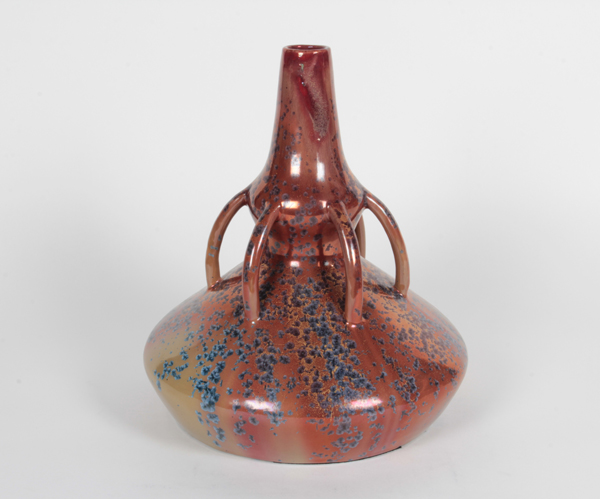
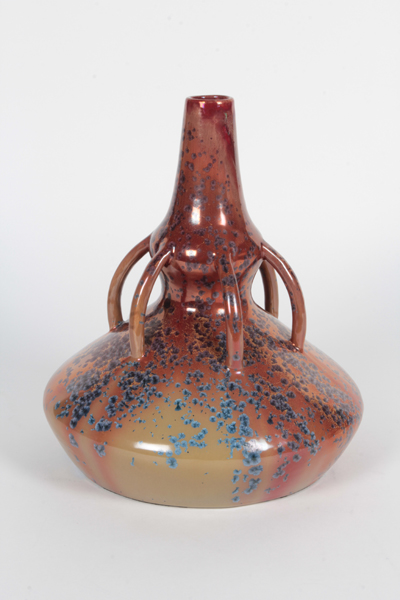
Olivier de Sorra / Pierrefonds (Count Hallez d'Arros) French Art Nouveau six branch vase c. 1900
More Information
Olivier de Sorra / Pierrefonds (Count Hallez d’Arros) French Art Nouveau six branch vase c. 1900
OLIVIER DE SORRA
SOCIETE FAIENCIERE HERALDIQUE DE PIERREFONDS
Six-branch vase c. 1900
Copper color glaze with blue oxide flower crystallization
H: 11″ x Dia: 9″
Price: $7,250
The Societe Faienciere Heraldique de Pierrefonds pottery studio was founded in the village of Pierrefonds in 1903 by Count Hallez d’Arros and is renowned for it’s crystalline and flambe glazes
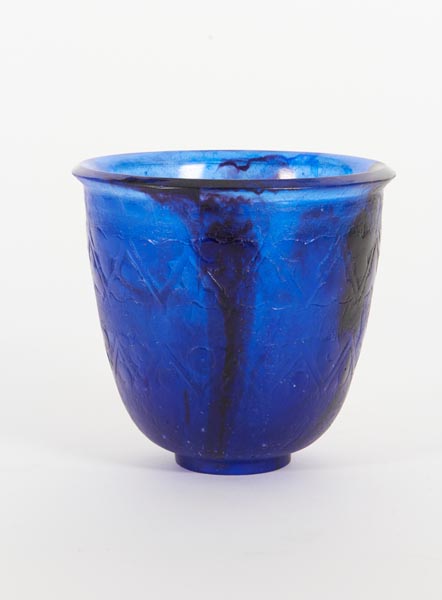
Francois-Emile Decorchement French Art Deco “Bleu” pâte-de-crystal vase 1926
FRANÇOIS-EMILE DECORCHEMENT (1880-1971) France
“Bleu” pâte-de-crystal vase c. 1926
Cobalt blue pâte-de-crystal (lost wax cast crystal) with mauve inclusions, two low-relief friezes of varying abstract vine motifs
Impressed: DECORCHEMENT in a lunette seal, numbered A 865
For more information on Decorchement see: Art Deco, Victor Arwas (New York: Harry N. Abrams,1980) pp. 268-69, 298.
H: 4 1/2″ x Dia: 4 3/4″
Decorchement, Francois Emile. (1880-1970) He set up a glass house in Conches in 1902 producing exquisite pate-de-verre, statuettes, bowls and vases. He extended this range to encompass a rougher hewn surface with motifs of flowers and sometimes insects. His designs became increasingly abstract during the 1930s toward the outbreak of the Second World War; these were often executed in pate-de-cristal. Later the production continued although in a more restrained manner with softer semi-opaque and translucent colors.
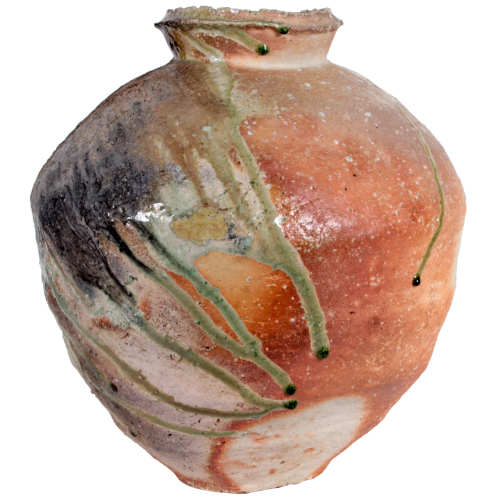
Kishimoto Kennin Japan Hand Thrown Monumental “Iga” Stoneware Vase, c. 1995
KISHIMOTO KENNIN (b. 1934), Japan.
Monumental “Iga” vase, circa 1995.
Hand thrown and handbuilt stoneware vase with a natural ash glaze in rich salmon rust, celadon, grey and black glaze
H: 20″ x Dia: 22″
Price: $20,000
1934 born in Nagoya 1953–1955 attends college in Nagoya 1960 moves to Mino, Gifu Prefecture 1965 establishes his own studio 1970 builds an anagama in Mikuni-Sanroku, where he lives and works until today 1976 appointed member of the Japan Crafts Association (Nihon kôgei-kai) Group exhibitions 1967 Asahi Ceramics Exhibition (Asahi tôgei-ten) 1968 Exhibition of Japanese Ceramics (Nihon tôgei-ten) 1970 International Exhibition of Chûnichi Ceramics (Chûnichi kokusai tôgei-ten) 1972–75 Japan Traditional Crafts Exhibition (Nihon dentô kôgei-ten)
One man shows:
1979 Takashimaya Gallery, Tôkyô; since then again in 1981, 1983, 1985, 1987, 1990.
1982 Hankyû Gallery, Ôsaka; since then again in 1983, 1984, 1985, 1986, 1987.
1984 Maru’ei Gallery, Nagoya; again in 1986.
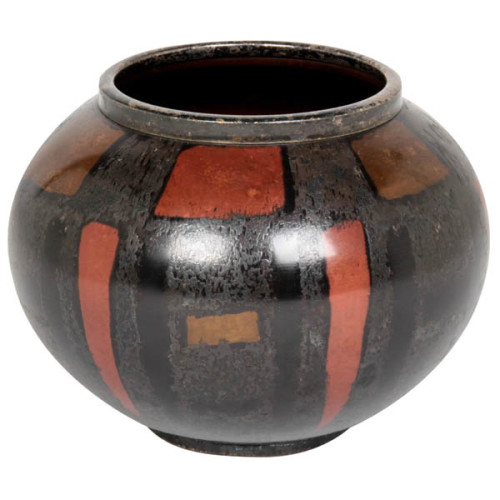
Silver-plated copper with with red patinated squares and rectangles on a black-patinated textured background
Marks: WMF castle mark, IKORA
Illustrated: WMF Ikora Metall / Metalwork, Carlo Burschel and Heinz Scheiffele (Stuttgart, Germany: ARNOLDSCHE, 2006), p. 142, 90/585.
For more information see: WMF Glas Keramik Metall 1925-1950, Jörg Schwandt, (Berlin: Kunstgewerbemuseum, Staatliche Museum Preussischer Kulturbesitz, 1981). Metallkunst, Band IV (Berlin: Bröhan-Museum, 1981) pp. 546-579.
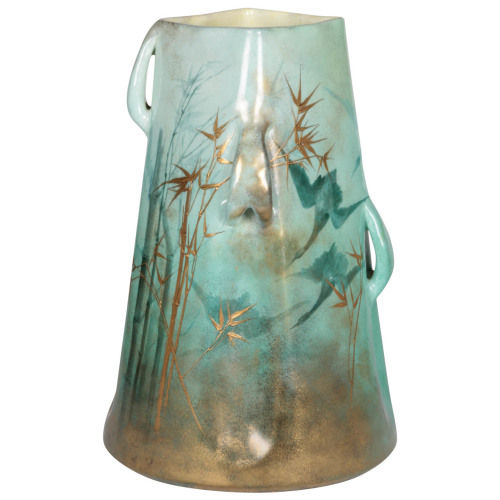
Clement Massier / French Art Nouveau “Bamboo and Flying Crane” Vase circa 1900
CLÉMENT MASSIER (1845-1917) France
MASSIER ART POTTERY Golfe Juan, France
“Bamboo and flying crane” vase c. 1900
Earthenware tapering form with applied handles, hand painted with bamboo and flying cranes with gilt motives and details
Marks: Clement Massier Golfe Juan (block impressed letters)
For more information and other works by the Massier family see: Lost Paradise: Symbolist Europe (Montreal, Quebec: The Montreal Museum of Fine Arts, 1995) p. 176, cat. 269; Jugendstil Art Nouveau, Floral and Functional Forms, Siegfried Wichmann (New York/Boston: Graphic Society/Little, Brown & Co., 1984) p. 45; Art Nouveau Belgium France. Exh. cat. Yvonne Brunhammer et al. (Houston, TX: Institute for the the Arts, Rice University, 1976); La Céramique Art Nouveau, Edgar Pélichet, Michèle Duperrex (Paris: La Bibliothèque des Arts, 1976) p. 89





 @hd_jewels