Product Description
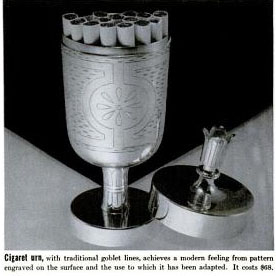
Tommi Parzinger, Sterling covered pedestal cigarette box with neoclassical motifs c. 1938

TOMMI PARZINGER (1903-1981) Germany/USA
PETER ALBERT REIMES Silversmith (1900-1945) Germany / USA
Sterling covered pedestal cigarette box with neoclassical motifs c. 1938
Tommi Parzinger, Sterling covered pedestal cigarette box with neoclassical motifs c. 1938
You must be logged in to post a comment.

Ando Jubei Nagoya, Japan
Japanese Meiji Period (1868-1912) Japan
Enamel and copper covered box circa 1900
Patinated copper, applied foil-backed enameled red berries, stylized green leaves and vines, riveted corners.
H: 1 5/8″ x D: 4″ x W: 5 3/4″
TOMMI PARZINGER (1903-1981) Germany/USA
PARZINGER, INC. New York
Coffee table c.1939
Carved and ceruse oak with an incised diamond pattern pewter top
Illustrated: Arts and Decoration, June 1940
***This table was originally priced at $80 during the period, as it appears in the Arts and Decoration vintage illustration from 1940.
For other examples of Parzinger’s work see: Town & Country, Vol. 54, “Counter Points”, December 1939, p. 31; Town & Country, Vol. 95, “Counter Points”, June 1940, p. 19; The Studio, 1938, “For the Table”, p.107-09; The Studio, 1942, “Tommi Parzinger, Designer of Modern Interiors and Silver”, p.37; Decorative Art, Studio Yearbook (London & New York: The Studio Publications, 1952-53), p. 98; Craft in the Machine Age, ed. Janet Kardon (New York: American Craft Museum, 1995) p.128, 134, 183, 241.
H: 12” x L: 42” x D: 14”
Price: $34,500
This is a wonderful and rare coffee table by Tommi Parzinger in beautifully detailed ceruse oak with a diamond pattern pewter inset top. This table was
completely handmade and dates from 1940, shortly after Parzinger opened his first eponymous gallery on East 57th Street. It is low and lean with exquisite Neoclassical Revival carved details and a silhouette that calls to mind an American take on Jean Michel Frank’s sober and refined elegance of the same time period. The cross-hatch carving with tassels on the two long sides and the related top corner details also have a charm reminiscent of Parzinger’s affable personality and effervescent design sensibility.
NATHAN LERNER (1913-1997) Chicago, USA
Dowels Light Box Study c.1937
Silver gelatin print
Signed on back
Illustrated: New Bauhaus, 50 Jahre: Bauhausnachfolge in Chicago (Berlin: Bauhaus-Archiv and Argon Verlag GmbH: 1987), p. 177
H: 18 5/8” x 22 ½” (framed)
Nathan Lerner’s long career was inextricably bound up in the history of visual culture in Chicago. Born in 1913 to immigrants from Ukraine, he began studying painting at the Art Institute of Chicago at the age of 16, taking up the camera to perfect his compositional skills. At 22 he began doing a kind of photojournalism, developing his well-known series on ”Maxwell Street,” an immigrant neighborhood hit hard by the Depression, and also photographing the southern Illinois mining area. In 1936 when the New Bauhaus was established in Chicago by Lazlo Moholy-Nagy, Lerner became one of its first scholarship students and turned increasingly to photographic experimentation. He began making semi-abstract, strongly Constructivist images involving luminous projections, solarization, photograms and other methods, and his interest in manipulating light led him to invent the first ”light box.” In 1939 he became the assistant of Gyorgy Kepes, head of the school’s light workshop; together, they wrote ”The Creative Use of Light” (1941). With Charles Niedringhaus in 1942 he developed a machine for forming plywood that was used in making most of the school’s furniture. After working as a civilian light expert for the Navy in New York during World War II, Lerner returned to the school, now called the Institute of Design, and was named education director after Moholy-Nagy’s death in 1946. He left in 1949, opening a design office that became nationally known for its furniture, building systems and glass and plastic containers (including bottles for Revlon and Neutrogena and the Honeybear honey container). In 1968 Lerner married Kiyoko Asia, a classical pianist from Japan, and over the next two decades made numerous trips to Japan, where he took his first color photographs, as well as Mexico. He had his first solo exhibition of photography in 1973 and thereafter exhibited regularly in galleries and museums in the United States, Europe and Japan. His work is included in photography and design collections around the world. (Roberta Smith, New York Times, February 15, 1997).
Reviews
There are no reviews yet, would you like to submit yours?