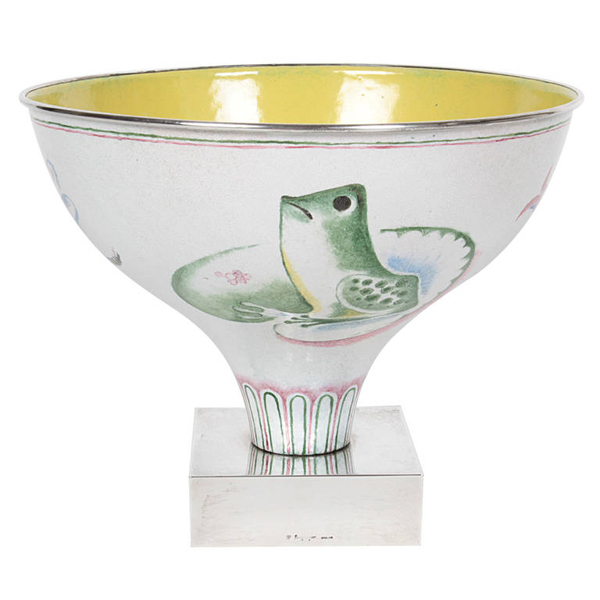
Tommi Parzinger, Sterling and enamel pedestal centerpiece bowl on an attached square base with a frog, lily pad and fish motif as part of the overall enamel design c. 1938
TOMMI PARZINGER (1903-1981) Germany/USA
WILLIAM STARK / KARL DRERUP Enamel
PETER REIMES Silversmith
Sterling and enamel pedestal centerpiece bowl on an
attached square base with a frog, lily pad and fish motif as part of the
overall enamel design c. 1938
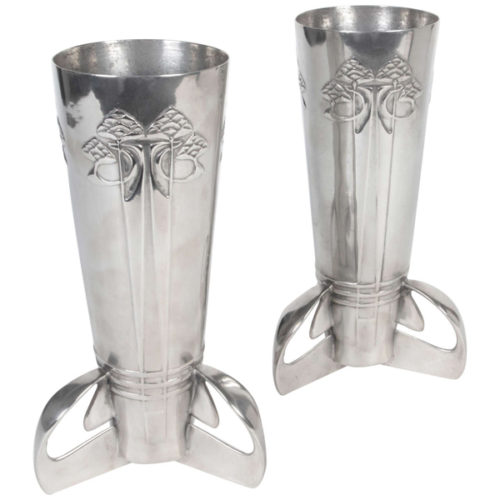
Archibald Knox / Liberty & Co. Pair of tri-footed vases c. 1902-05
ARCHIBALD KNOX (1864-1933) UK
LIBERTY & CO. London
Pair of tri-footed vases c. 1902-05
Pewter with abstract Celtic floral design in bas-relief on tri-footed base
Marks: 6, MADE BY LIBERTY & CO.., ENGLISH PEWTER 0227
Illustrated: Archibald Knox, ed. by Stephen A. Martin (London: Academy Editions, 1995) ; Liberty Design 1874-1914, Barbara Morris (London: Pyramid Books, 1989) p. ; The Designs of Archibald Knox for Liberty & Co., A.J. Tilbrook (London: Ornament Press Ltd., 1976)
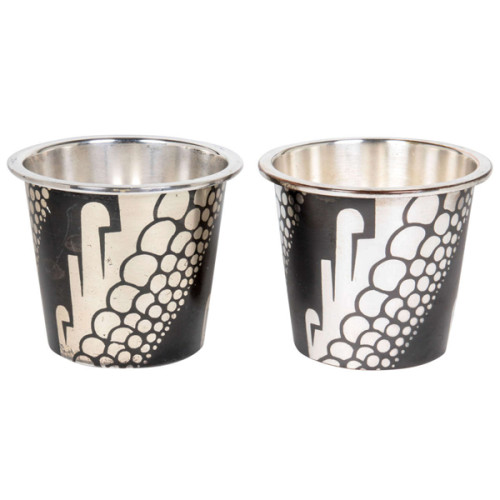
Rudolf Rieger / WMF Ikora Germany Art Deco Dinanderie Pair of Vases c. 1930
RUDOLF RIEGER Germany
WMF [WÜRTTEMBERGISCHE METALLWARENFABRIK] Geislingen, Germany
Dinanderie pair of vases c. 1930
Brass with a black patina and stylized silver inlay in a geometric motif
Marks: WMF castle mark
Illustrated: WMF Ikora Metall / Metalwork, Carlo Burschel and Heinz Scheiffele (Stuttgart, Germany: ARNOLDSCHE, 2006), p. 58, 156 and 185.
H: 3 1/4″ x Dia: 4″
Price: $1,950
Rudolf Rieger was in Paul Haustein’s master class and worked as self-employed goldsmith in Stuttgart. Between 1920 and 1930 he submitted designs for metal objects to WMF AG and from 1940 until 1941 he was the master instructor at the WMF art-metal division.





 @hd_jewels