Flavio Poli / Seguso Vetri d'Arte Murano Mid-Century Modern art glass vase c. 1950's
More Information
Flavio Poli / Seguso Vetri d’Arte Murano Mid-Century Modern art glass vase c. 1950’s
FLAVIO POLI (1900-1984) Italy
SEGUSO VETRI D’ARTE Italy
Vase c. 1950’s
Blue and clear Murano glass
H: 10″ x D: 3″ x W: 4 1/2″
Price: $1,850
Designer, businessman, ceramic artist. Born in Chioggia, he attended the Istituto d’Arte di Venezia and began work as a designer in ceramics. in 1929 he switched to glass and for Libero Vitali’s I.V.A.M. he designed animals, splendid Novecento-style nude figures in massiccio glass, as well as bowls and urns with figures resting on the inside, on lids or as handles. He subsequently collaborated with the Compagnia di Venezia e Murano, with the furnace of Mario and Lino Nason and with the engraver Gino Francesconi. in 1934 he accepted the artistic direction of Barovier, Seguso & Ferro, later to become Seguso Vetri d’Arte, and became partner three years later. Together with the master of the principal team Archimede Seguso, Poli was the author of grandiose lighting installations, of corroded vessels, of sculptures in bulicante glass, of animals in massiccio glass shaped while hot, productions which represented a milestone in the development of Murano glass. At the height of his artistic maturity, in the years between 1950 and 1960 he designed a series of sommerso glass pieces in a Nordic style, essential forms and sharp cold colors, which were awarded prestigious prizes (Compasso d’Oro). After leaving Seguso in 1963, between 1964 and 1966 he organized the artistic glass division at the Societˆ Veneziana di Conterie e Cristallerie.
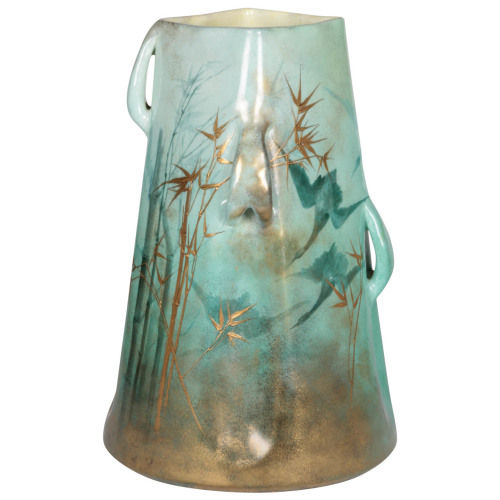
Clement Massier / French Art Nouveau “Bamboo and Flying Crane” Vase circa 1900
CLÉMENT MASSIER (1845-1917) France
MASSIER ART POTTERY Golfe Juan, France
“Bamboo and flying crane” vase c. 1900
Earthenware tapering form with applied handles, hand painted with bamboo and flying cranes with gilt motives and details
Marks: Clement Massier Golfe Juan (block impressed letters)
For more information and other works by the Massier family see: Lost Paradise: Symbolist Europe (Montreal, Quebec: The Montreal Museum of Fine Arts, 1995) p. 176, cat. 269; Jugendstil Art Nouveau, Floral and Functional Forms, Siegfried Wichmann (New York/Boston: Graphic Society/Little, Brown & Co., 1984) p. 45; Art Nouveau Belgium France. Exh. cat. Yvonne Brunhammer et al. (Houston, TX: Institute for the the Arts, Rice University, 1976); La Céramique Art Nouveau, Edgar Pélichet, Michèle Duperrex (Paris: La Bibliothèque des Arts, 1976) p. 89
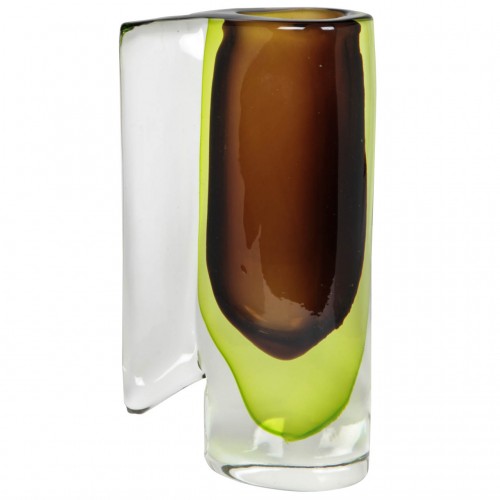
Flavio Poli / Seguso Vetri d’Arte Brown Murano Art glass vase c. 1950’s
FLAVIO POLI (1900-1984) Italy
SEGUSO VETRI D’ARTE Italy
Vase c. 1950’s
Asymmetric vase in a dark brown Murano glass cased inside with a layer of pale green and clear glass
H: 10 1/2″ x W: 5 1/2″ x D: 2 3/4″
Price: $4,000
Designer, businessman, ceramic artist. Born in Chioggia, he attended the Istituto d’Arte di Venezia and began work as a designer in ceramics. in 1929 he switched to glass and for Libero Vitali’s I.V.A.M. he designed animals, splendid Novecento-style nude figures in massiccio glass, as well as bowls and urns with figures resting on the inside, on lids or as handles. He subsequently collaborated with the Compagnia di Venezia e Murano, with the furnace of Mario and Lino Nason and with the engraver Gino Francesconi. in 1934 he accepted the artistic direction of Barovier, Seguso & Ferro, later to become Seguso Vetri d’Arte, and became partner three years later. Together with the master of the principal team Archimede Seguso, Poli was the author of grandiose lighting installations, of corroded vessels, of sculptures in bulicante glass, of animals in massiccio glass shaped while hot, productions which represented a milestone in the development of Murano glass. At the height of his artistic maturity, in the years between 1950 and 1960 he designed a series of sommerso glass pieces in a Nordic style, essential forms and sharp cold colors, which were awarded prestigious prizes (Compasso d’Oro). After leaving Seguso in 1963, between 1964 and 1966 he organized the artistic glass division at the Societˆ Veneziana di Conterie e Cristallerie.
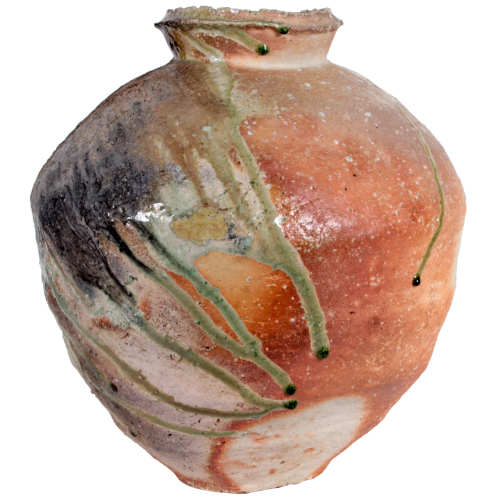
Kishimoto Kennin Japan Hand Thrown Monumental “Iga” Stoneware Vase, c. 1995
KISHIMOTO KENNIN (b. 1934), Japan.
Monumental “Iga” vase, circa 1995.
Hand thrown and handbuilt stoneware vase with a natural ash glaze in rich salmon rust, celadon, grey and black glaze
H: 20″ x Dia: 22″
Price: $20,000
1934 born in Nagoya 1953–1955 attends college in Nagoya 1960 moves to Mino, Gifu Prefecture 1965 establishes his own studio 1970 builds an anagama in Mikuni-Sanroku, where he lives and works until today 1976 appointed member of the Japan Crafts Association (Nihon kôgei-kai) Group exhibitions 1967 Asahi Ceramics Exhibition (Asahi tôgei-ten) 1968 Exhibition of Japanese Ceramics (Nihon tôgei-ten) 1970 International Exhibition of Chûnichi Ceramics (Chûnichi kokusai tôgei-ten) 1972–75 Japan Traditional Crafts Exhibition (Nihon dentô kôgei-ten)
One man shows:
1979 Takashimaya Gallery, Tôkyô; since then again in 1981, 1983, 1985, 1987, 1990.
1982 Hankyû Gallery, Ôsaka; since then again in 1983, 1984, 1985, 1986, 1987.
1984 Maru’ei Gallery, Nagoya; again in 1986.
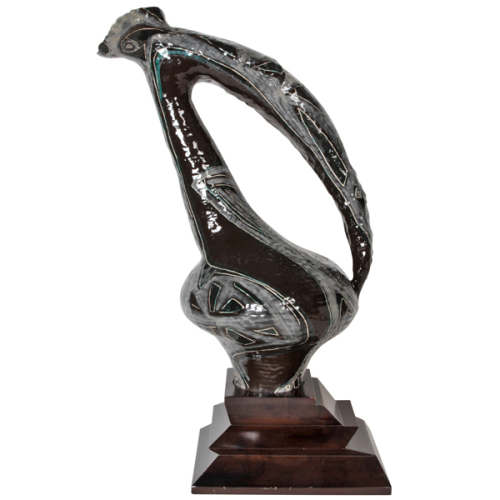
Salvatore Meli Important large scale Italian Sculpture / Ewer 1952
SALVATORE MELI (b. 1929) Italy
Important Sculpture / Ewer 1952
Glazed terra cotta, brown and dark green with white scraffito decoration, original stepped and angular wood base.
Signed: Meli 1952 Roma
For more info on Meli see: Design 1935-1965, What Modern was, ed. Martin Eidelberg (New York: Harry Abrams, 1991) p. 237.
Salvatore Meli belongs to that initial group of artists, including Guido Gambone and Lucio Fontana among others, who elevated Italian ceramics to a fine art during the post-war period. Meli conceived this vessel, first on paper, then by laboriously constructing the body in clay, coil by coil, to achieve the richly textured and dynamic form; the incised and painted decoration is in concert with the organic shape. The massive scale of this work defies function as a ewer but was created as a sculptural object. The original wooden base recalls Italian futurist sculpture forms of the early twentieth century.
H (with base): 23 1/2” x W: 13” x D: 9.5”
H (without base): 19 1/8”




 @hd_jewels