
Product Description
Flavio Poli / Seguso Vetri d’Arte Murano Mid-Century Modern art glass vase c. 1950’s



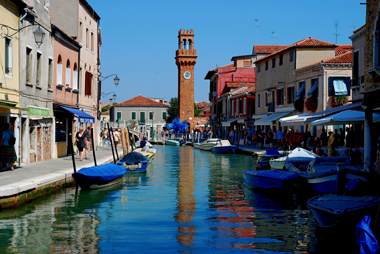
FLAVIO POLI (1900-1984) Italy
SEGUSO VETRI D’ARTE Italy
Vase c. 1950’s
Blue and clear Murano glass
H: 10″ x D: 3″ x W: 4 1/2″
Price: $1,850
Designer, businessman, ceramic artist. Born in Chioggia, he attended the Istituto d’Arte di Venezia and began work as a designer in ceramics. in 1929 he switched to glass and for Libero Vitali’s I.V.A.M. he designed animals, splendid Novecento-style nude figures in massiccio glass, as well as bowls and urns with figures resting on the inside, on lids or as handles. He subsequently collaborated with the Compagnia di Venezia e Murano, with the furnace of Mario and Lino Nason and with the engraver Gino Francesconi. in 1934 he accepted the artistic direction of Barovier, Seguso & Ferro, later to become Seguso Vetri d’Arte, and became partner three years later. Together with the master of the principal team Archimede Seguso, Poli was the author of grandiose lighting installations, of corroded vessels, of sculptures in bulicante glass, of animals in massiccio glass shaped while hot, productions which represented a milestone in the development of Murano glass. At the height of his artistic maturity, in the years between 1950 and 1960 he designed a series of sommerso glass pieces in a Nordic style, essential forms and sharp cold colors, which were awarded prestigious prizes (Compasso d’Oro). After leaving Seguso in 1963, between 1964 and 1966 he organized the artistic glass division at the Societˆ Veneziana di Conterie e Cristallerie.
Flavio Poli / Seguso Vetri d’Arte Murano Mid-Century Modern art glass vase c. 1950’s
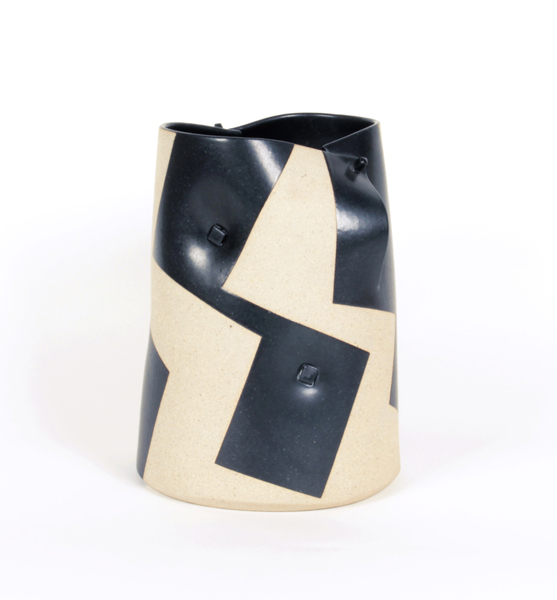
GUSTAVO PEREZ Mexico
Stoneware vase 2000
Black, randomly positioned rectangles on a cream / sandy base with a pinned overlap detail
Signed: GP 2000-68
H: 9 1/4″ x D: 6 1/2″
Price: $5,500
Gustavo Pérez makes vessels that are simple, smooth and symmetrical. Their elegance is due to the precision of the incised lines and other markings on the pots. While using the same clay body—sand colored stoneware—throughout his work, the artist achieves a wide range of form and pattern and includes slowly undulating walls beneath the subtly incised surfaces.
Gustavo Pérez works are incessantly experimental. There have been parallel lines, calligraphic traces, geometric cuts into the surface, minimalist vessels, recollections of pre-Hispanic vases and references to other ancient cultures.
The ceramics of Gustavo Pérez are distinguished by eliminating superfluous details, by synthesis of his elements. During the past two decades he has created a visual language that seems closely aligned with music. Pure in form, with a significant structure, completely abstract and without specific associations, his language of line, the bending of forms, and the definition of the vessel mark his work as a distinctive voice. The form is not just a container or a receptacle; it is architecture.
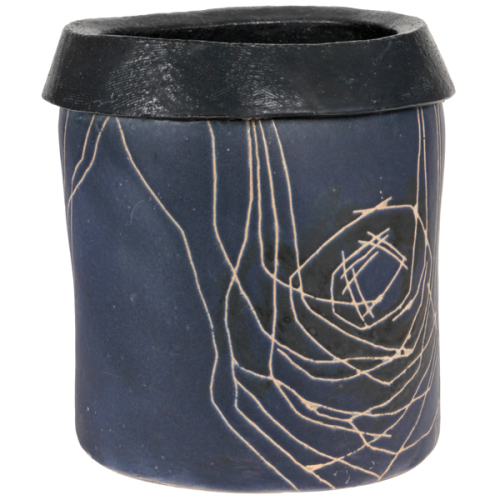
LUKE LIETZKE (1906-2000), USA
LIETZKE DESIGNS Mogodore, Ohio
Large floor vessel c. 1955-1960
Blue glazed stoneware cylindrical vessel which has been shaped at the top into an elliptical form; the black glazed lip is rolled over with a flaring collar-like edge and the body is decorated with an abstract incised sgraffito line decoration.
Signed on bottom: Lietzke (inscribed in oval)
H: 15″ x W: 14″ x D: 13″
Price: $17,500
Luke Lietzke studied art at Michigan State University and the Art Institute of Chicago. At Michigan State she met her husband and life-long partner in design, Rolland. They moved to Ohio when Rolland accepted a job with Goodyear Aerospace and in 1942, when Rolland took a job with Firestone, they moved to Akron, Ohio. It was there that Luke volunteered at the Akron Art Museum. This position quickly developed into a design curator’s position created especially for her. Her memorable exhibits included such notable artists as Charles Eames, George Nelson and Isamu Noguchi. In 1964 she left the Museum and for a short period worked as a design coordinator. In 1966, she and her husband created their own company where she functioned as an exhibition designer, an interior design consultant and most significantly: a designer craftsman. Her porcelain pieces consistently received exhibition awards since 1948 and are included in six museum collections. Her talents would often combine to develop special projects, such as the design for the Akron-Summit County Public Library. Both her pottery and jewelry reflect her wealth of knowledge as well as her exposure to the world of International art.
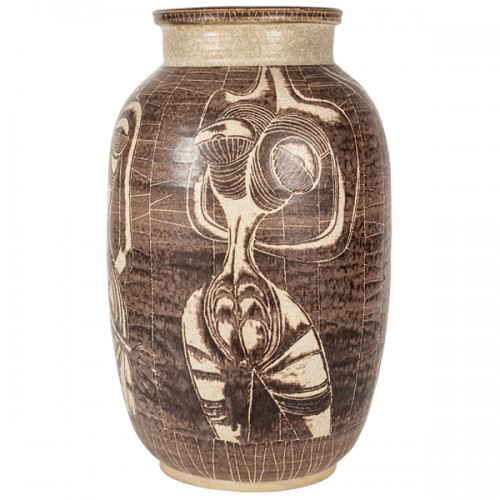
AARON BOHROD (1907-1997) USA
F. CARLTON BALL (1911- 1992) USA
“Eve” vase 1952-56
Monumental glazed stoneware vase with a brown and cream beige glaze with sgraffito decoration of four stylized nudes.
Signed: A. Bohrod F.C. Ball (inscribed)
Illustrated: Aaron Bohrod: Figure Sketches, Edwin E. Elliott and Howard E. Wooden (Dodge City, Kansas: Gall and Shaull, 1990) p. 17, fig. 32. A Decade of Still Life: Aaron Bohrod (Madison, Wis.: University of Wisconsin Press, 1966) p. 41.
H: 20 3/4 x Dia: 12 1/2″
Price: $29,000
***Aaron Bohrod himself considered this vase his most important work in ceramic. This exact vase is illustrated in “A Decade of Still Life: Aaron Bohrod” in a bisque state. There is a stable firing crack that is visible on the base (see photo) near the Bohrod signature which happened in the firing, but in no way affects the structure of the piece. A letter from Aaron Bohrod himself describing this piece and the history surrounding it also accompanies the vase.
For more information see: The Potter’s Art in California: 1885-1955, Hazel V. Bray (Oakland: Oakland Museum Art Department, 1980) pp. 56-57.
A painter of cityscapes, landscapes and trompe l’oeil paintings, Aaron Bohrod lived in Chicago from birth until 1948, when he moved to Madison, Wisconsin. There he was a member of the University of Wisconsin’s art faculty. Bohrod was a graduate of the School of the Art Institute of Chicago, and he also attended the Arts Students League in New York.
Aaron Bohrod was an American artist who was nationally known in his lifetime. He was the subject of frequent exhibitions and gallery shows in various locations, generally focusing on a particular chronological period of his artistic production. The recipient of numerous prizes and awards (including two Guggenheims and the purchase prize at the “Artists for Victory” exhibition of 1942-43 at the Metropolitan Museum in New York), he was both proficient and prolific as a painter, sculptor, printmaker, ceramicist and as an illustrator. In addition, he was the author of several books on art and an autobiography. Although he studied at the Art Institute of Chicago and the Art Students League in New York with a number of well-known and influential teachers, the one who exerted the most profound influence on him was John Sloan, who taught him to value both the Old Masters and the visual reality of the urban American scene. Bohrod returned to Chicago after studying with Sloan in New York “determined to do in my own way with my own city what Sloan had done with New York.” (Bohrod’s stylistic development has been typically characterized in terms of his early relationship to the gritty urban realism of the Ashcan School with which Sloan was associated and his later magic realism style with its virtuoso and meticulous technique and witty visual repartee, almost as if they were two separate and unrelated developments. Although his own description of the origins of his unique still life approach in his autobiographical book, A Decade of Still Life, may have guided critics to look at his oeuvre in this way, a closer assessment reveals clear connections between the earlier and alter periods. Before 1940, for example, he had created a prototype of the still lifes that were to become his hallmark. By the mid 1950s, he began to dedicate himself to the creation of paintings that are by turns resonant, mysterious, evocative and humorous. The studied and careful detail of the bricks on the buildings foreshadow the care that Bohrod will lavish on each of the carefully observed and realized objects in his later still lifes, while the anecdotal detail predicts the accumulation of objects on which his later work depends. The polished and masterful technique of this later work also suggests the Old Masters to whom he was introduced by Sloan.
F. Carlton Ball (1911-1992)
F. Carlton Ball was born in Sutter Creek, California, He studied art at Sacramento Junior College before enrolling at USC. He graduated from the University of Southern California in 1933. He later did graduate studies under Glen Lukens at USC. He taught at several colleges/universities, such as the CCAC (his first position in 1935), Mills College, University of Wisconsin at Madison, University of Southern Illinois at Carbondale, USC University of Puget Sound and etc. From our research, we believe his last teaching position was in Tacoma, Washington, at the Tacoma Community College. Primarily known for his throwing, he did combine his pots with the decorative artistry of his first wife Kathryn Uhl Ball and most importantly, the Wisconsin artist, Aaron Bohrod. He exhibited at the Association of San Francisco Potters, 1952 Los Angeles County Fair’s 6000 Years Art in Clay and the Crocker-Kingsley of Sacramento, California, to mention a few locations. Exhibited at the Nationals in 1941-1949, 1951-1960 and 1966.
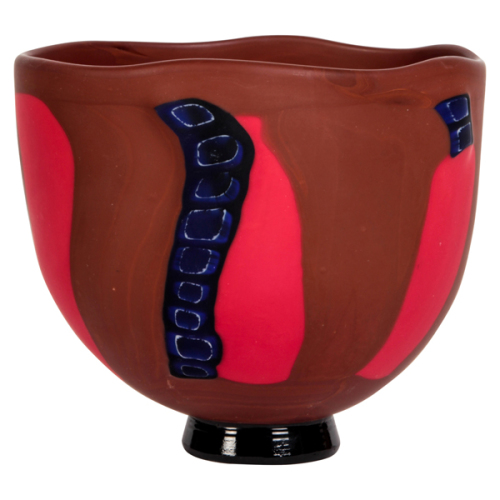
Tsuchida Yasuhiko (b. 1969) Osaka, Japan/ Italy
Art glass mosaic technique vase 1999
Overall matte finish art glass vase with an elaborate mosaic technique inset with red rectangular patchwork sections and blue murrina jewels all on a chocolate brown body with a black glass foot
Marks: Tsuchida Yasuhiko 99, 77
For more information see: Tsuchida Yasuhiko, exh. cat., Franco Schiavon (Murano, Italy: Palazzo del Vetro, 2000).
Provenance: Pauly & Co. Venice
H: 4 3/4″ x Dia: 5 1/8″
Price: $5,450
Yasuhiko Tsuchida was born in Osaka, Japan in 1969. In 1988, soon after graduating TSUJI Culinary Institute, he left Japan to explore food and art in Paris. Since 1992, he has lived in Venice, Italy. Tsuchida has been making glass work in Murano Island since 1995, and next year assumed the office of art director at Schiavone Glass Co. Ltd. In 1996 he presented a glass sculpture entitled “Bamboo Collection” with Japanese motif of bamboo. The work was highly acclaimed, which gave him a chance to start to hold solo exhibitions around the world. In 2000, Tsuchida became a member of the board of directors at Venetian Glass Institute, and a chief director there in 2003. In 2004, he won Honorary Technique Prize in Düsseldorf, Germany, and in 2008, received Award of Contribution to Cultural Promotion from Grosseto city, Toscana. In the same year, he represented Japan at International Open Exhibition of Sculpture, and won the Grand-Prix. In 2010, Tsuchida was invited to the Issei Miyake “IM10” Project Competition, and held a solo exhibition at Lorusso Gallery, Andria, Italy. Tsuchida continues to exhibit in many solo shows around the world.
 @hd_jewels