Product Description
Theodore B. Starr (attr.) American Art Nouveau brooch, 18k gold with two large oval cabochon emeralds, one tear drop emerald with 144 old European round cut diamonds and six small cabochon emeralds, c. 1900

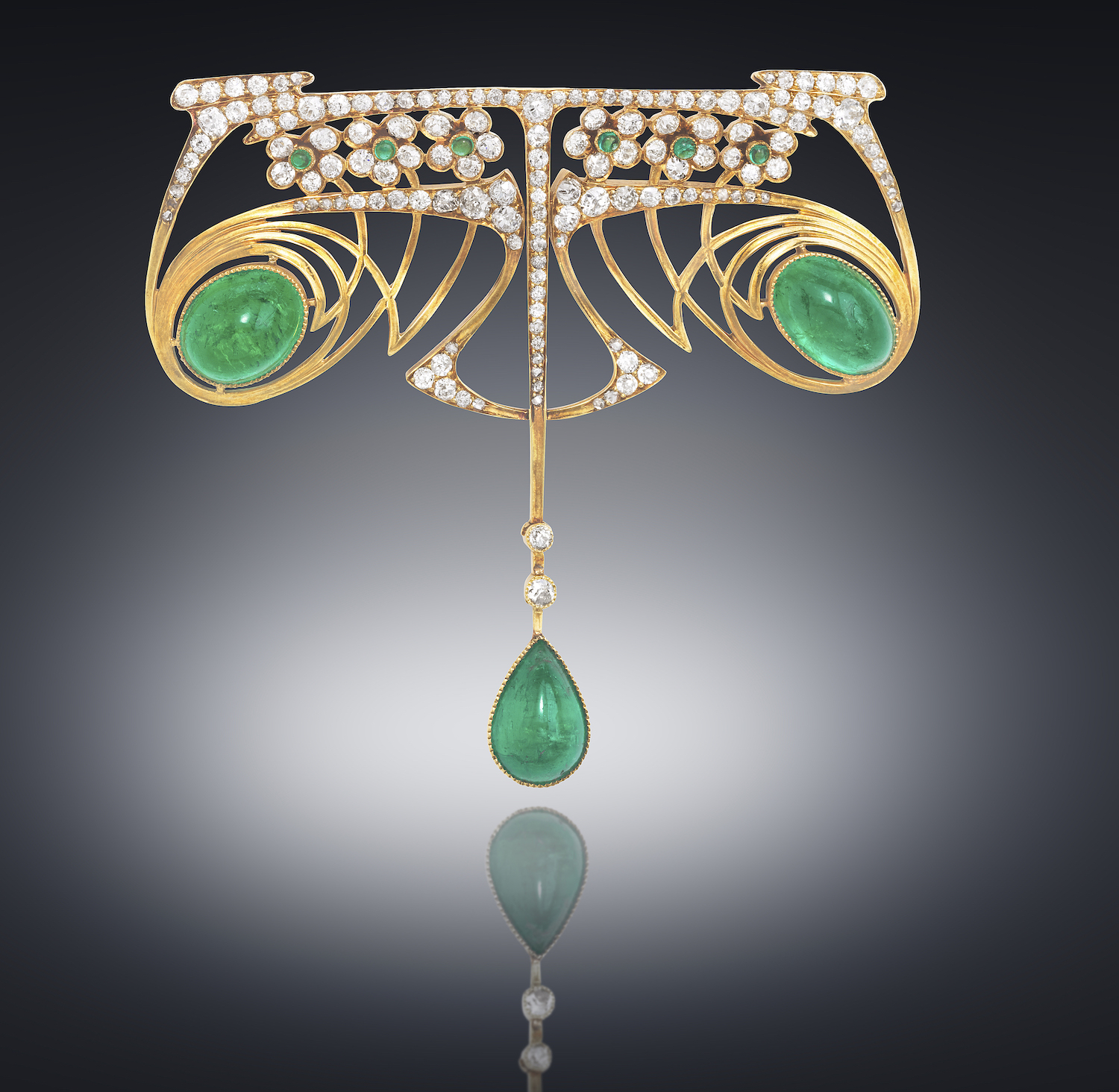
Theodore B. Starr (attr.) American Art Nouveau brooch, 18k gold with two large oval cabochon emeralds, one tear drop emerald with 144 old European round cut diamonds and six small cabochon emeralds, c. 1900

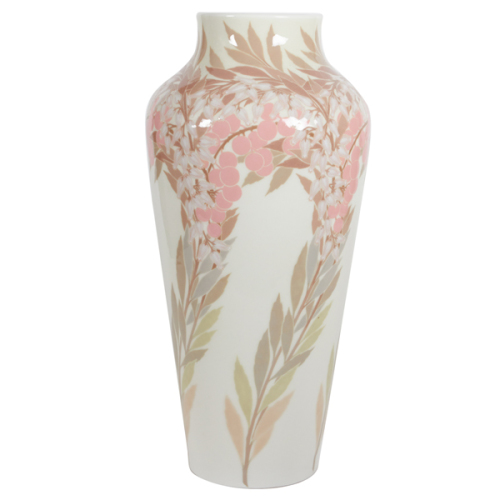
AMÉDÉE DE CARANZA (active 1875-1914) (b. Turkey / active France)
COPILLET ET CIE Noyon
Nasturtium vase 1903-1906
Blown glass with floral & foliate luster decoration handpainted on a muted iridescent ground.
Signed: A. de CARANZA (on the side near base)
Marks: Copillet et Cie, Noyon, 842 (twice)
For more information and related illustrations: European Art Glass (New York: Ray & Lee Grover, Charles E. Tuttle Publishers, Inc., 1970) pp. 69, 94-96; L’Art Du Verre En France 1860-1914, Janine Bloch-Dermant (Edita Denoel, 1974) pp. 36-37; Glass: Art Nouveau to Art Deco, Victor Arwas (New York: Abrams, 1987) pp. 56-58; L’Europe de L’Art Verrier, des Precurseurs de l’Art Nouveau a l’Art Actuel 1850-1990, Giuseppe Cappa (Liège: Mardaga, 1991) pp. 72-74.
H: 10″
Copillet, H.A. Thomas Henri Alfred Copillet was originally a printer, and produced a local newspaper in Paris. When he moved his works to 13 Fauburg de Paris he acquired a kiln in the process, and thus in 1903 was began a new glass works. His designers were Amedee de Caranza and Edouard de Neuville. They produced a whole range of Art Nouveau glassware, many with a dark iridescent finish. They also produced opaline glass, and glass panels for use in church windows. The company went bankrupt in 1906, although the new management (Lefevre and Lhomme) kept a little of the production going for a while, the factory was destroyed during the First World War.
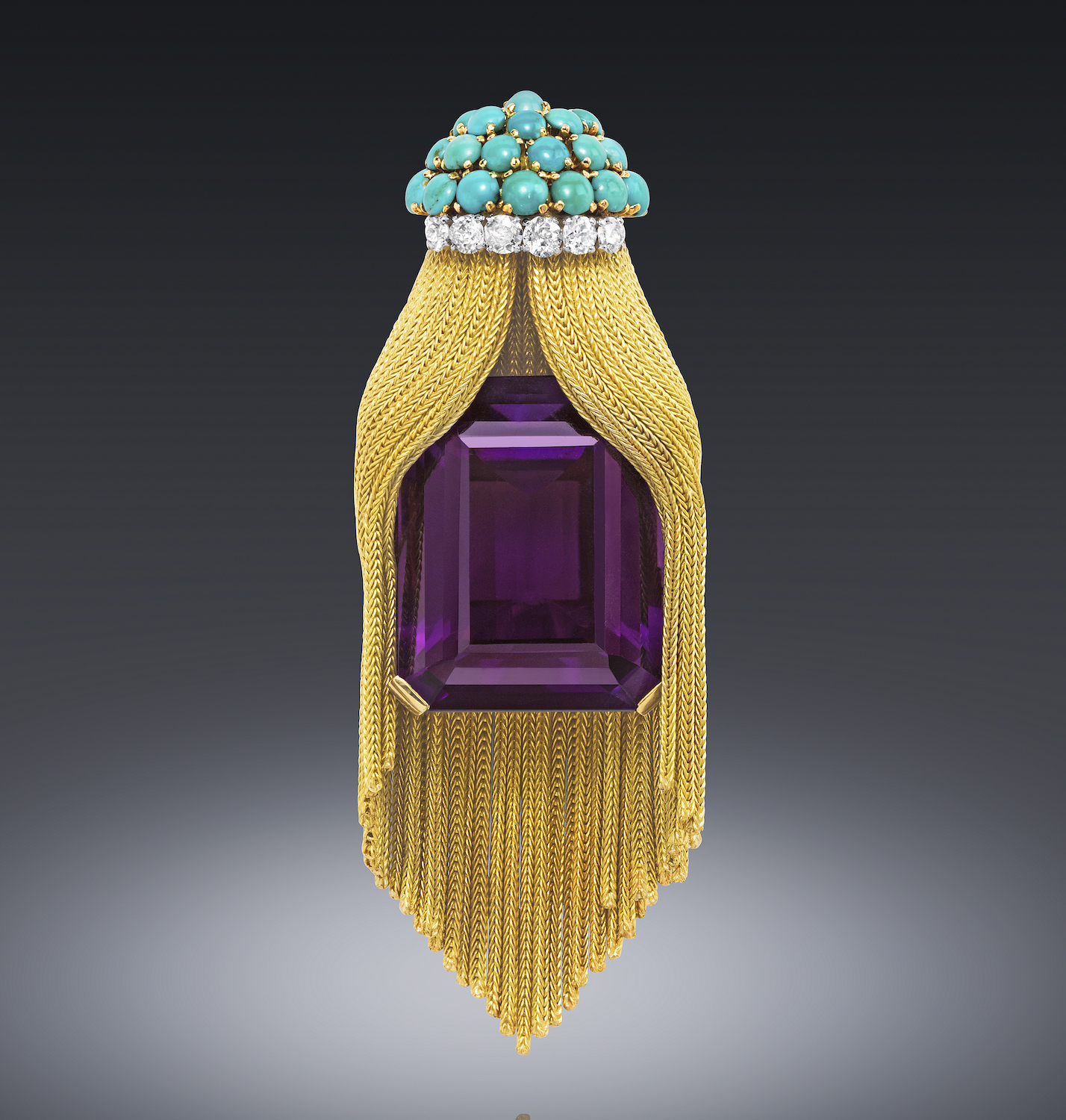
***This is a closely related “Grape” cluster clip/brooch model that Seaman Schepps made on commission for the eminent socialite Doris Duke (Collection Seaman Schepps, but there is a predominance of dark blue and purple cabochon sapphires in the DD brooch as opposed to the predominance of larger and more translucent cabochon sapphires as well as cabochon emeralds in this example
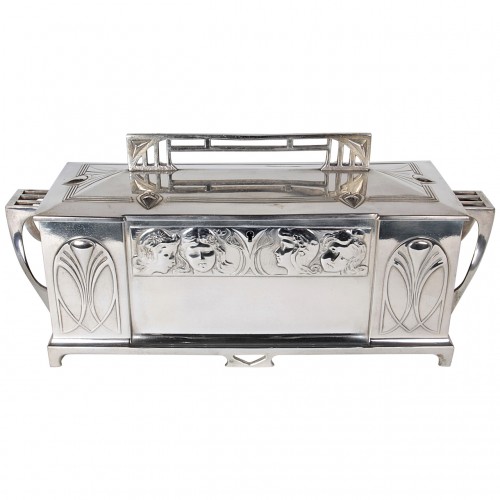
WMF [Württembergische Metallwarenfabrik] Germany
“Four Seasons” Art Nouveau Jewelry box c. 1900
Silver plate with Jugendstil design buttress handles and open work handle with a frieze of Art Nouveau maidens representing the four seasons, velvet lined with two original keys.
Marks: WMF mark, I/O (in a box), E
For more information see: WMF: Glas, Keramik, Metall, 1925-1950, Jörg Schwandt (Berlin: Kunstgewerbemuseum, Staatliches Museum Preussischer Kulturbesitz, 1981); Metallkunst, Band IV (Berlin: Brohan-Preussischer Kulturbesitz, 1981) pp. 546-579.
H: 7 1/2″ x W: 17″ x D: 5 1/2″
Price: $3,500
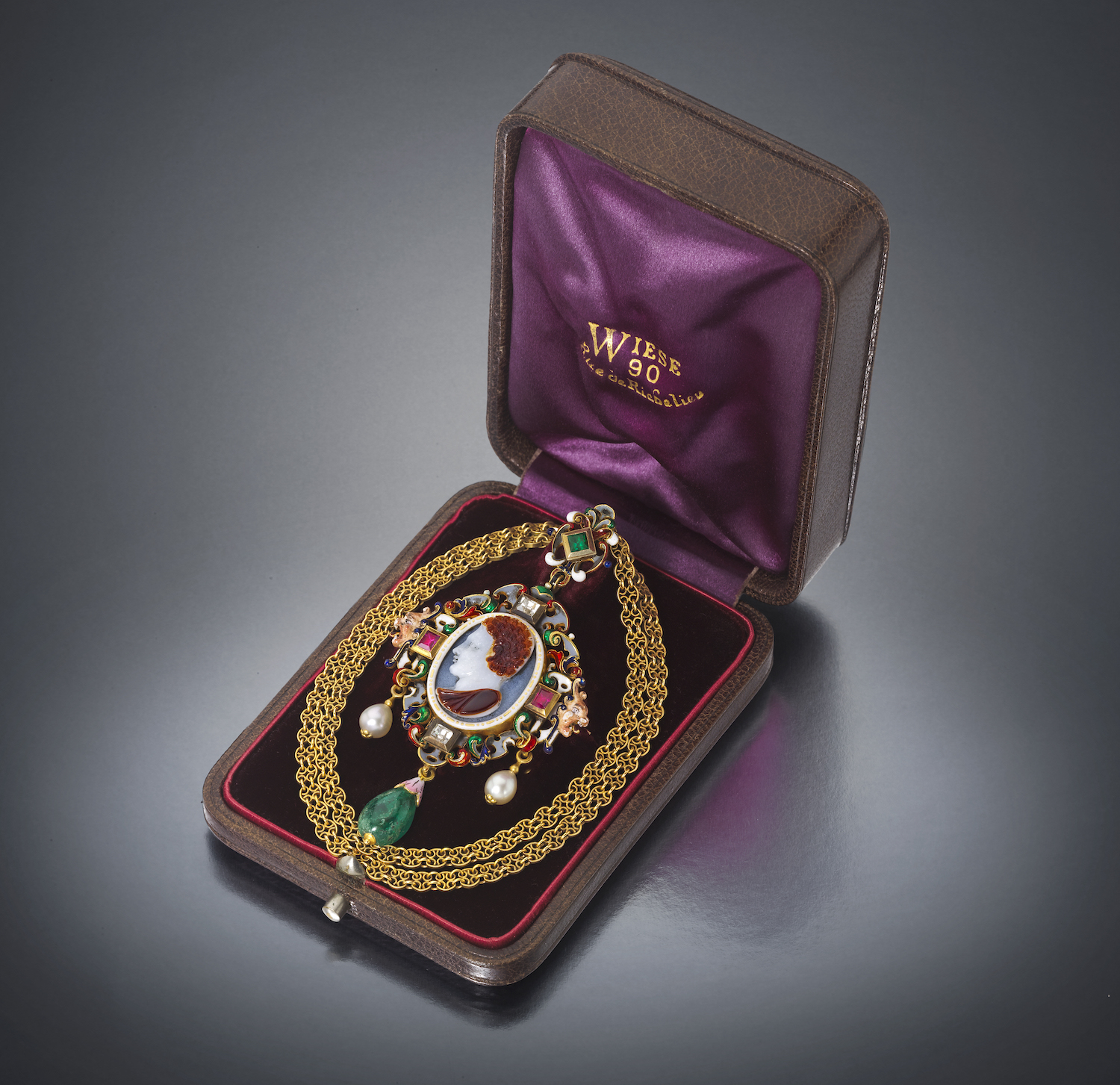
A goldsmith and jeweler, Louis Wiese (Berlin 1818 – Paris 1890) began his career in Berlin where he served his apprenticeship before moving to Paris to work for J.V. Morel and then more significantly with F.D. Froment-Meurice, with whom he established a close bond. Weise opened his first atelier rue Jean-Pain-Molet in 1844 and worked exclusively for Froment-Meurice, as ever a supporter of Wiese’s work, he pushed for Wiese to receive the collaborator’s medal at the Exposition of 1849. Jules Wiese eventually worked for many of the top manufacturing jewelers and went on to win a first-class medal at the 1855 Exposition and a medal of honor at the 1862 Exhibition in London. M. Magne was quoted as follows when discussing Jules Wiese in light of the 1855 Exposition, “fine goldsmith and jeweler with an already distinguished reputation which can only be enhanced by his display. The importance of his pieces and his brave experiments reveal, even in the most modest work, an awareness of art and beauty which deserves to be encouraged by the jury.” Louis, Jules’ son, took over the company in 1880, continuing the reputation for fine craftsmanship and artistry that his father had established.