Product Description
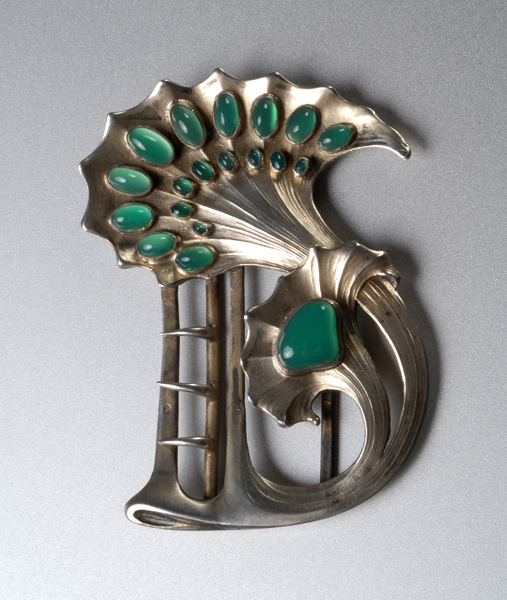
Theodore B. Starr (attr.) American Art Nouveau brooch, 18k gold with two large oval cabochon emeralds, one tear drop emerald with 144 old European round cut diamonds and six small cabochon emeralds, c. 1900

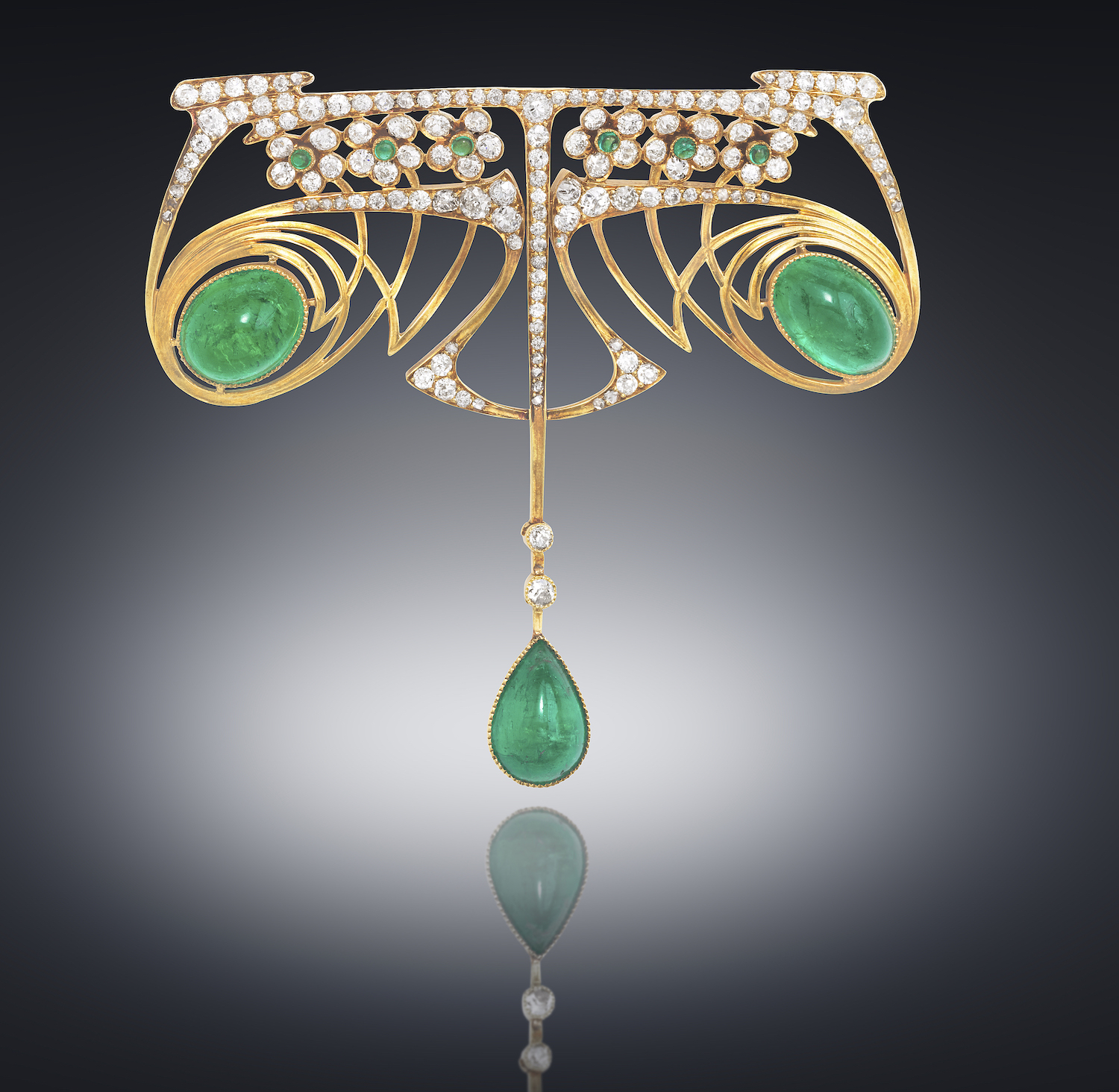
Theodore B. Starr (attr.) American Art Nouveau brooch, 18k gold with two large oval cabochon emeralds, one tear drop emerald with 144 old European round cut diamonds and six small cabochon emeralds, c. 1900

CHRISTIAN THOMSEN (1860-1921) Denmark
ROYAL COPENHAGEN
“Frog and Dragonfly” vase 1901
Glazed porcelain with a frog in 3-D sculptural relief looking at a dragonfly seated on a calla lily leaf looking up at the blossom.
Form number 280
Marks: ROYAL COPENHAGEN, CROWN, 465/250, 3 wavy lines (Royal Copenhagen) insignia, inscribed A. 250
For more information see: Musterbuch KPF, um 1930, Illustration number 204; Porzellan, Kunst und Design 1889 bis 1939, vom Jugendstil zum Funktionalismus (Berlin: Bröhan-Museum, 1993) p. 467, ill. 435; Sammlung Bröhan: Kunsthandwerk 2, Metall, Porzellan (Berlin: Bröhan Museum, 1977), pp. 222-285.
H: 9″ x Dia: 3 1/2″
Christian Thomsen was employed at the Royal Porcelain Manufactory (Royal Copenhagen) in 1898, and was employed there until his death in 1921. Thomsen is said to have had a huge impact on Royal Copenhagen’s success throughout the 20th century. A large part of the recognition by the Royal Porcelain Factory has enjoyed over the years, they can thank Christian Thomsen for. He produced more than 100 different figurines, especially he had a fondness for agricultural characters, children figurines, figurines inspired by Hans Christian Andersen’s fairy tales, fauns and trolls, and not least charming animals and bird figures.
AMÉDÉE DE CARANZA (active 1875-1914) (b. Turkey / active France)
COPILLET ET CIE Noyon
Nasturtium vase 1903-1906
Blown glass with floral & foliate luster decoration handpainted on a muted iridescent ground.
Signed: A. de CARANZA (on the side near base)
Marks: Copillet et Cie, Noyon, 842 (twice)
For more information and related illustrations: European Art Glass (New York: Ray & Lee Grover, Charles E. Tuttle Publishers, Inc., 1970) pp. 69, 94-96; L’Art Du Verre En France 1860-1914, Janine Bloch-Dermant (Edita Denoel, 1974) pp. 36-37; Glass: Art Nouveau to Art Deco, Victor Arwas (New York: Abrams, 1987) pp. 56-58; L’Europe de L’Art Verrier, des Precurseurs de l’Art Nouveau a l’Art Actuel 1850-1990, Giuseppe Cappa (Liège: Mardaga, 1991) pp. 72-74.
H: 10″
Copillet, H.A. Thomas Henri Alfred Copillet was originally a printer, and produced a local newspaper in Paris. When he moved his works to 13 Fauburg de Paris he acquired a kiln in the process, and thus in 1903 was began a new glass works. His designers were Amedee de Caranza and Edouard de Neuville. They produced a whole range of Art Nouveau glassware, many with a dark iridescent finish. They also produced opaline glass, and glass panels for use in church windows. The company went bankrupt in 1906, although the new management (Lefevre and Lhomme) kept a little of the production going for a while, the factory was destroyed during the First World War.
Friedrich Gornik (1877-1943) Austria.
“Pelicans” vide poche c. 1910.
Bronze with a natural gold patina of two pelicans on a rock, one seated and the other eating fish.
Marks: F Gornik and monogram.
For more information on Friedrich Gornik see: Der Österreichische Werkbund, Astrid Gmeiner & Gottfried Pirhofer (Salzburg & Wien: Residenz Verlag,1985) p. 228; Österreichische Keramik des Jugendstils, Waltraud Neuwirth (Munich: Prestel-Verlag, 1974) p. 156.
H: 9″ x W: 6 1/2″ x D: 6″
SCANDINAVIAN ART NOUVEAU
“Wisteria” bronze photo frame c.1910
Elaborately detailed, acid etched and multi-patinated bronze table top photo frame with gilt details of a cascade of wisteria blossoms, leaves and vines.
Overall Frame: H: 12” x W: 7 ½”
Oval photo window opening H: 5 ½” x W: 4”
Price: $3,650