Product Description
Cartier, Paris “Elephant” Maillon Panthere bracelet in 18k gold and set with 200 round cut diamonds and three round cut emeralds for the eyes, signed, c.1980’s

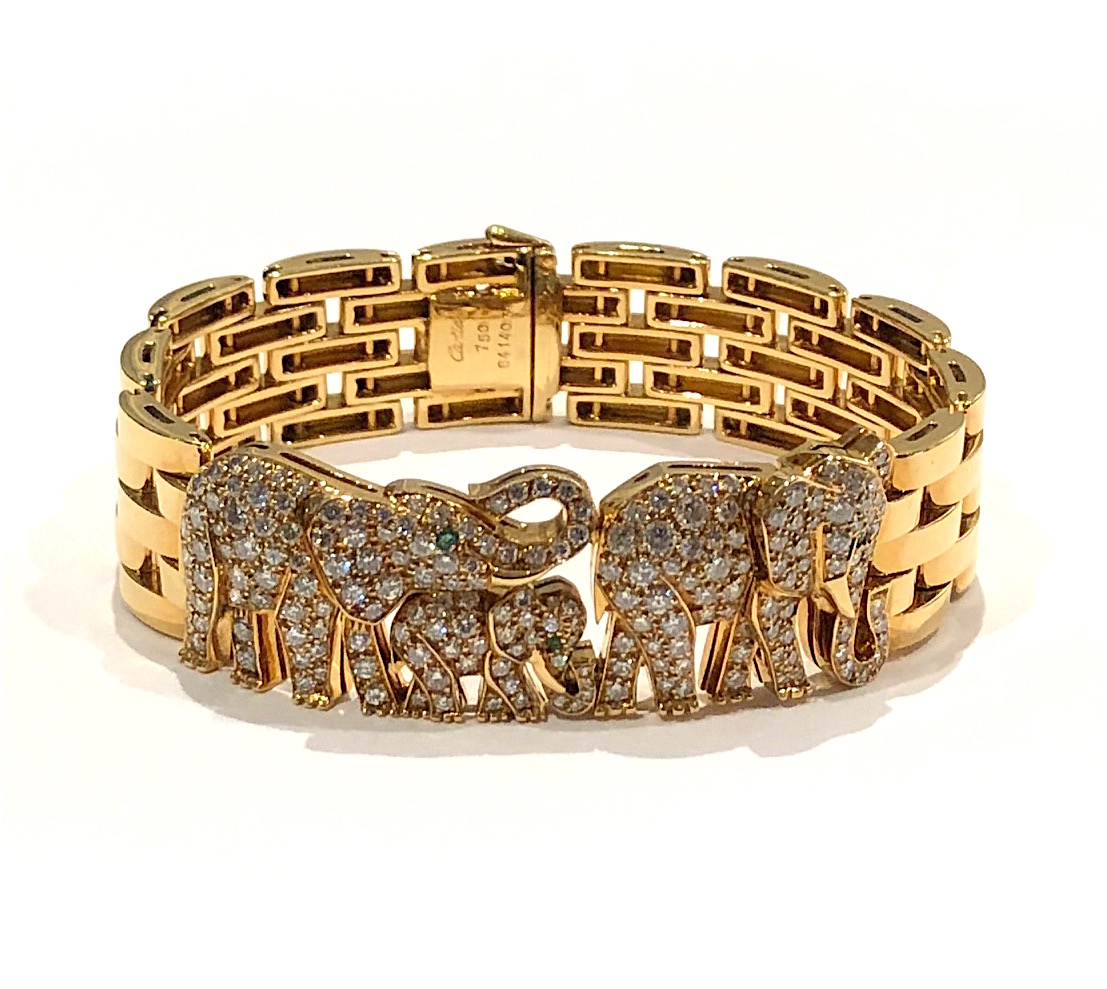
Cartier, Paris “Elephant” Maillon Panthere bracelet in 18k gold and set with 200 round cut diamonds and three round cut emeralds for the eyes, signed, c.1980’s
LAWRENCE HUNTER, San Diego, California
Punch Bowl set c.1965
Hand hammered and hand wrought large asymmetric punch bowl with matching ladle, turned walnut pedestal platter and twenty four hand wrought brass and walnut pedestal shape goblets
Marks: HUNTER spelled out within a large outline of an H (name logo and monogram mark on all pieces)
Punchbowl H: 13 ½” x Dia: 16”
Cups: H: 5” x Dia: 3 ½”
Serving tray: H: 2 ¾” x Dia: 17 ¾”
Price: $11,500
By repute, this elaborate punch set was a custom commissioned work for a West Coast collector and likewise was purchased directly from Larry Hunter in the mid-1960’s for $2,500.
Lawrence “Larry” Hunter grew up in San Diego and received a BA from San Diego State College in the late 1950s. As an undergraduate, Hunter studied with John Dirks, who founded the furniture design program at San Diego State College, and Ilse Ruocco. While completing an MA at University of California, Los Angeles, Hunter worked in clay and was a teaching assistant for Laura Andreson. Hunter was hired to teach general crafts and design classes at San Diego State in 1962, and later inherited the furniture design program from Dirks.
Hunter was a member of the Allied Craftsmen of San Diego and exhibited furniture regularly in the California Design series at the Pasadena Art Museum and the California Crafts series at the Crocker Art Gallery in Sacramento. Hunter led the San Diego State furniture design program until the late 1980s, helping the furniture program to become a vital part of the community. Featured artists will include Toza and Ruth Radakovich, Rhoda Lopez, Jack Hopkins, Arline Fisch, Ellamarie and Jackson Woolley, Larry Hunter, Kay Whitcomb, Ilse Ruocco, and James Hubbell. It was at this same time that Constantine’s, a New York fine wood merchant, offered plans for clocks with wooden works; that John Gaughan made a skeletal grandfather’s clock with wooden works; and that Larry Hunter, who taught at San Diego State, used the clock form to explore kinetic sculpture within a functional format. Hunter eschewed the older traditional adornment of the case and focused upon visible works so that people could watch time actually move.
JAIPUR, MUGHAL INDIA
Enameled and gem set gold Cup and Saucer c. mid-19th Century
High carat yellow gold (22-24 carat) cup and saucer set with a fine emerald, ruby and diamonds, the cup with a high foot with rounded sides and handle formed of two snakes intersecting at three points and biting the rim. The exterior is decorated with red, green, blue and white enamels with roundels containing combatant animals on a ground of floral sprays, the saucer with gently rounded sides decorated with lobed cartouches containing warriors combating tigers and birds, the underside with a series of oval panels containing peacocks and hummingbirds.
Provenance: a gift from a European diplomat in the 1930’s-40’s, and thence by descent.
Saucer: Dia: 5 1/4;
Cup: H: 2 3/4″ (with handle) x Dia: 2 5/8″
Similar animal decoration can be found in an epaulette attributed to Rajesthan, probably Jaipur, in the Khalili Collection (Pedro Moura Carvalho, Gems and Jewels of Mughal India, London, 2010, p. 225, no. 120. A related cup and saucer with similar animal depictions was sold at Christie’s (Islamic Art, Indian Miniatures, Rugs and Carpets, London, 21st October 1993, lot 350.