Product Description
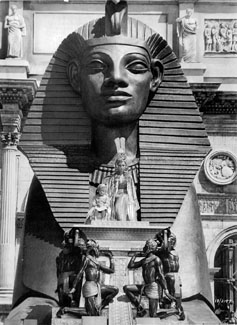
Paul-Auguste Gagné, French Egyptian Revival Gilt Bronze Garniture Set c. 1875

Paul-Auguste Gagné (Sculptor) France
Egyptian Revival garniture set, circa 1875
Gilt bronze and carved rouge marble mantle clock and candelabra in a high Egyptian Revival style
Marks: P.A. Gagne (elaborate incised scroll signature on the back of the portrait bust)
For more information on Gagné see: Dictionnaire des peintres, sculpteurs, dessinateurs et graveurs, vol. 4, E. Bénézit (Paris: Librairie Gründ, 1976) p. 579.
For other related Egyptian Revival garniture sets see: Egyptomania: Egypt in Western Art, 1730-1930 (Paris: Éditions de la Réunion des Musées Nationaux and Ottawa: National Gallery of Canada, 1994)
H: 20 3/4″ x D: 6 3/4″ x W: 14 1/2″
Paul-Auguste Gagné, French Egyptian Revival Gilt Bronze Garniture Set c. 1875
Friedrich Gornik (1877-1943) Austria.
“Pelicans” vide poche c. 1910.
Bronze with a natural gold patina of two pelicans on a rock, one seated and the other eating fish.
Marks: F Gornik and monogram.
For more information on Friedrich Gornik see: Der Österreichische Werkbund, Astrid Gmeiner & Gottfried Pirhofer (Salzburg & Wien: Residenz Verlag,1985) p. 228; Österreichische Keramik des Jugendstils, Waltraud Neuwirth (Munich: Prestel-Verlag, 1974) p. 156.
H: 9″ x W: 6 1/2″ x D: 6″
NIGERIA
Benin Head of King Oba, c. early to mid-20th Century
Lost wax cast bronze with a rich brown and black patina with light desert sand patina in some of the recessed areas.
The art of Benin is the product of an urban royal court, and is meant to symbolize and to extol the power, mystique, grandeur, continuity, and endurance of the ruling dynasty and its governing institutions. From the 14th century until its fall in 1897, Benin was ruled by the Oba, a divine ruler at the head of the political system of titled chiefs. Under royal support, a number of craftsman’s guilds produced bronze, brass, and wood sculptures and embroidered cloth, all of which have become prized by museums and collectors.
These heads were typically placed on altars dedicated to each of the past Oba’s of Benin. The altars are semicircular mud platforms that have been packed hard and rubbed smooth and are located in open courtyards of the palace. The royal altars are the settings for one of the two most important rites of divine kingship in Benin, Ugie Erha Oba, when the Oba honors the spirit of his late father and performs sacrifices to the royal ancestors and to the earth in which they are buried. Acknowledging his role as his fathers’ successor, the chiefs pay homage to the king and greet him in order of seniority. The rite expresses the continuity of divine kingship, and the altar before which it takes place provides the means by which the connection between the living king and his predecessors was established and made.
H: 14 1/2″ x D: 7 1/2″ x W: 8 1/2″
Franz Xaver Bergman (1861–1936) (attr.) Vienna, Austria.
Bull pen wipe c. 1900
Cold painted bronze, boar’s hair bristles, horn.
For information see: Art Bronzes, Mich. Forrest (Schiffer, 1988).
H: 5 1/4” x L: 11”
Franz Xaver Bergman (1861–1936) was the owner of a Viennese foundry who produced numerous patinated and cold-painted bronze Oriental, erotic and animal figures, the latter often humanized or whimsical, humorous objects d’art.
A well-known anamalier at the turn-of-the century, the sculptor Franz Bergman created a number of small bronzes in a variety of subject matter. Other figurative works were informed by the Jugendstil/Art Nouveau style and the European taste for the exotic as is found in his figures of rug merchants and camels. His animal sculptures, however, capture the Viennese tradition of naturalistic bronzes. The quality of the bronze casting shows tremendous detail, which was carefully brought out through the applied patination process known as cold painting.
GUSTAV GURSCHNER (1873-1970) Austria
Vase c. 1905
Cast bronze ovoid shaped vase with decorative Celtic motif, lightly gilded, the body of the vase simulating leather with a rich brown patina
Signed: GURSCHNER, M180 (stamped in the bronze)
Related works illustrated: The Studio, Special Summer Number 1906: The Art Revival in Austria, ill. no. D6; Studio Yearbook (London, 1909), pp. 139-140; Vienna Turn of the Century: Art and Design, Fischer Fine Art, exhib. cat. (London 1979), p. 23, illus. 1; Bronzes, sculptors & Founders, H. Berman, (Atglen 1994 III) p. 781, cat. nos. 2893, 2894; Decorative Art 1880-1980, Dan Klein & Margaret Bishop (Oxford, England: Phaidon and Christie’s Limited, 1986) p. 84, illus. 1
H: 7 1/4″ x D: 7″ x D: 4″
Price: $14,500
Gustav Gurschner was born in Tirol, Austria. He attended the Fachschule für Holzindustrie in Bozen from 1885-1888. After three years, his instructors encouraged him to attend the Austrian Museum for Applied Arts’ Kunstgewerbeschule in Vienna. After finishing his formal training, Gurschner pursued a career as a sculptor of monumental works. It was while he was in Paris in 1897, that he first turned his energies from the application of small-scale, sculptural works to the aesthetic design of household objects. Shortly thereafter, he returned to Vienna to join the Secessionists whose ideals he shared. By the turn-of-the-century, Gurschner was not only one of the better known artists working in Vienna but enjoyed a reputation that extended into other European countries as well.