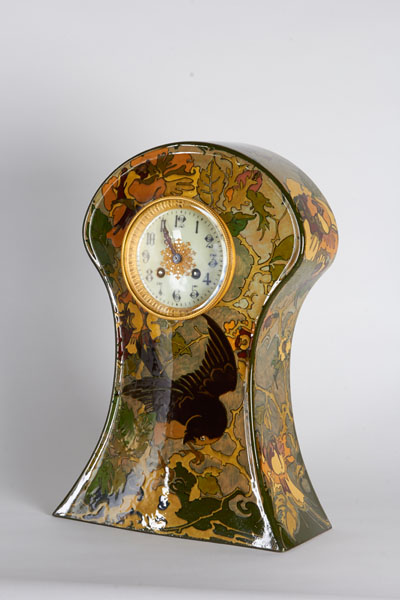
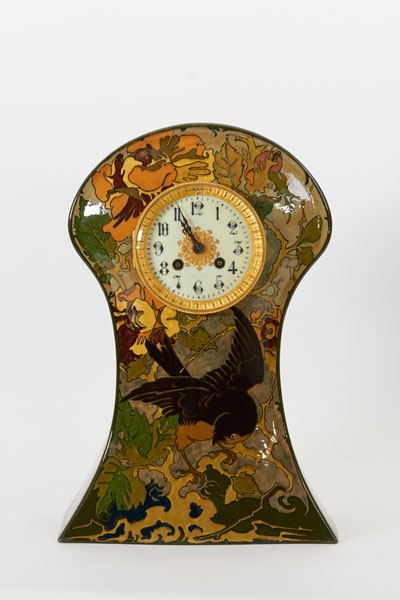
Rozenburg Pottery Holland, W.P. Hartgring Art Nouveau Mantle Clock, 1904
More Information
Rozenburg Pottery Holland, W.P. Hartgring Art Nouveau Mantle Clock, 1904
W. P. HARTGRING
ROZENBURG POTTERY The Hague, The Netherlands
Blackbird mantle clock 1904
Handpainted earthenware with exotic foliage and a bird, porcelain face, gilt bronze surround, original clock mechanism.
Marks: H (artist’s monogram) 534, Rozenburg den Haag trademark, date mark symbol for 1904
For more information see: Art et Décoration, vol. 8 (1900) 193, illus. p. 189 (A. Sandier, La ceramique à l’Exposition); Kunst und Kunsthandwerk, vol. 3. (1900) 395, illus. p. 392; Art et Décoration, vol. 9 (1901) 56 Abb. S. 54 (A. Sandier, La Ceramique à l’Exposition II); Der Moderne Stil, Julius Hoffmann, Vol. 3, (1901) Taf. 53.; La Kunstgewerbeblatt Neue Folge, Vol. 12. (1901) p. 95, Abb. S. 82,89; “The International Exhibition of Modern Decorative Art at Turin – The Dutch Section,” Enrico Thovez in The Studio, vol. 26 (1902), pp. 204-6; Kunst und Kunsthandwerk, Vol. 7 (1904), p. 568, Abb. S. 574-5, (K. Ruge, Kunst und Kunstgewerbe auf der Weltausstellung zu St. Louis); Art et Décoration, vol. 17 (1905) p.86 Abb. S. 77, 88 (G. Mourey, L’Art Decoratif Hollandais); Sprechsaal, Vol. 38, (1905) p. 517 (W.H. Zimmer, Die Weltausstellung in St. Louis; Rozenburg, Monographie einer Manufaktur 1883-1917, Marjan Boot et al. (Munich: Verlag Künst & Antiquitäten, 1984); Sammlung Bröhan: Kunsthandwerk 1-Jugendstil, Werkbund, Art Deco, Glas, Holz, Keramik, (Berlin: Karl H. Brohan, 1976) p. 367-380.
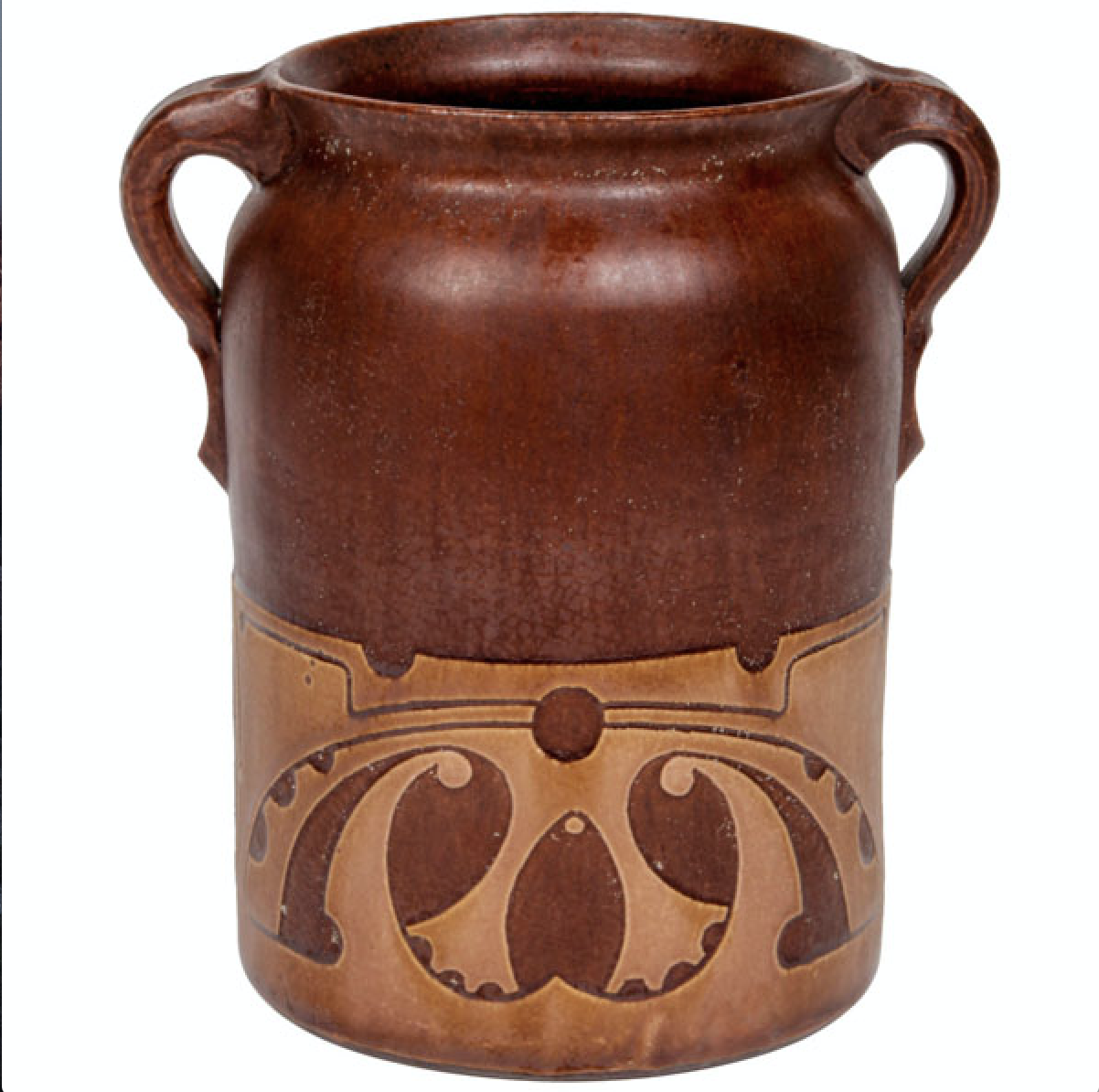
Willem Brouwer Dutch Art Nouveau / Arts & Crafts Pottery Vase c. 1905
WILLEM COENRAAD BROUWER (1877-1933) The Netherlands
POTTERIJ VREDELUST Leiderdorp, The Netherlands
Vase with handles c. 1905
Brown glazed red clay with tan light brown cut out overlaid and sgraffito decoration in a stylized organic motif, two applied looping handles
Marks: Brouwer 139 (incised)
For similar work see: Dutch Decorative Arts 1880-1940, eds. Titus M. Eliëns, Marjan Groot, Frans Leidelmeijer (New York: Battledore Ltd.,1997),p. 56; Leven in een verzameling: Toegepaste kunst 1890-1940 uit de collectie Meentwijck (Laren: Singer Museum, 2000), illus. 76, 77, p. 74.
For more information on Brouwer see: Art Nouveau en Art Deco in Nederland: verzamelobjecten uit de vernieuwingen in de kunstnijverheid van 1890 tot 1940, Frans Leidelmeijer and Daan van der Cingel (city unknown: Meulenhoff/ Landshoff, 1983), pp. 80-82.
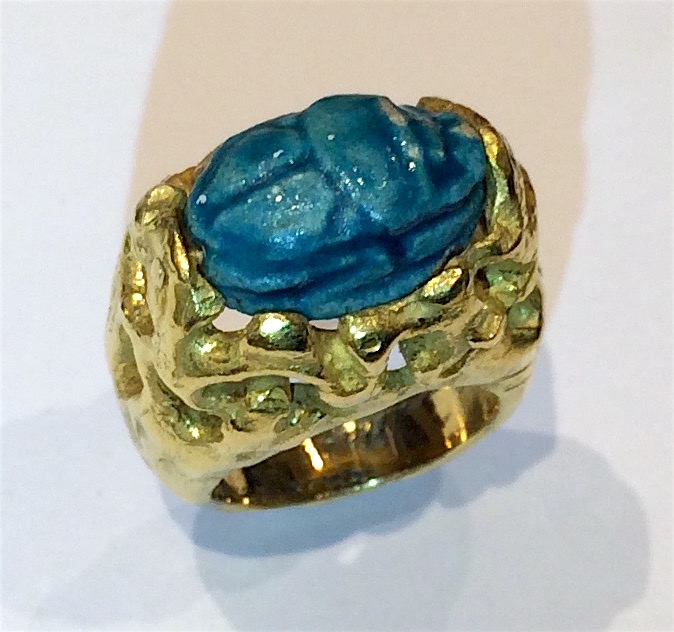
Franco Cannilla / Mario Masenza, Roma “Scarab” ring in an 18k gold expressionistic openwork mounting set with an ancient glazed pottery scarab, signed, c.1950’s
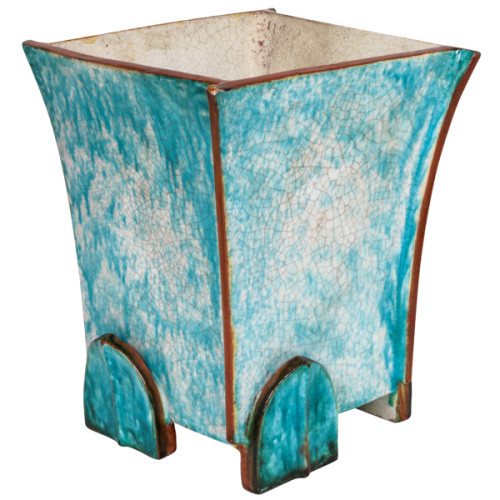
Münchner Werkstätten / Art Deco Large Glazed Pottery Vase c. 1928
MÜNCHNER WERKSTÄTTEN Germany
Vase c. 1928
Blue and white modeled glazed earthenware with orange red outlines
Marks: “M” over “W” mark, Germany
Provenance: Mr. Ernest L. King (Watkins) “Rockledge” Commission, Winona, MN c.1930’s Phillip Brooks Maher (interior architect), descended in the King Family to Bud (E. L. King Jr.) and Betty King, Winona, MN, Hollander Gallery, Milwaukee, WI, Private Collection, New York, NY
H: 9 ¾” x W: 8 ¼” x D: 8 ¼”
Price: $5,450
ROCKLEDGE, the summer home of Ernest and Grace King (the Watkins Family Company fortune was made from door-to-door sales of health potions and hygiene related products) was built and designed in its entirety from the expansive main home building with all of the furnishings to the custom silver service all the way down to the hand woven carpets and lace curtain designs, is arguably the most famous American Arts and Crafts commissioned home in America and was built and meticulously designed by George Washington Maher. It was finished in 1912, and was used by the Kings for the month of August only for a couple of decades before the interior was completely redone in the fashionable Art Deco design of the 1930’s. George Washington Maher’s son Phillip Brooks Maher, was hired for the project and went shopping for the best of the design of the period in both New York and Paris. He assembled a legendary collection of Art Deco design that comprised many important examples of both American and European Art Deco including the famous Donald Deskey square form telescope table, a Gilbert Rohde “Z” clock, a pair of Mies van der Rohe red lacquer and wicker armchairs, DIM furniture and rugs from Paris and rare Paolo Venini floor lamps and sculptural glass pieces among many other major 20th Century design works. This rare vase was indicative of the avant-garde furnishings throughout the King Home as well as the exquisite quality and attention to the detail of every single object that the Kings surrounded themselves with and became accustomed to enjoying and living with whether they were at their Daytona Beach resort, their lakeside property at Lake Tahoe or their plantation in Hawaii!






 @hd_jewels