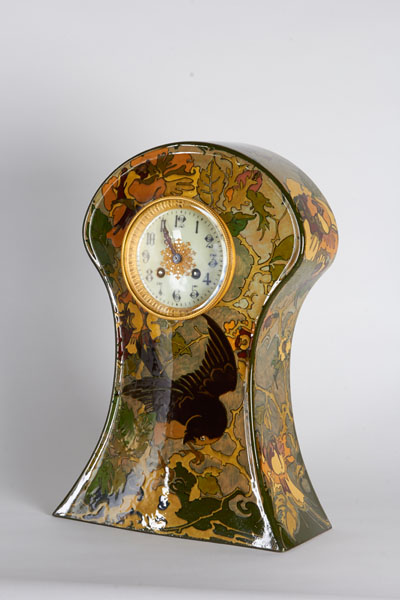
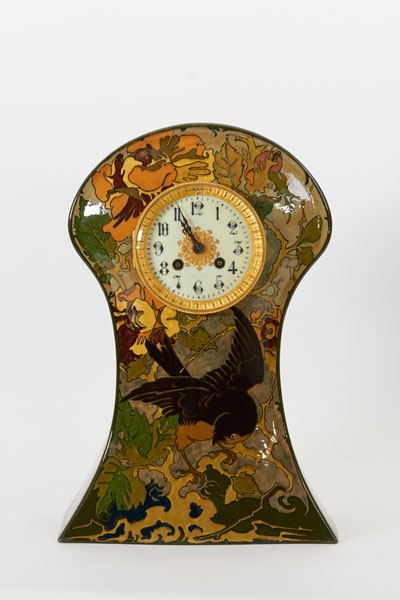
Rozenburg Pottery Holland, W.P. Hartgring Art Nouveau Mantle Clock, 1904
More Information
Rozenburg Pottery Holland, W.P. Hartgring Art Nouveau Mantle Clock, 1904
W. P. HARTGRING
ROZENBURG POTTERY The Hague, The Netherlands
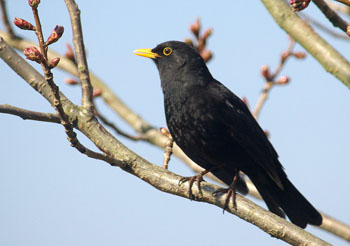
Blackbird mantle clock 1904
Handpainted earthenware with exotic foliage and a bird, porcelain face, gilt bronze surround, original clock mechanism.
Marks: H (artist’s monogram) 534, Rozenburg den Haag trademark, date mark symbol for 1904
For more information see: Art et Décoration, vol. 8 (1900) 193, illus. p. 189 (A. Sandier, La ceramique à l’Exposition); Kunst und Kunsthandwerk, vol. 3. (1900) 395, illus. p. 392; Art et Décoration, vol. 9 (1901) 56 Abb. S. 54 (A. Sandier, La Ceramique à l’Exposition II); Der Moderne Stil, Julius Hoffmann, Vol. 3, (1901) Taf. 53.; La Kunstgewerbeblatt Neue Folge, Vol. 12. (1901) p. 95, Abb. S. 82,89; “The International Exhibition of Modern Decorative Art at Turin – The Dutch Section,” Enrico Thovez in The Studio, vol. 26 (1902), pp. 204-6; Kunst und Kunsthandwerk, Vol. 7 (1904), p. 568, Abb. S. 574-5, (K. Ruge, Kunst und Kunstgewerbe auf der Weltausstellung zu St. Louis); Art et Décoration, vol. 17 (1905) p.86 Abb. S. 77, 88 (G. Mourey, L’Art Decoratif Hollandais); Sprechsaal, Vol. 38, (1905) p. 517 (W.H. Zimmer, Die Weltausstellung in St. Louis; Rozenburg, Monographie einer Manufaktur 1883-1917, Marjan Boot et al. (Munich: Verlag Künst & Antiquitäten, 1984); Sammlung Bröhan: Kunsthandwerk 1-Jugendstil, Werkbund, Art Deco, Glas, Holz, Keramik, (Berlin: Karl H. Brohan, 1976) p. 367-380.
Jan Van Der Vaart / Dutch Avant-Garde Pottery “I-beam” Vase, 1991
JAN VAN DER VAART (1931-2000) The Netherlands
I-beam vase 1991
Matte bronze glazed stoneware
Signed: 91 VD VAART (incised)
For more information on Van der Vaart and his work see: Jan van der Vaart, Ceramics, Marjan Unger, et al. (The Netherlands: Stichting Harten Fonds, 1991); Jan van der Vaart Multipels 1967-1997, Allaard Hidding (Leeuwarden: Keramiekmuseum Het Princessehof, 1997), illus. 88, p. 88.
H: 9 1/2” x W: 10 1/8” x D: 5 1/2”
Price: $8,000
Jan van der Vaart, born in 1931, is one of the Netherlands’ best known potters. He was not only a trend-setting artist and industrial designer, he also taught an entire generation of Dutch ceramicists while teaching at the Rietveld Academie in Amsterdam (1968-1990). His work is in the collection of many Dutch museums, the Victoria & Albert Museum in London and the Museum of Modern Art in New York.
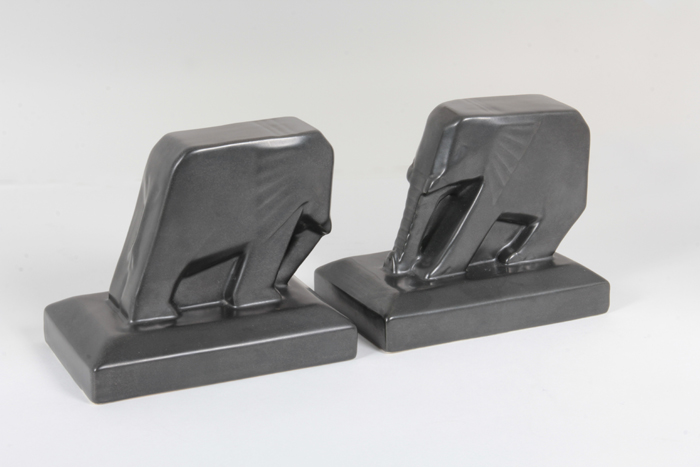
Margaret Postgate / Cowan Pottery Studio American Art Deco Cubist Elephant bookends c. 1929
MARGARET POSTGATE (1879-1953) USA
WAYLANDE GREGORY (1905-1971) USA
ARTHUR BAGGS (1886-1947) (glaze development) USA
COWAN POTTERY STUDIO USA
Cubist Elephant bookends 1929
Ceramic bookends with a black gunmetal glaze
Signed: Cowan studio mark (under glaze) Cowan bookend numbers 840 and 841
For more information and illustration see: Cowan Pottery and the Cleveland School, by Mark Bassett and Victoria Naumann (Atglen, PA: Schiffer, 1997).
H: 4 1/2″ x W: 5 1/2” x D: 3 3/4”
Margaret J. Postgate was born in Chicago, IL on September 29, 1879 and died at a hospital in the Bronx, NY in 1953. Her family moved to Manhattan around 1910 and then Brooklyn around 1925 and she remained a Brooklyn resident right up until her death. Her parents were both born in England: John W. Postgate and Margaret Postgate nee Derry. She had siblings, a brother George and one or two sisters, Mary and/or Mae. Margaret studied at the Art Institute of Chicago and Cooper Union School of Art in New York. In 1925, 1925, and 1926 she participated in soap sculpture carving competitions, some sponsored by Procter & Gamble Corporation in Cincinnati, Ohio. Pamphlets exist as well as exhibition brochures and others on “how-to” carving penned by Postgate. Margaret Postgate designed for Cowan from 1929-1930 where she adapted a few of the designs she had rendered in soap for ceramic sculptures for the Cowan Pottery. She also executed a few pieces of sculpture that were cast in bronze for the bronze division of the Gorham Manufacturing Company.
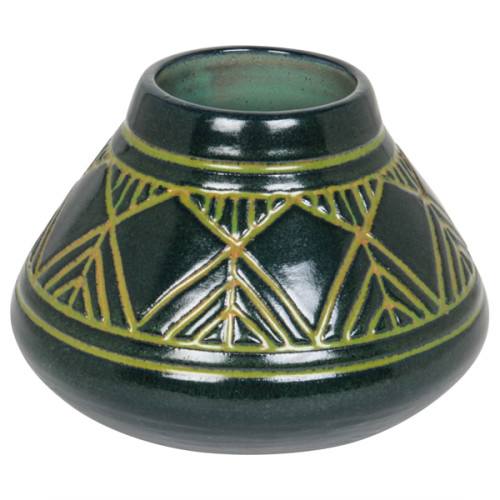
Julia Edna Mattson – Univ. of North Dakota American Art Pottery Vase circa 1913-20
JULIA EDNA MATTSON (d.1967) Grand Forks, ND
UNIVERSITY OF NORTH DAKOTA Grand Forks, ND
Vase c. 1913-1920
Earthen-ware with blue-green glaze, incised with lime-green linear decoration
Marks: University of North Dakota, Made at School of Mines, Barclay, Grand forks, ND (Cobalt blue seal), JM (Julia Mattson)
For more information see: Barr, Paul E. North Dakota Artists. Grand Forks: University of North Dakota Library, 1954; Miller, Don. University of North Dakota Pottery: The Cable Years. Grand Forks: University of North Dakota Visual Arts Dept., 1999; Palmer, Bertha Rachael. Beauty Spots in North Dakota. Boston: Bruce Humphries, Inc., 1939
H: 3 5/8″ x Dia: 5 1/4″
Price: $3,250
Julia Edna Mattson worked as an instructor and later as Assistant Professor in the University of North Dakota’s Ceramic department between the years 1924-1963. Her designs reflect an interest in the Arts and Crafts movement in America and American Indian pottery. Early UND pottery is characteristic of the Arts and Crafts and Art Nouveau movement. The decoration of this vessel recalls the graphic designs found on Indian basketry as well as the Prairie School windows of Frank Lloyd Wright.
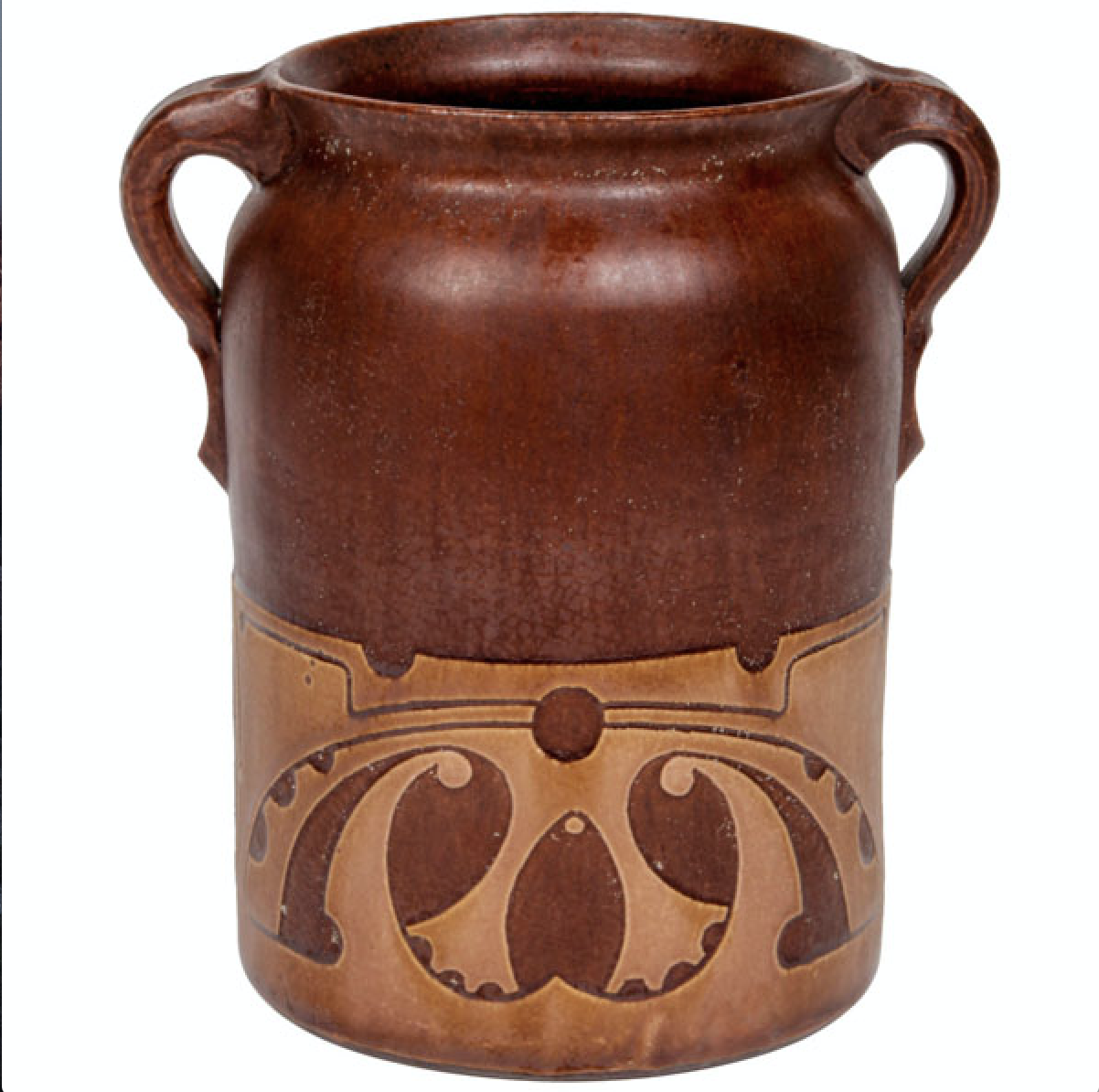
Willem Brouwer Dutch Art Nouveau / Arts & Crafts Pottery Vase c. 1905
WILLEM COENRAAD BROUWER (1877-1933) The Netherlands
POTTERIJ VREDELUST Leiderdorp, The Netherlands
Vase with handles c. 1905
Brown glazed red clay with tan light brown cut out overlaid and sgraffito decoration in a stylized organic motif, two applied looping handles
Marks: Brouwer 139 (incised)
For similar work see: Dutch Decorative Arts 1880-1940, eds. Titus M. Eliëns, Marjan Groot, Frans Leidelmeijer (New York: Battledore Ltd.,1997),p. 56; Leven in een verzameling: Toegepaste kunst 1890-1940 uit de collectie Meentwijck (Laren: Singer Museum, 2000), illus. 76, 77, p. 74.
For more information on Brouwer see: Art Nouveau en Art Deco in Nederland: verzamelobjecten uit de vernieuwingen in de kunstnijverheid van 1890 tot 1940, Frans Leidelmeijer and Daan van der Cingel (city unknown: Meulenhoff/ Landshoff, 1983), pp. 80-82.






 @hd_jewels