


Product Description
Peter Shire Memphis Group California Art Pottery Rare Early “Peach Tea Set” 1980


PETER SHIRE (b. 1947) USA
Rare and early “California Peach” teaset 1980
Handmade earthenware with polychrome glazes
Made by Shire at his studio in Echo Park, California
Signed: Shire 1980 EXP (painted on base of each)
Model illustrated: Tempest in a Teapot, the Ceramic Art of Peter Shire, Norman M. Klein et al. (New York: Rizzoli, 1991) p. 11.
Teapot H: 10” x W: 11 1/4” x D: 5 1/2”
Pair of teacups H: 7 3/4” & 8”
Price: $8,500
Peter Shire (born 1947) is a Los Angeles artist. Shire was born in the Echo Park district of Los Angeles, where he currently lives and works. His sculpture, furniture and ceramics have been exhibited in the United States, Italy, France, Japan and Poland; Shire has been associated with the Memphis Group of designers, has worked on the Design Team for the XXIII Olympiad with the American Institute of Architects, and has designed public sculptures in Los Angeles and other California cities. Shire has been honored by awards for his contribution to the cultural life of the City of Los Angeles.
Peter Shire Memphis Group California Art Pottery Rare Early “Peach Tea Set” 1980
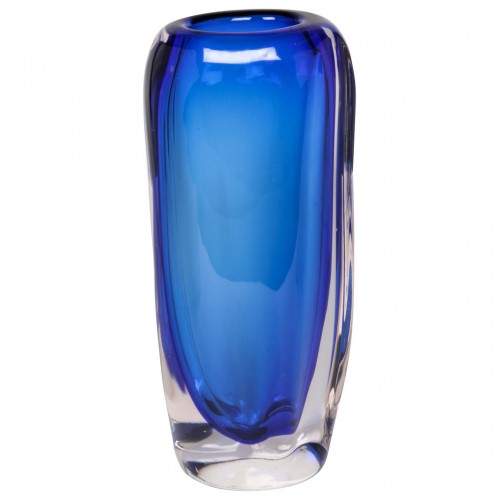
FLAVIO POLI (1900-1984) Italy
SEGUSO VETRI D’ARTE Italy
Vase c. 1950’s
Blue and clear Murano glass
H: 10″ x D: 3″ x W: 4 1/2″
Price: $1,850
Designer, businessman, ceramic artist. Born in Chioggia, he attended the Istituto d’Arte di Venezia and began work as a designer in ceramics. in 1929 he switched to glass and for Libero Vitali’s I.V.A.M. he designed animals, splendid Novecento-style nude figures in massiccio glass, as well as bowls and urns with figures resting on the inside, on lids or as handles. He subsequently collaborated with the Compagnia di Venezia e Murano, with the furnace of Mario and Lino Nason and with the engraver Gino Francesconi. in 1934 he accepted the artistic direction of Barovier, Seguso & Ferro, later to become Seguso Vetri d’Arte, and became partner three years later. Together with the master of the principal team Archimede Seguso, Poli was the author of grandiose lighting installations, of corroded vessels, of sculptures in bulicante glass, of animals in massiccio glass shaped while hot, productions which represented a milestone in the development of Murano glass. At the height of his artistic maturity, in the years between 1950 and 1960 he designed a series of sommerso glass pieces in a Nordic style, essential forms and sharp cold colors, which were awarded prestigious prizes (Compasso d’Oro). After leaving Seguso in 1963, between 1964 and 1966 he organized the artistic glass division at the Societˆ Veneziana di Conterie e Cristallerie.
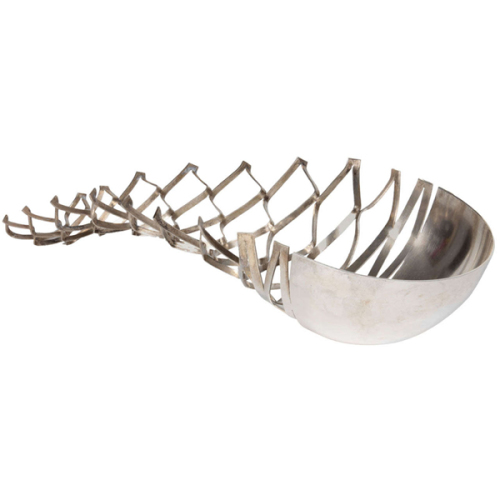
ANE CHRISTENSEN (b.1972) born in Copenhagen, Denmark/ based in London, UK
Bowl 1999
Sterling silver
Marks: AKC, 925, Z, British hallmarks
H: 2 ½” x L: 12”
Price: $5,950
The starting point for all of metalworker Ane Christensen’s tableware is a single sheet of metal. Her aim is to develop a three dimensional object from a flat sheet without adding or removing any elements. Japanese paper packaging influences Ane’s work, but a more important influence is the half finished or half demolished structures of building sites that she says can hold unexpected sculptural qualities.
Ane graduated from the Royal College of Art and has since been involved in exhibitions in London, Denmark and Copenhagen, including more recently at Collect, V&A.
Ane makes pieces in a variety of metals including silver, stainless steel and powder coated copper.
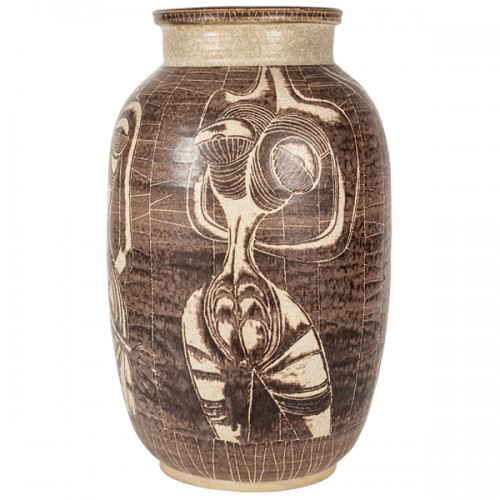
AARON BOHROD (1907-1997) USA
F. CARLTON BALL (1911- 1992) USA
“Eve” vase 1952-56
Monumental glazed stoneware vase with a brown and cream beige glaze with sgraffito decoration of four stylized nudes.
Signed: A. Bohrod F.C. Ball (inscribed)
Illustrated: Aaron Bohrod: Figure Sketches, Edwin E. Elliott and Howard E. Wooden (Dodge City, Kansas: Gall and Shaull, 1990) p. 17, fig. 32. A Decade of Still Life: Aaron Bohrod (Madison, Wis.: University of Wisconsin Press, 1966) p. 41.
H: 20 3/4 x Dia: 12 1/2″
Price: $29,000
***Aaron Bohrod himself considered this vase his most important work in ceramic. This exact vase is illustrated in “A Decade of Still Life: Aaron Bohrod” in a bisque state. There is a stable firing crack that is visible on the base (see photo) near the Bohrod signature which happened in the firing, but in no way affects the structure of the piece. A letter from Aaron Bohrod himself describing this piece and the history surrounding it also accompanies the vase.
For more information see: The Potter’s Art in California: 1885-1955, Hazel V. Bray (Oakland: Oakland Museum Art Department, 1980) pp. 56-57.
A painter of cityscapes, landscapes and trompe l’oeil paintings, Aaron Bohrod lived in Chicago from birth until 1948, when he moved to Madison, Wisconsin. There he was a member of the University of Wisconsin’s art faculty. Bohrod was a graduate of the School of the Art Institute of Chicago, and he also attended the Arts Students League in New York.
Aaron Bohrod was an American artist who was nationally known in his lifetime. He was the subject of frequent exhibitions and gallery shows in various locations, generally focusing on a particular chronological period of his artistic production. The recipient of numerous prizes and awards (including two Guggenheims and the purchase prize at the “Artists for Victory” exhibition of 1942-43 at the Metropolitan Museum in New York), he was both proficient and prolific as a painter, sculptor, printmaker, ceramicist and as an illustrator. In addition, he was the author of several books on art and an autobiography. Although he studied at the Art Institute of Chicago and the Art Students League in New York with a number of well-known and influential teachers, the one who exerted the most profound influence on him was John Sloan, who taught him to value both the Old Masters and the visual reality of the urban American scene. Bohrod returned to Chicago after studying with Sloan in New York “determined to do in my own way with my own city what Sloan had done with New York.” (Bohrod’s stylistic development has been typically characterized in terms of his early relationship to the gritty urban realism of the Ashcan School with which Sloan was associated and his later magic realism style with its virtuoso and meticulous technique and witty visual repartee, almost as if they were two separate and unrelated developments. Although his own description of the origins of his unique still life approach in his autobiographical book, A Decade of Still Life, may have guided critics to look at his oeuvre in this way, a closer assessment reveals clear connections between the earlier and alter periods. Before 1940, for example, he had created a prototype of the still lifes that were to become his hallmark. By the mid 1950s, he began to dedicate himself to the creation of paintings that are by turns resonant, mysterious, evocative and humorous. The studied and careful detail of the bricks on the buildings foreshadow the care that Bohrod will lavish on each of the carefully observed and realized objects in his later still lifes, while the anecdotal detail predicts the accumulation of objects on which his later work depends. The polished and masterful technique of this later work also suggests the Old Masters to whom he was introduced by Sloan.
F. Carlton Ball (1911-1992)
F. Carlton Ball was born in Sutter Creek, California, He studied art at Sacramento Junior College before enrolling at USC. He graduated from the University of Southern California in 1933. He later did graduate studies under Glen Lukens at USC. He taught at several colleges/universities, such as the CCAC (his first position in 1935), Mills College, University of Wisconsin at Madison, University of Southern Illinois at Carbondale, USC University of Puget Sound and etc. From our research, we believe his last teaching position was in Tacoma, Washington, at the Tacoma Community College. Primarily known for his throwing, he did combine his pots with the decorative artistry of his first wife Kathryn Uhl Ball and most importantly, the Wisconsin artist, Aaron Bohrod. He exhibited at the Association of San Francisco Potters, 1952 Los Angeles County Fair’s 6000 Years Art in Clay and the Crocker-Kingsley of Sacramento, California, to mention a few locations. Exhibited at the Nationals in 1941-1949, 1951-1960 and 1966.
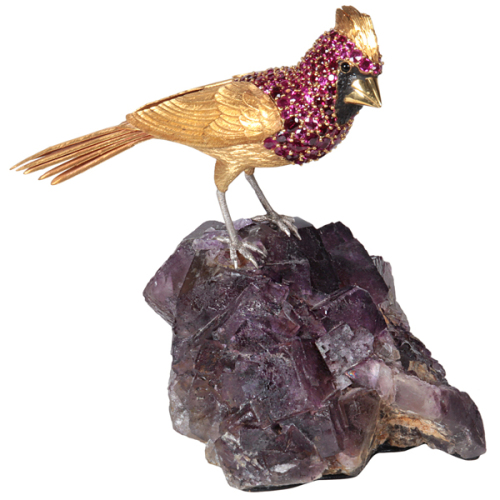
ASPREY & CO. LTD. (founded 1781) London, UK
Important Natural Ruby Gem Set 18K Gold Cardinal Bird Sculpture 1980
Finely chased and chiseled 18K yellow and white gold realistically rendered sculpture of a Cardinal bird set with
85+ carats (approx.) of natural gem quality oval and round cut Burmese rubies (GIA certificate) further heightened with enamel eyes and blackened gold face plumage details, the 18K gold and natural ruby cardinal sets atop a natural Amethyst crystal “mountain rock” with a tooled and gilt (script mark) on the leather under-pad.
Marks: A & Co. (in a quatrefoil), Crown mark, 750 (gold standard mark) Lion’s head (London assay mark) “F” date mark for 1980, tooled and gilt Asprey (script mark) on the leather under-pad
Provenance: Privately commissioned by the Sultan of Brunei’s younger brother, Prince Jefri Bolkiah who also later became the owner of Asprey & Co in the 1995. This rare sculptural 18K gold and natural ruby Cardinal was handmade by the finest jewelers and work masters in the workshop of the London Asprey & Co. located above the flagship store at 167 New Bond Street.
H: 3 ¾” x L: 5 3/4” x W: 1 ½”(Cardinal only)
H: 6” x W: 6 ¾” x D: 5 ¾” (with Cardinal atop natural Amethyst crystal rock)
As one might guess, a large part of the animal symbolism of the cardinal comes from the brilliant red color of the males. In fact, its name is derived from the royal red vestments worn by Catholic cardinals. This shock of red, especially against the stark backdrop of winter snow, is a magnificent sight. The male cardinal reminds us passion, warmth and vibrancy is available to us – even under the cloak of Winter’s grey clouds. Interestingly, the more bold and bright his color is, the more successful the cardinal will be at prolonging his lineage. Dull colored male cardinals are less likely to mate successfully than bright colored ones. True to the fire of his color, the crimson cardinal has got some major spunk. He will aggressively defend his territory, and fight attackers with ferocity. Indeed, they have been known to fight ghost males (their reflections) in mirrors for hours on end. Both male and female give us glorious songs. Along with peeps and pips and warbles, the tuned ear can also hear “cheer, cheer, cheer!” Very appropriate to the animal symbolism of cardinals, because they are a delight to both eyes and ears. The cardinal makes a fantastic animal totem. It reminds us to hold ourselves with pride, not ego pride but rather the cardinal asks us to stand a little taller, be a bit more regal and step into our natural confidence as if we were born to lead with grace and nobility. Those who attract the cardinal as their totem are naturally energetic, love life, and happily help others where and when they can!
 @hd_jewels