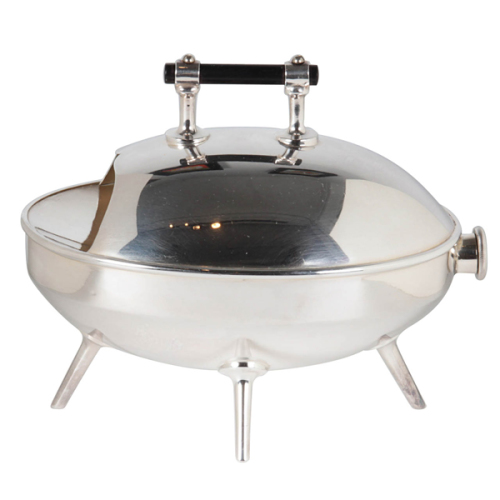
Christopher Dresser / Heath & Middleton Petite claret jug 1887
More Information
Christopher Dresser / Heath & Middleton Petite claret jug 1887
CHRISTOPHER DRESSER (1834-1904) UK
HEATH & MIDDLETON Birmingham, England
Petite claret jug 1887
Sterling silver mounts with hinged covers to both top and spout, glass, ebony handle
Marks: JTH & JHM in a four-lobed cartouche, London assay marks for 1887 (“M” in a shield), Vienna import mark (conjoined AV in a 6-sided cartouche)
Illustrated: Industrial Design Unikate Serienerzeugnisse, Die Neue Sammlung ein neuer Museumstyp des 20. Jahrhunderts, Hans Wichmann (Munich: Prestel-Verlag, 1985), p. 131; Christopher Dresser, ein Viktorianischer Designer, 1834-1904 (Cologne: Kunstgewerbemuseum der Stadt Köln, 1981), p. 73, ill. 86, cat. no. 23; Industrial Design, John Heskett (New York and Toronto: Oxford University Press, 1980), p. 24, illus. 9; Christopher Dresser 1834-1904, Michael Collins (London: Camden Arts Centre, 1979), p. 171, cat.no.12.
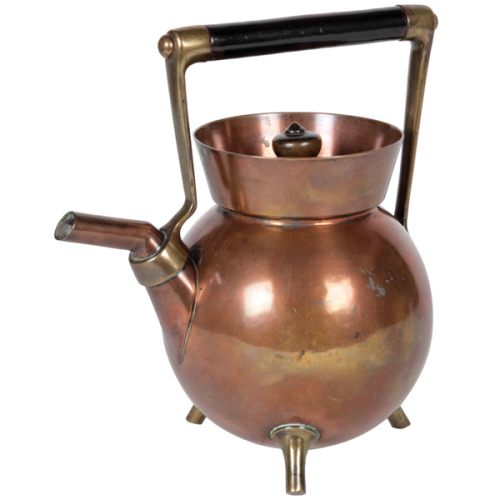
Christopher Dresser / Benham & Froud Aesthetic Movement Kettle c. 1885
CHRISTOPHER DRESSER (1834-1904) UK
BENHAM & FROUD London, England
Kettle c. 1885
Copper, brass, wood handle and finial
Marks: maker’s cipher
Illustrated: Minor Masters of the XIXth Century: Christopher Dresser, Industrial Designer, by N. Pevsner, (Architectural Review, 1937), p. 184, illus. 1; Truth, Beauty, Power: Dr. Christopher Dresser 1834-1904, exhib. cat. Historical Design, Inc. (New York, 1998) p. 67.
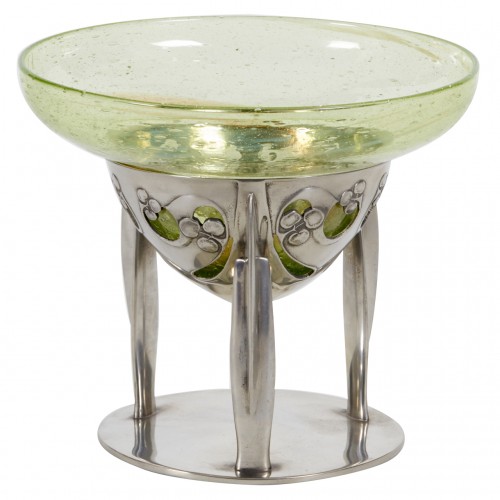
Archibald Knox / Liberty & Co. Clutha bowl on tri-leg Tudric stand c. 1902
ARCHIBALD KNOX (1864-1933) UK
LIBERTY & CO. London
JAMES COUPER & SONS Glasgow
Clutha bowl on tri-leg stand c. 1902
Clutha glass with inclusions of aventurine streaks and bubbles, polished tri-leg Tudric pewter stand.
Marks: Tudric, 0276
Illustrated: Liberty’s 1875-1975, An Exhibition to mark the Firm’s Centenary (London: Victoria & Albert Museum, 1975), p. 89, number D 250 A; The Designs of Archibald Knox for Liberty & Co., A.J. Tilbrook (London: Ornament Press Ltd., 1976), p. 114; Liberty Style, The Classic Years: 1898-1910, Mervyn Levy (New York: Rizzoli, 1986), p. 31; Archibald Knox, ed. by Stephen A. Martin (London: Academy Editions, 1995), p. 96.
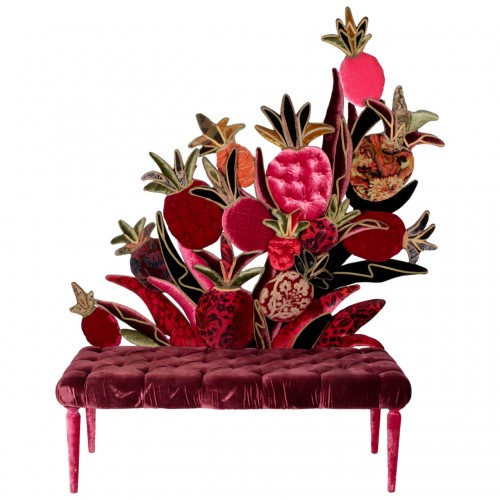
Exotic variety of silk and cut silk velvets sewn and sculpted in the form of a spray of various pineapple shapes on a tufted cushion seat and upholstered legs.
Marks: Tolomeo (written on the velvet), Tolomeo script signature (brass plaque)
Exhibited: Fondazioni Cerratelli, Pisa, Italy, Summer 2006
Model illustrated and biographical information on Carla Tolomeo: Il Fogliaccio, July 7th, 2006
For further information see: Carla Tolomeo Mai Sedersi Sugli Allori, Never rest on your laurels 1995-2004, Carla Tolomeo (Milano 2004)





 @hd_jewels