Christopher Dresser / Heath & Middleton Petite claret jug 1887
More Information
Christopher Dresser / Heath & Middleton Petite claret jug 1887
CHRISTOPHER DRESSER (1834-1904) UK
HEATH & MIDDLETON Birmingham, England
Petite claret jug 1887
Sterling silver mounts with hinged covers to both top and spout, glass, ebony handle
Marks: JTH & JHM in a four-lobed cartouche, London assay marks for 1887 (“M” in a shield), Vienna import mark (conjoined AV in a 6-sided cartouche)
Illustrated: Industrial Design Unikate Serienerzeugnisse, Die Neue Sammlung ein neuer Museumstyp des 20. Jahrhunderts, Hans Wichmann (Munich: Prestel-Verlag, 1985), p. 131; Christopher Dresser, ein Viktorianischer Designer, 1834-1904 (Cologne: Kunstgewerbemuseum der Stadt Köln, 1981), p. 73, ill. 86, cat. no. 23; Industrial Design, John Heskett (New York and Toronto: Oxford University Press, 1980), p. 24, illus. 9; Christopher Dresser 1834-1904, Michael Collins (London: Camden Arts Centre, 1979), p. 171, cat.no.12.
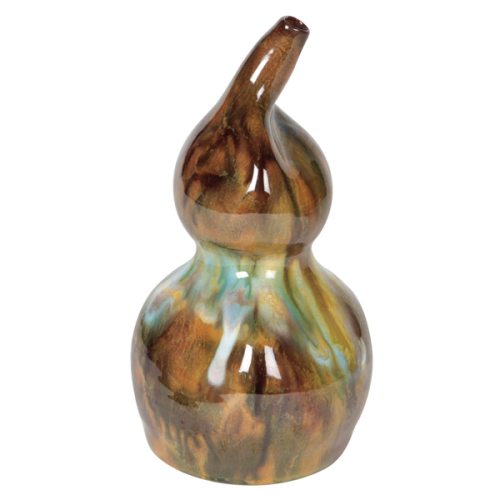
Christopher Dresser / Linthorpe Art Pottery Rare Aesthetic Movement “Gourd” Vase 1879-1882
CHRISTOPHER DRESSER (1834-1904) UK
LINTHORPE ART POTTERY, Middlesbrough
HENRY TOOTH Artistic Manager Linthorpe (1842-1918) UK
“Gourd Vase” 1879-1882
Glazed Earthenware
***Extremely rare Dresser / Linthorpe model.
Marked: LINTHORPE, Chr. Dresser (facsimile signature) HT, no. 326
Illustrated: Christopher Dresser: Truth, Beauty, Power exh. cat. (New York: Historical Design, 1998) p.75; illustrated in two drawings for gourd vases in Dresser’s 1881 design and account book under heading “Aug. 29, 1881. Sent to J. Harrison Esq. 41 Designs for Linthorpe.”
H: 7 3/4″
The contrasts in Dresser’s designs for different materials showed how his approach to design was also shaped by the properties and nature of a material. In 1879 Dresser was appointed art director at the newly established Linthorpe pottery, near Middlesbrough. Founded by John Harrison, a local businessman, the pottery’s aim was to use local clay to provide jobs for local men. Dresser’s design for the moulds for the pottery were inspired by a wide range of cultures from Japan, Peru, Mexico, Morocco and Ancient British forms. These very striking pieces, with the metal oxides in the complex and innovative glazes providing the only decoration. All of his designs were impressed with a facsimile signature. When Linthorpe closed in 1889, its moulds were acquired by a rival, Ault Pottery in Derbyshire. In 1893, Dresser signed a contract with Ault for new designs specifying that each pot should be marked with his facsimile signature.
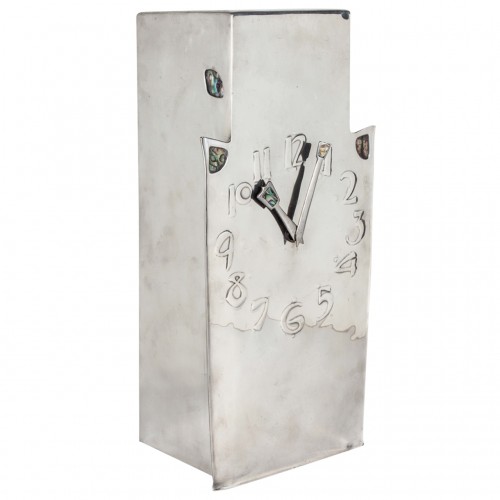
Archibald Knox / Liberty & Co. Important and Rare Tudric Clock 1902
ARCHIBALD KNOX (1864-1933) UK
LIBERTY & CO. London
Extremely rare and important grand clock by Archibald Knox for Liberty & Co. This is the largest of all of the Tudric models designed and is inset with abalone shell on the sides, the front corners and on the hands of the clock.
Marks: TUDRIC, 098
Illustrated: The Designs of Archibald Knox for Liberty & Co., A..J. Tilbrook (London: Ornament Press Ltd., 1976) pg. 88; The Liberty Style, (Japan: Hida Takayama Museum of Arts, 1999) fig. 168, p 114; Archibald Knox, ed. by Stephen A. Martin (London: Academy Editions, 1995) p. 88.
H: 15″ x W: 7″ x D: 5″
***This is the largest clock designed by Archibald Knox for
Liberty & Co. and one of only three models known.
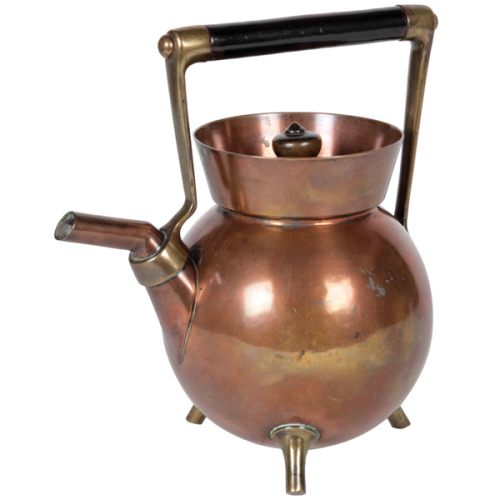
Christopher Dresser / Benham & Froud Aesthetic Movement Kettle c. 1885
CHRISTOPHER DRESSER (1834-1904) UK
BENHAM & FROUD London, England
Kettle c. 1885
Copper, brass, wood handle and finial
Marks: maker’s cipher
Illustrated: Minor Masters of the XIXth Century: Christopher Dresser, Industrial Designer, by N. Pevsner, (Architectural Review, 1937), p. 184, illus. 1; Truth, Beauty, Power: Dr. Christopher Dresser 1834-1904, exhib. cat. Historical Design, Inc. (New York, 1998) p. 67.
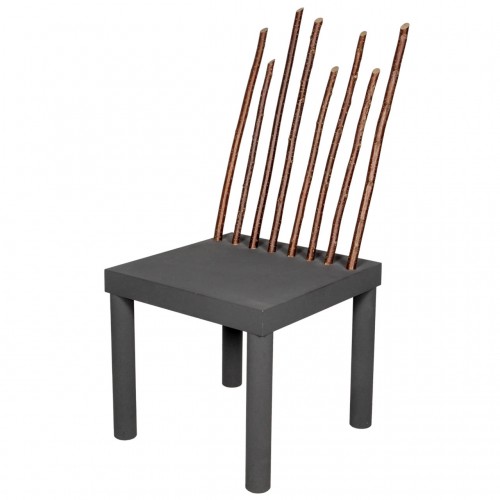
Illustrated: Domestic Animals: The Neoprimative Style Andrea and Nicoletta Branzi, (London, 1987) n.p.; Designed by Architects in the 1980s, Julie Capella and Quim Larrea, Barcelona, 1987, p. 37; Anne Bony, Paris Les années 80, 1995, p. 520; Charlotte and Peter Fiell, 1000 Chairs, Cologne, 2000, p. 588
H: 42 3/4″ x W: 19 3/4″ x D: 24″
Price: $19,000
The “Cucus” chair was part of the “Domestic Animals” series
designed in 1985/86 by Andrea Branzi for Zabro.
Andrea Branzi's “Domestic Animals” series was designed in 1985 and 1986 for the Italian firm Zabro. Designs were later also manufactured by Zanotta. Andrea Branzi created “Domestic Animals” in collaboration with Nicoletta Branzi, who produced limited edition art clothing for this series. The “Neoprimitive” style in which this collection has been rendered utilizes natural materials such as sticks to create an object that brings archetypal symbols into the home to produce emotional effects. These objects combine technology and nature and the symbols and codes that these entail demonstrating that “a hybrid love between different creatures is possible.” (Branzi, Domestic Animals, 1987, n.p.) With these objects Branzi aims to “domesticate” technological inventions so as to make them a positive presence in man's life.
“The difference between a domestic animal and a trained (or tamed) one lies in the fact that the latter is the outcome of an unnatural and violent attitude, while the domestic animal establishes the dream of a loving relationship with man.” (Branzi, Domestic Animals, 1987, n.p.)
Andrea Branzi, architect and designer, born in Florence in 1938, where he graduated in 1967, lives and works in Milano. From 1964 to 1974 he was a partner of Archizoom Associati, first vanguard group internationally known, whose projects are preserved at Centro Studi e Archivio della Comunicazione in Parma and at Centre Georges Pompidou in Paris.
Since 1967 he works in the fields of industrial and research design, architecture, urban planning, education and cultural promotion.He is Professor at the Third Faculty of Architecture and Industrial Design of Politecnico di Milano.





 @hd_jewels