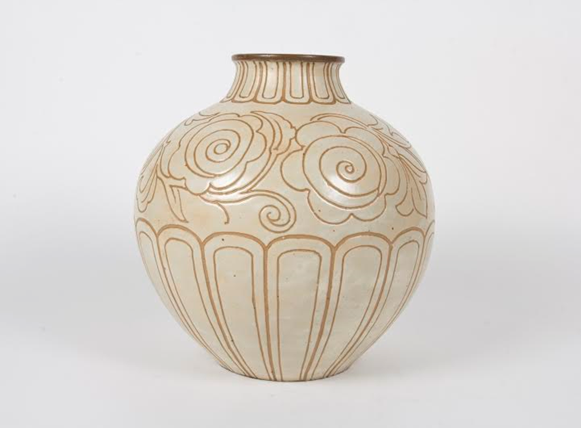
Georges Serré, Warm ivory /sand colored glazed stoneware vase c. 1925
More Information
Georges Serré / Art Deco Warm ivory /sand colored glazed stoneware vase c. 1925
GEORGES SERRÉ (1889-1956) France
Vase c. 1925
Warm ivory /sand colored glazed stoneware with hand incised stylized leaf and floral motif with a top collar and lower half in a softened geometric repeat pattern all in a light brown tonality.
Marks: G Serre (hand incised signature)
For more information see: La Céramique Art Déco, Edgar Pelichet (Paris: Bibliothèque des Arts, 1988), p. 47.
For more information on Serré see: Georges Serré, exhib. cat. (Paris: Galerie Landrot, 1992).
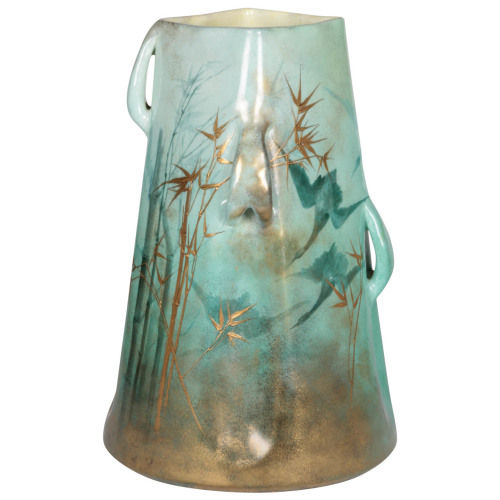
Clement Massier / French Art Nouveau “Bamboo and Flying Crane” Vase circa 1900
CLÉMENT MASSIER (1845-1917) France
MASSIER ART POTTERY Golfe Juan, France
“Bamboo and flying crane” vase c. 1900
Earthenware tapering form with applied handles, hand painted with bamboo and flying cranes with gilt motives and details
Marks: Clement Massier Golfe Juan (block impressed letters)
For more information and other works by the Massier family see: Lost Paradise: Symbolist Europe (Montreal, Quebec: The Montreal Museum of Fine Arts, 1995) p. 176, cat. 269; Jugendstil Art Nouveau, Floral and Functional Forms, Siegfried Wichmann (New York/Boston: Graphic Society/Little, Brown & Co., 1984) p. 45; Art Nouveau Belgium France. Exh. cat. Yvonne Brunhammer et al. (Houston, TX: Institute for the the Arts, Rice University, 1976); La Céramique Art Nouveau, Edgar Pélichet, Michèle Duperrex (Paris: La Bibliothèque des Arts, 1976) p. 89
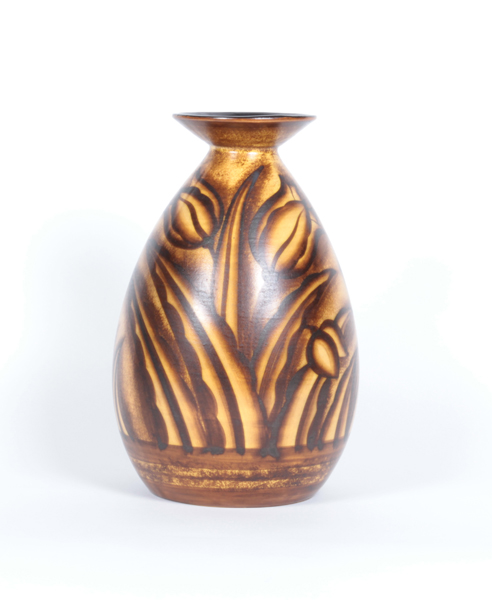
Charles Catteau / Boch Freres Keramis Belgium Glazed pottery vase c. 1930
CHARLES CATTEAU (1880-1966)
BOCH FRERES KERAMIS La Louviere Belgium
Tulip vase c. 1930
Glazed earthenware
Marks: “Keramis” Made in Belgium , D. 2524 B, 945
H: 10 1/4″ x D: 6 1/2″
Charles Catteau could be regarded as one of the most versatile ceramic artists of his generation, especially for the style of Art Deco. Catteau advanced the forms, techniques and decoration of modern ceramics, creating an exceptionally original, new and decorative genre.
Hired as a ceramic decorator in Ecole Nationale de Sèvres from 1903 to 1904, he began producing designs that were rather traditional, based on the observation of nature, and showing the influence of Japonisme, characterized by pure lines and meticulous details. From 1904 to 1906, he worked in Nymphenburg Porzellan Manufaktur near Munich, a factory specializing in new hand painting procedures under a slip, as well as Art Nouveau.
In 1907 he finally moved to Louvière in Belgium where he was promoted to head of the decoration department at Boch Freres Keramis at the age of 27. This is where most of his exceptional talent came to the fore especially during the period between the two World Wars. Influenced by the great creative art movements of the time (Africanism, Japonisme, Cubism, Abstraction) and his observation of nature gave him inspiration for his designs, with the integration of plants, stylized animals and geometric motifs. The international avant-garde movements were also an influence leading to his use of purely abstract, geometric designs and intense colors. Charles Catteau was incredibly resourceful and explored various harmonies of form, techniques, designs, colors, shades, topics, variants and influences. In this way Catteau became a representative par excellence of Art Deco designs, giving it his personal touch. He was instrumental in introducing technical innovations during the 20’s and 30’s to aid mass production of ceramic products and expand availability of affordable products. During difficult times in Europe, he created vivid, colorful, original and uplifting ceramic wares.
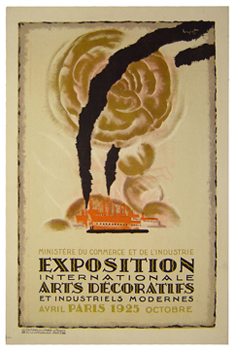
Charles Cotteau motto was “Art for All” and he also taught decorative painting at the School of Industrial in Louvière. In 1925 he obtained international recognition in the exhibition of Decorative Arts in Paris. which helped raise the profile of Boch Freres. He remained at the company until he retired to Nice in 1946 .
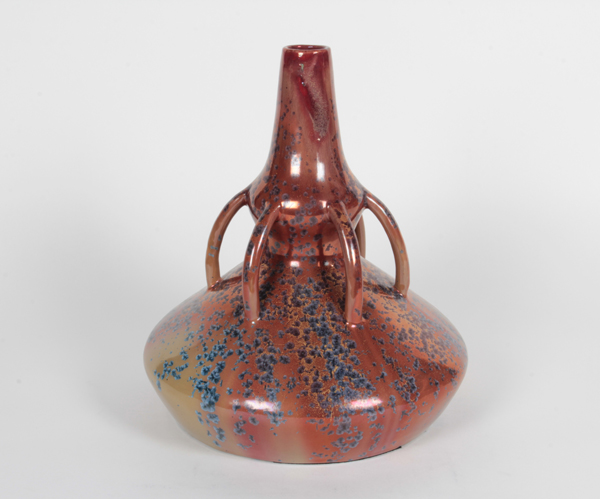
Olivier de Sorra / Pierrefonds (Count Hallez d’Arros) French Art Nouveau six branch vase c. 1900
OLIVIER DE SORRA
SOCIETE FAIENCIERE HERALDIQUE DE PIERREFONDS
Six-branch vase c. 1900
Copper color glaze with blue oxide flower crystallization
H: 11″ x Dia: 9″
Price: $7,250
The Societe Faienciere Heraldique de Pierrefonds pottery studio was founded in the village of Pierrefonds in 1903 by Count Hallez d’Arros and is renowned for it’s crystalline and flambe glazes




 @hd_jewels
Reviews
There are no reviews yet, would you like to submit yours?