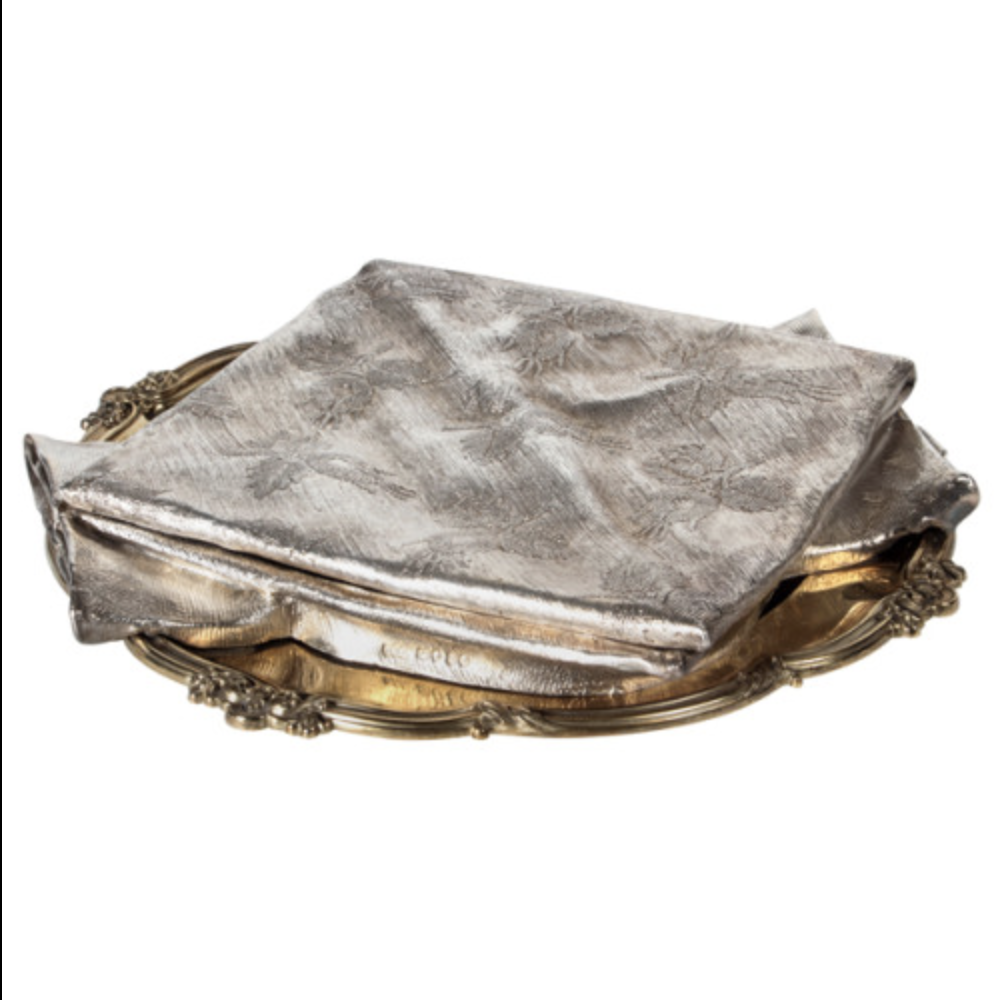
George Richards Elkington British Sterling Trompe L’Oeil Covered Box 1854
George Richards Elkington (1801-1865)
Trompe L’Oeil Box 1854
Sterling silver shallow box with a hinged lid of a life-size trompe l’oeil damask napkin neatly folded on a gilt-sterling Georgian dinner plate
Weight: 45 troy ounces
Marks: GRE makers mark, London hallmarks for 1854
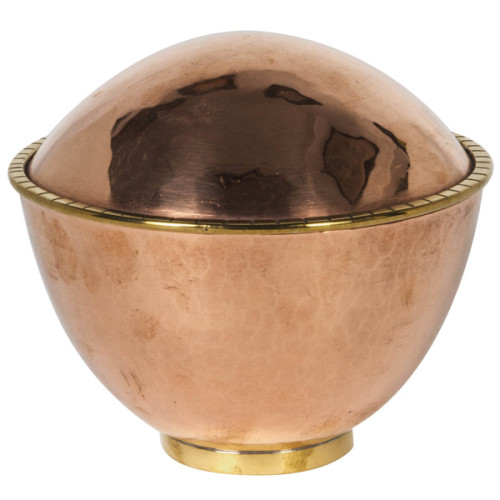
Hayno Focken / Modernist round covered copper box c. 1935
HAYNO FOCKEN (1905-1968) Germany
Round covered box c. 1935
Hand-wrought and hand-hammered copper with brass details
Marks under the foot: HF (conjoined monogram)
For other works by Hayno Focken see: Metallkunst: Vom Jugendstil zur Moderne (1889-1939), ed. Karl H. Bröhan (Berlin: Bröhan Museum, 1990), illus. 177, p. 183; Avantgarde Design 1880=1930,Torsten Bröhan & Thomas Berg (Köln, Benedict Taschen, 1994) p. 116; , (Berlin 1937) S. 43f, Abb. 37, Abb. S 128, S 146, Sl 243; Die Schaulade 15 Ausg. A (1939) Abb. S. 197, S. 204, S. 213; Die Schaulade 16 Ausg. A (1940) Abb. S. 44, S. 51., S. 54, S. 71, S. 83. S. 89; Die Kunst 84 (1941) S. 136, S. 139-39; Die Schaulade 17 (1941) Abb. S. 13, S. 41, S. 82, S. 229;
H: 4 ¼” x Dia: 4 7/8”
Hayno Focken (1905-1968) was an eminent German metal artist. He completed his training under Professor Karl Müller (1888-1972) at the design and arts school on Giebichenstein Castle in Halle (Saale), which was strongly tied to the ideals of the Deutsche Werkbund and the Bauhaus. In 1932 he established his own workshop in Lahr/Schwarzwald and continued his work until shortly before his death. His artistic work always stood out with a strong preference for large, organic forms, a similar manner of surface design and the same adherence to the principle of handicraft. Even his artist signet was modelled on the simple, square castle mark. In the 1950s he became one of those significant artists who had a major impact on contemporary metal design. The foundation of his creative work was a masterful understanding of proportions.





 @hd_jewels