Product Description
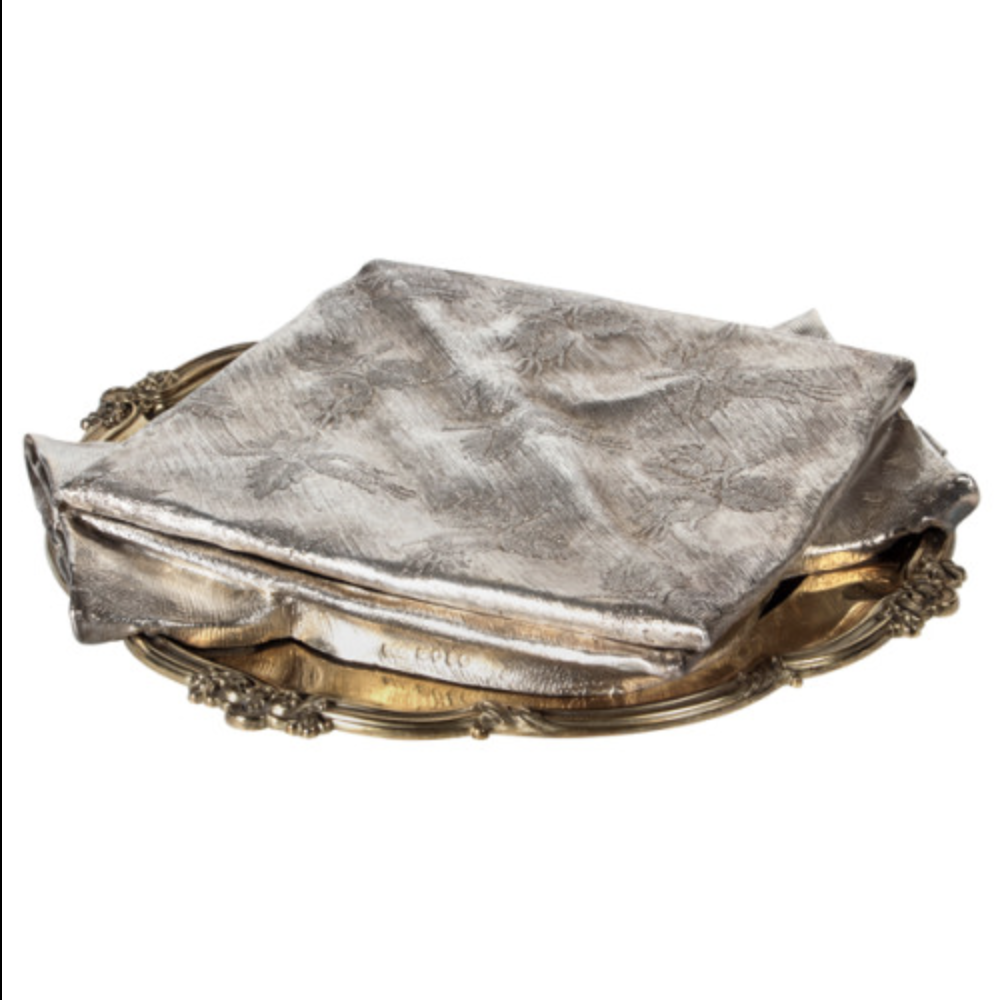
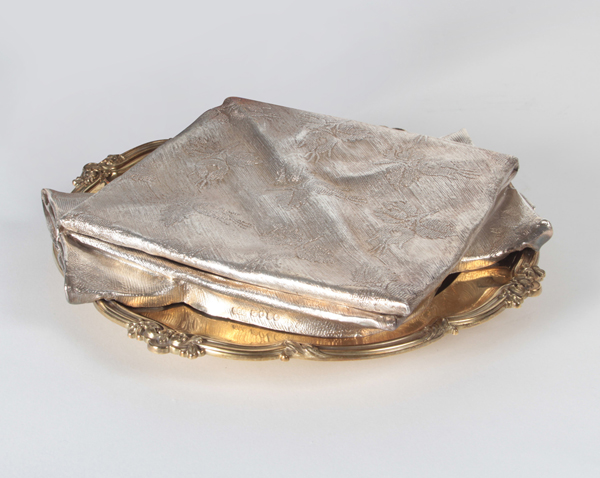
George Richards Elkington British Sterling Trompe L’Oeil Covered Box 1854

George Richards Elkington (1801-1865)
Trompe L’Oeil Box 1854
Sterling silver shallow box with a hinged lid of a life-size trompe l’oeil damask napkin neatly folded on a gilt-sterling Georgian dinner plate
Weight: 45 troy ounces
Marks: GRE makers mark, London hallmarks for 1854
H: 2″ x Dia: 10 1/2″
George Richards Elkington British Sterling Trompe L’Oeil Covered Box 1854
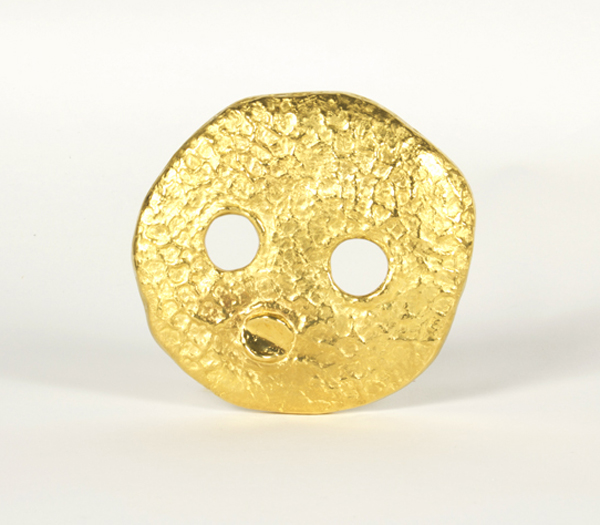
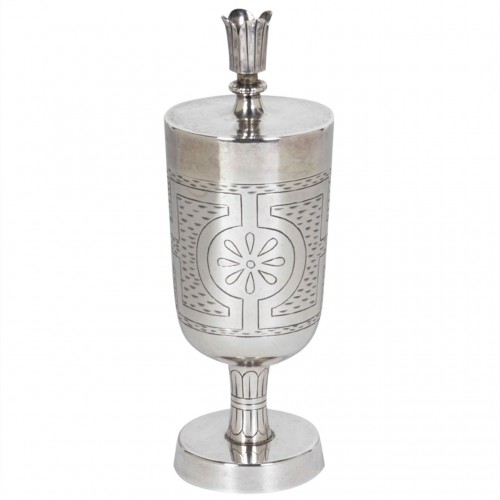
HAYNO FOCKEN (1905-1968) Germany
Round covered box c. 1935
Hand-wrought and hand-hammered copper with brass details
Marks under the foot: HF (conjoined monogram)
For other works by Hayno Focken see: Metallkunst: Vom Jugendstil zur Moderne (1889-1939), ed. Karl H. Bröhan (Berlin: Bröhan Museum, 1990), illus. 177, p. 183; Avantgarde Design 1880=1930,Torsten Bröhan & Thomas Berg (Köln, Benedict Taschen, 1994) p. 116; , (Berlin 1937) S. 43f, Abb. 37, Abb. S 128, S 146, Sl 243; Die Schaulade 15 Ausg. A (1939) Abb. S. 197, S. 204, S. 213; Die Schaulade 16 Ausg. A (1940) Abb. S. 44, S. 51., S. 54, S. 71, S. 83. S. 89; Die Kunst 84 (1941) S. 136, S. 139-39; Die Schaulade 17 (1941) Abb. S. 13, S. 41, S. 82, S. 229;
H: 4 ¼” x Dia: 4 7/8”
Hayno Focken (1905-1968) was an eminent German metal artist. He completed his training under Professor Karl Müller (1888-1972) at the design and arts school on Giebichenstein Castle in Halle (Saale), which was strongly tied to the ideals of the Deutsche Werkbund and the Bauhaus. In 1932 he established his own workshop in Lahr/Schwarzwald and continued his work until shortly before his death. His artistic work always stood out with a strong preference for large, organic forms, a similar manner of surface design and the same adherence to the principle of handicraft. Even his artist signet was modelled on the simple, square castle mark. In the 1950s he became one of those significant artists who had a major impact on contemporary metal design. The foundation of his creative work was a masterful understanding of proportions.
TIFFANY & CO. New York, NY
“Frog on a lily pad” cigarette case 1880
Hand wrought sterling silver with repoussé and chased gold design of a frog sitting on a lily pad with a dragonfly in it’s mouth, “lap over edge” and hand hammered details, gilt interior and spring action to the hinge when the sides are pressed
Tiffany Archive Illustration: Design for Cigarette Case No. 5804, No. 1019, 249, stamped Tiffany & Co. New York, February 26, 1880
Model and Archive illustration: Bejewelled by Tiffany 1837-1987 Clare Phillips (New Haven and London: Yale University Press, 2006)
For more information see: Tiffany Silver, Charles H. Carpenter, Jr. (New York: Dodd, Mead & Company, 1978); The Silver of Tiffany & Co., 1850-1987, Charles H. Carpenter, Jr. and Janet Zapata (Boston: Museum of Fine Arts, 1987).
Marks: Tiffany & Co., 5804, M, 2540, Sterling-Silver, 1019
H: 3/4” x W: 2 7/8” x D: 2 1/8”
The Frog and the Dragonfly
from The Lost Lagoon
by Reg Down, 2010
Once upon a time a dragonfly lived beside a lake high in the mountains. He flitted from bulrush to bulrush – and zipped after mosquitoes. He snapped them out of the air so quickly that no one could ever quite see what he was doing.
One day, as he was flying across the water, his beautiful wings glistening like rainbows, he came across a frog.
“Ribbit!” said the frog. “Come here, Mr. Dragonfly. I would like to have a better look at you.”
But the dragonfly was clever. In fact, he was so clever that his eyes were made up of hundreds of eyes all put together on the top of his head. And each one of those eyes said to him: “That frog wants to eat me!”
So he landed on top of a bulrush where the frog could not get him, and said, “Yes, Mr. Frog, I am close enough for you. What do you want?”
“Ribbit! Ribbit!” croaked the frog, “I think you should come closer because my eyes are not very good.”
So the dragonfly came a little closer. He flitted to a flower floating on the water—but still not close enough for the frog to grab him with his mouth.
“Yes, Mr. Frog, what do you want?” he asked.
“Oh, Mr. Dragonfly,” said the frog, “I have an itch on the end of my nose and my legs aren”t long enough to reach it. But your legs are scratchy—they will be able to scratch my itchiness much better that I ever could.”
The dragonfly found this quite funny. He thought, “That frog wants to eat me! I am sure that frog wants to eat me!” So he flew behind the frog and landed on his back.
The frog could feel the dragonfly crawling on his back, but he could not turn around to grab him. “Oh, Mr. Dragonfly,” he said, “you have to come closer to my nose. In fact, my lips are getting very itchy—please come closer.”
So the dragonfly went and sat between the frog”s eyes. Now the frog”s eyes were looking into the dragonfly”s eyes, and the frog saw that the dragonfly had far, far more eyes than he had. So he said, “Oh, Mr. Dragonfly, you are surely much, much more wise than I am. You have so many eyes that you can see the whole world!”
And the dragonfly replied, “Of course I can see the whole world! I have so many eyes that I am the wisest of all flies!”
“Well,” said the frog, “I have a little tickle in the bottom of my throat—what is happening there?”
And the dragonfly looked, and looked, and looked…….and Snap! the frog ate him up.
The Sweetser Co. New York, New York
(active 1900-1915)
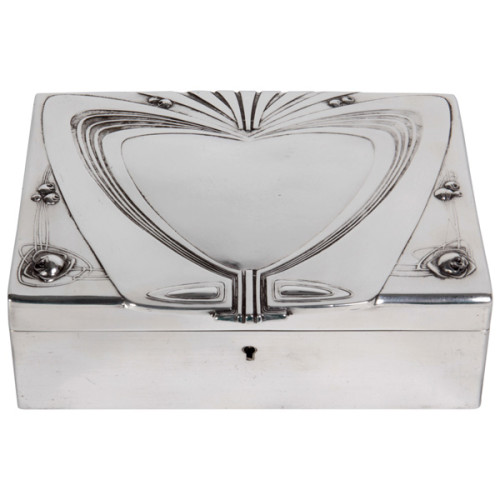
Covered cigar box c. 1910
Elaborately etched sterling silver cover with a spherical jade finial and a copper box bottom, wood lined
Marks: S & E in three separate boxes (2x), STERLING, 2158
H: 4 3/4″ x D: 6 1/8″ x W: 7 5/8″
The Sweetser Co. New York, NY was active 1900-1915 and were manufacturers of fancy gold and sterling wares