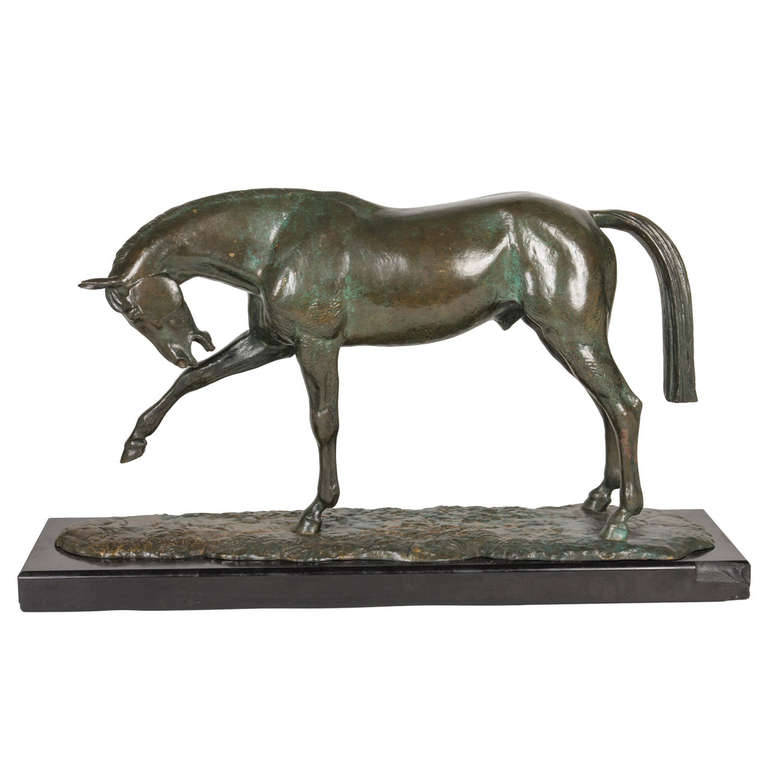
Andre Vincent Becquerel Arabian Horse bronze sculpture c. 1930
More Information
Andre Vincent Becquerel Arabian Horse bronze sculpture c. 1930
ANDRE VINCENT BECQUEREL (1893-1981) France
Arabian Horse sculpture c. 1930
Bronze with overall rich green/brown patina with intricate sculpting and details, black Belgian marble plinth base
Signed: A. Becquerel (inscribed in the bronze)
H: 12” x W: 21” x D: 6”
Price: $27,500
Andre Vincent Becquerel was born in St. Andre-Farivilliers. He studied at the l’Ecole des Beaux Arts in Paris under Hector Lemaire and Prosper Lecourtier. He specialized in fine animal sculpture and regularly exhibited at the Salon des Artistes Francais from 1914 to 1922. Becquerel worked for the Editeur Parisiens Edmond Etling in Paris and created a monumental sculpture in patinated plaster for the “Pavillon international” at the Exposition Internationale in Paris in 1937.
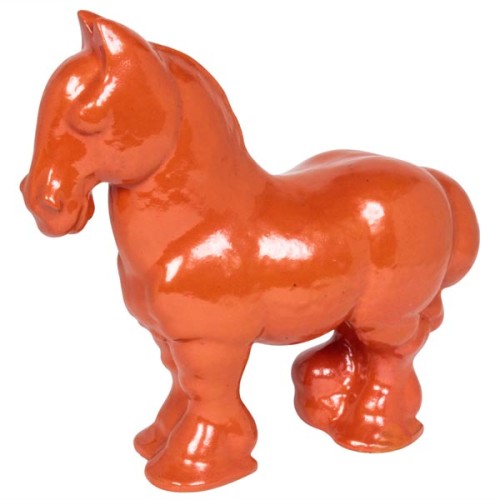
Pedro de Lemos / Art Deco Orange glazed American Pottery Clydesdale Horse Sculpture c. 1930
PEDRO DE LEMOS (1882-1945) Bay Area, California
Clydesdale horse sculpture c. 1930
Hand modeled orange glazed terra cotta.
Marks: De Lemos Palo Alto (sticker on the bottom), various pencil notations on the foot bottom
H: 9 1/8″ x D: 3 1/2″ x W: 9 1/2″
Pedro Joseph de Lemos (25 May 1882 Austin, Nevada – 5 December 1945) was an American painter, printmaker, architect, illustrator, writer, lecturer and museum director. He started his art career in the Bay Area. He studied under Arthur Frank Mathews at the Mark Hopkins Institute of Art in 1900, later was a student of George Bridgman at the Art Students League in New York and of Arthur Wesley Dow at Columbia University Teachers College. The influence of traditional Japanese woodcuts is clearly seen in his work.
Pedro’s father Francisco, a cobbler, emigrated from the Azores in 1872, and settled in Oakland, California where Pedro was educated. Pedro and his brothers Frank and John all followed careers in art. Pedro was employed by Pacific Press Publishing Company between 1900 and 1906, afterwards starting the Lemos Illustrating Company with his brothers in 1907. Later this became known as the Lemos Brothers Art and Photography Studio, which offered art classes in copper, leather and landscaping as well as the traditional media of drypoint, etching and illustrating.
Lemos worked from a studio overlooking Lake Merritt and taught art at the University of California, Berkeley, working at the same time as illustrator and designer and giving classes in decorative design and etching at the San Francisco Institute of Art, where he had earlier studied when it was the Mark Hopkins Institute. He helped found the California Society of Etchers and an aqua print of his was acclaimed at the 1915 Panama-Pacific International Exposition, for which he helped organise the California print exhibition. He filled the position of Professor of Design at Stanford University and became director of the Stanford University Museum of Art in 1919. Besides being the first president of the Carmel Art Association, he was an affiliate member of several art organisations such as the California Society of Etchers, the California Print Makers, the Palo Alto Art Association, the Chicago Society of Etchers and the Bohemian Club. In 1943 he was elected a Fellow of the Royal Society of Arts in London.
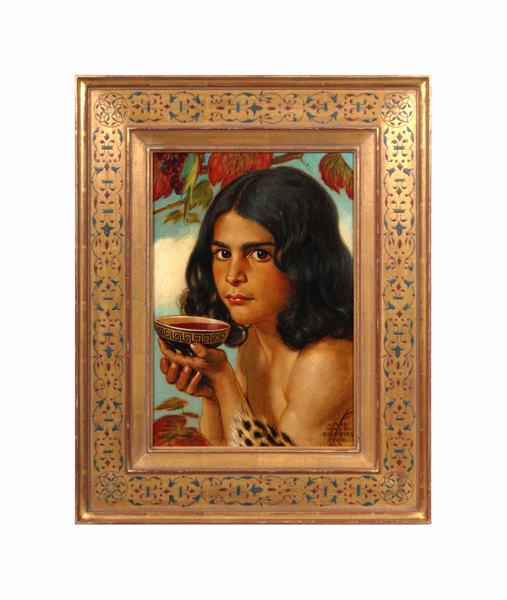
Alfred Meyer-Bernburg, Bacchus, Oil on board, 1924
ALFRED MEYER-BERNBURG (1872-?) Berlin & Munich, Germany
Bacchus 1924
Oil on board
Signed: Alfred Meyer-Bernburg MCNN 1924 (lower right on the canvas)
Image: H: 16” x W: 11”
Framed: H: 23 1/4” x W: 18 3/8”
Price: $39,000
Alfred Meyer-Bernburg was born in Bernburg, Germany on July 27th, 1872. He studied at the Akademie in Berlin from 1891-92 and later at the Akademie der Bildenden Kuenste in Munich from 1897-1904. Meyer-Bernburg was a member of the Münchner Künstlergruppe (MKG).
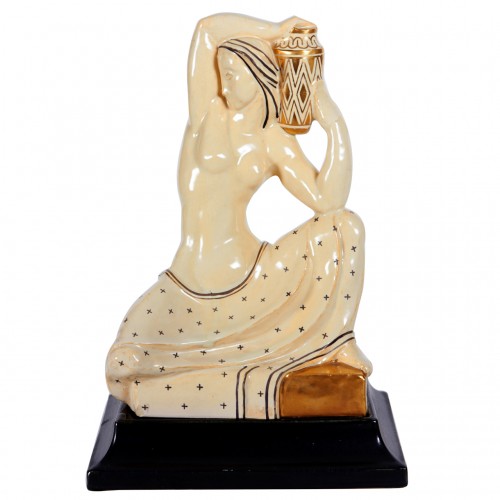
Walter Paul Suter, American Art Deco glazed pottery sculpture 1929
WALTER PAUL SUTER USA
AMERICAN ENCAUSTING TILING CO. New York, NY
Art Deco Seated Female Figure with Draped Skirt and Holding an Art Deco Vase 1929
Hand-modeled and molded cream glazed earthenware figure with gold and silver details on a separate, but matching black glazed earthenware base.
Signed: SUTER ‘29 (under glaze on back right hand corner)
H: 13″ x D: 7 1/2″ x W: 9″
Price: $14,500
Walter Paul Suter was born inBasel, Switzerland in 1902 and studied there at the School of Fine and Applied Arts. He moved to the United States in 1924 and settled in New York. He was a member of the American Ceramic Society, as well as the Society of Swiss Painters, Sculptors & Architects. In 1932 Suter won first prize in the Robineau Member Exhibition in Syracuse. He was a member of the American Encaustic Tiling Company in NYC.



 @hd_jewels
Reviews
There are no reviews yet, would you like to submit yours?