


Product Description
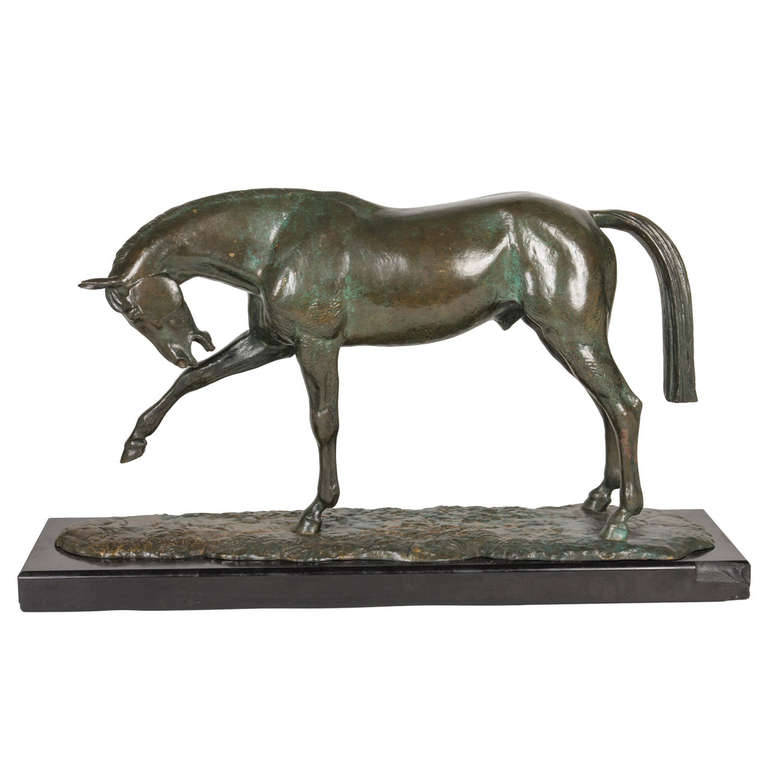
Andre Vincent Becquerel Arabian Horse bronze sculpture c. 1930

ANDRE VINCENT BECQUEREL (1893-1981) France
Arabian Horse sculpture c. 1930
Bronze with overall rich green/brown patina with intricate sculpting and details, black Belgian marble plinth base
Signed: A. Becquerel (inscribed in the bronze)
H: 12” x W: 21” x D: 6”
Price: $27,500
Andre Vincent Becquerel was born in St. Andre-Farivilliers. He studied at the l’Ecole des Beaux Arts in Paris under Hector Lemaire and Prosper Lecourtier. He specialized in fine animal sculpture and regularly exhibited at the Salon des Artistes Francais from 1914 to 1922. Becquerel worked for the Editeur Parisiens Edmond Etling in Paris and created a monumental sculpture in patinated plaster for the “Pavillon international” at the Exposition Internationale in Paris in 1937.
Andre Vincent Becquerel Arabian Horse bronze sculpture c. 1930
You must be logged in to post a comment.
SOPHIE BURGER-HARTMANN (1868-1940) Munich, Germany
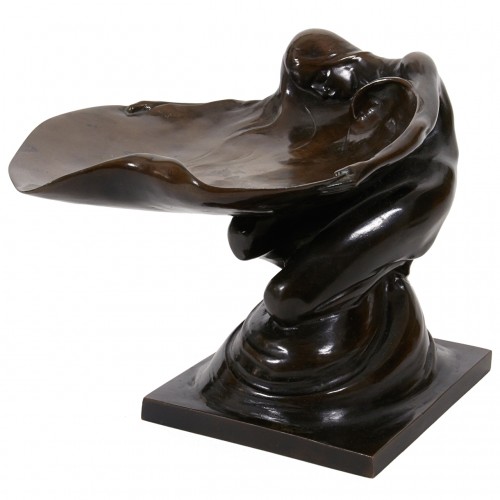
Vide Poche c. 1900
Richly patinated dark brown bronze Vide Poche modeled as a swirling Art Nouveau nymph holding a stylized shell form low tray.
Marks: VW (Vereinigte Werkstätten für Kunst im Handwerk Munich)
H: 6 1/2″ D: 7″ x W: 8″
ANDREE FLAMANT-DUCANY-GIDE (1882-1970) France
VALSUANI FONDEUR (1899-1981) Paris, France
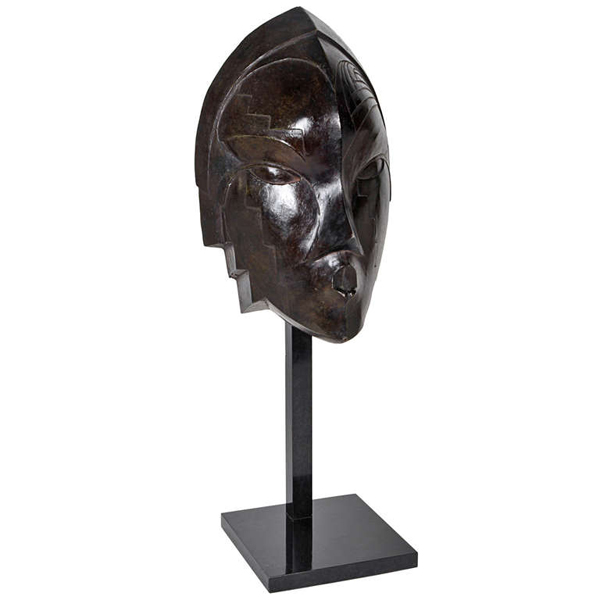
Cubist mask sculpture 20th Century
Cast bronze with rich brown-black patina (possibly cast at a later date by the Valsuani Foundry)
Marks: G. Flamant, 2/8 C. Valsuani Cire Perdue (signed on chin)
H: 11” x W: 7” x D: 5 ½”;
On stand: H: 18 ½”
Price: $35,000
ANDREE FLAMANT-DUCANY-GIDE
Flamant-Gide was born in Nimes, France on January 2nd, 1892 and died on March 28th 1970. She was both a painter and sculptor and exhibited regularly at the Salon des Artists Francais beginning in 1923. She sculpted in an angular Cubist style influenced by African Art and was a fellow artist of Joseph Csaky, Gustave Miklos, Jacques Lipchitz and Henri Laurens who were considered the leading Art Deco sculptors in Paris during the 1920’s.
CUBISM
Cubism drew its influence from: Cezanne’s structural analysis in his oil landscapes, e.g. ‘La Montagne Sainte Victorie’ c.1887; Gauguin’s figurative landscapes, e.g. ‘Haymaking’ 1889; and African tribal Art such as Gabon masks. European artists were greatly influenced by African and Oceanic Art during the late 1890s and early 1900s. African sculpture, with its bold shapes and lines, had a great impact on the development of Cubism. Maurice de Vlaminck became a keen admirer and collector of African masks after seeing them in a Paris anthropological museum. He purchased similar masks and his excitement for these works displaying bold primitive expressions and simplistic design filtered through to Matisse, Derain, Gris and Picasso, who all became collectors as well. By the 1920s African art exhibitions were common in Paris and other cities throughout Europe.
Cubist sculpture brought the simplified shapes of Cubist painting together with the three-dimensional modeling medium of sculpture. The first Cubist sculpture, which could be properly deemed as such was made by Picasso in 1909 and was titled ‘Head of a Woman’. However Picasso did experiment with sculptural forms as early as 1907 when he found himself fascinated and deeply influenced by African masks. Cubist sculpture was mostly reminiscent of Analytical Cubism in its stripping away of illusionist details to reveal the fundamental form contained in each individual subject, be it human or still-life.
VALSUANI FOUNDRY
The Valsuani foundry was started by the brothers Claude and Attilio Valsuani who learned the foundry trade while employed at the Hebrard foundry. While working for Hebrard, Claude Valsuani showed great promise as a finisher and eventually worked his way up to become the Technical Director of the Hebrard foundry. In 1899 Claude Valsuani started his own foundry in Chatillon, casting mostly small works for various artists primarily using the lost wax technique of casting (cire perdue). In 1905 he moved his foundry to 74 Rue des Plantes in Paris. Among the famous sculptors who had the Valsuani foundry cast their works were: Renoir, Picasso, Despiau, Paul Troubetzkoy, Matisse, and Gaugin. Claude Valsuani died in 1923 in his native Italy but his son, Marcele then took over the foundry and continued the tradition of producing extremely fine bronzes until the 1970’s.
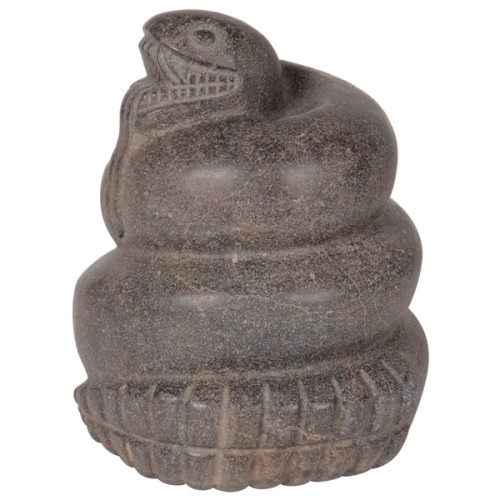
AZTEC AD 1325-1475 Mexico.
Important stone carved sculpture of a coiled serpent, AD 1325-1475 Mexico.
***Two scientific authentication reports are available with this sculpture.
H: 10″ x D: 8″
The serpent played a very important role in Aztec religion and was represented in a variety of forms. The majority of the serpents represented in Aztec sculpture are rattlesnakes.
Mexican mythology indicates the snake is a symbol of veneration, worship and honor. Often a symbol of great power, resurrection and rebirth, the snake continues to be a powerful emblem of renewal and transition.
Further, the snake is recognized as a symbol of humanity as a whole. Interestingly, the Mexican perspective provides hope for mankind to aspire to great heights as it correlates the shedding of the serpent’s skin to man’s ability to change his own circumstances and overcome adversity.
The Aztecs build an impressive empire in the valley of Mexico. This thriving area, known as Tenochitlan, was the cultural, religious and trading center of Mesoamerica. Aztecs were the Native American people who dominated northern Mexico at the time of the Spanish conquest led by Hernan Cortez in the early 16th century. According to their own legends, they originated from a place called Aztlan, somewhere in north or northwest Mexico. At that time the Aztecs (who referred to themselves as the Mexica, or Tenochca) were a small, nomadic, Nahuatl-speaking aggregation of tribal peoples living on the margins of civilized Mesoamerica. Sometime in the 12th century they embarked on a period of wandering and in the 13th century settled in the central basin of México. Continually dislodged by the small city-states that fought one another in shifting alliances, the Aztecs finally found refuge on small islands in Lake Texcoco where, in 1325, they founded the town of Tenochtitlan (modern-day Mexico City). The term Aztec, originally associated with the migrant Mexica, is today a collective term, applied to all the peoples linked by trade, custom, religion, and language to these founders. Warriors and pragmatic builders, the Aztecs created an empire during the 15th century that was surpassed in size in the Americas only by that of the Incas in Peru. As early texts and modern archaeology continue to reveal, beyond their conquests and many of their religious practices, the Aztecs had many positive achievements: the formation of a highly specialized and stratified society and an imperial administration, the expansion of a trading network as well as a tribute system, the development and maintenance of a sophisticated agricultural economy (which was carefully adjusted to the land) and the cultivation of an intellectual and religious outlook that held society to be an integral part of the cosmos.
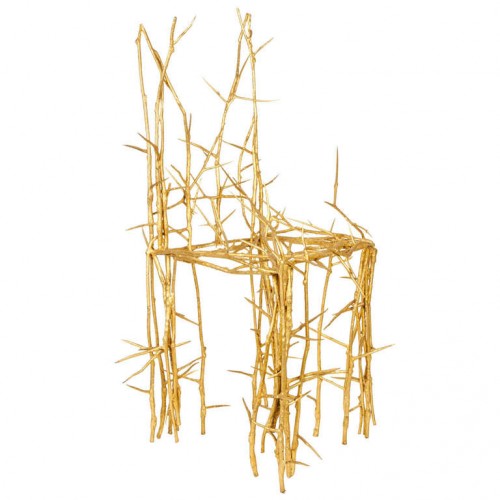
MICHELE OKA DONER (b. 1945) USA
Terrible Chair (unique) 1981
Gilded bronze
Illustrated: Michele Oka Doner, Natural Seduction, S. Ramljak, M. Lapidus, A. C. Danto (New York: Hudson Hills Press, 2003), p. 85
H: 31 ½” x W: 15” x D: 17 ½”
Excerpt from “The Furniture of the Universe” by Arthur C. Danto in Michele Oka Doner: Natural Seduction (New York: Hudson Hill Press) 2003 p. 30
The Terrible Chair
What drew me initially to the work of Michele Oka Doner was the way it acknowledges the rhetoric of sitting and the metaphorical language of furniture and, most particularly, of the chair. Consider, for examples, the work she calls Terrible Chair which a distant affinity to Adirondack furniture as it is cast from a prototype fashioned out of branches. The Adirondack chair itself refers more directly to the forest; it is made of branches and looks as If nothing more than an axe or a hunting knife were needed to construct it. It proclaims the skill of the woodsman prevailing over the forest by seeing it in terms of opportunities for survival rather than representing threats and dangers. The Adirondack chair is a domesticated tree, a bower and as much a testament to the superior power of the seated as a chair with clawed or hoofed legs, in which we sit as master over beasts. The proper habit for it is the hunting lodge, with bearskin rugs suitably prone on the look or the long veranda of a mountain chalet.
Terrible Chair is made of thorned branches, which have a certain menacing beauty but no real use unless to fashion a mocking crown. Oka Doner is drawn to natural objects; they are her models and her motifs, the source of her metaphors. She saw a thorny branch that she found on a neighbor’s property a clear challenge: “The way the thorns were arranged was exquisite,” she recalled. But those same thorns were too threatening to invite physical approach. A thorned plant has an evolutionary advantage because it refuses to yield to human use. This was an irresistible dare to an artist bent on turning the natural into the meaningful.
Terrible Chair is a victory; it defines what it means to be an artist in Oka Doner’s conception of that role. It is equally a victory for the thorns because the utility promised by the chair they form remains unavailable to sitters: the thorned sticks are available only as art but not for use. The radical unusability of the work constitutes a draw in the match with nature, and the bronze in which it is cast forms a suitable monument to that context. Terrible Chair enshrines an objective contradiction.
Nonetheless, the components of the Terrible Chair are combined to form a chair, but because there is no seat, no one would know how to use it in a conventional way. There have been treacherous chairs that have concealed their treachery, subverted the confidence shown in the act of sitting—chairs that collapse beneath their users, The Marquis de Sade offered chairs to female sitters that rotated them through an abrupt arch onto their backs and into a position of sexual accessibility from vertical dignity to horizontal vulnerability. By contrast, no one is tempted to sit on a Terrible Chair so dignity is at least not put in threat. So what is its meaning? In its outward inhospitality, the work says, in effect, “This chair is not for sitting.” It has to have the form of a chair to deliver this message. It excludes the chair from use as if to underscore the message, it excludes the chair from use as if to deliver the truth that chairs count in the game of meanings, transmitting auras to their occupants. It acquires a fairy tale inaccessibility like the glass slipper in Cinderella into which only the tiny foot of a natural princess can slip. Terrible Chair— a name, the artist told me, her two sons helped select—promises to transform whoever claims it. But clearly we are not its intended occupants. So it stands as a reminder of the higher meanings of chair to those who may have relegated them to the drab language of utility. Through its thorny point, brandished like the spikes on medieval armor, Terrible Chair transfers itself the power that sitting in it would confer.
I think of Terrible Chair as Oka Doner signature work, transmitting the message through its sharp spins that although she makes chairs, she is no a designer but an artist. And though the chair is part of the domestic lexicon, her project is to bring meaning rather than comfort. Should her work provide comfort, it is an incidental by-product of a class that acknowledges human needs but transform their satisfaction into symbolic acts and cosmic endorsements. Gesturing toward the spiky, spiny objects that furnish her tremendous loft—transfigurations of natural forms cast in various metals that carry their own system of meanings—Oka Doner draws attention to the fact that nothing here is upholstered. She likes the hard, the skeletal, the pronged and edgy armature of carapace, the natural scaffoldings t hat give shape and structure to the vulnerabilities of living things. It is the inner architectures whose natural powers we acquires as our own when we use those forms as evocations and signs , in the manner in which peoples who live close to nature use teeth, their claws, the furs and the feathers of wild animals as talismans of great power. Her furniture consists of so many apertures through which the cosmos enters the space of domestic life, transforming a utilitarian object into something that transcends that use and transforms the user into a participants in a celestial trial. Her aim, she confides, is to ritualize ordinary life. And this is an artistic practice far more deeply connected with the meaning than making things to hang on walls or stand in corners simply for visual delectation.
MICHELE OKA DONER (b. 1945) New York, NY
Michele Oka Doner is an internationally acclaimed New York-based artist and designer whose work translates natural forms–plant fronds, berries, shells, and life observed beneath the lens of the microscope–into objects of extraordinary power and seduction rendered in bronze, precious metals and stones, concrete handmade papers, ceramic, and now, glass. Since first appearing on the national scene in 1970 as the youngest artist showcased in the defining landmark museum exhibition Objects USA. Oka Doner has built a career encompassing monumental sculptures, public art, jewelry, and functional objects that range from fireplace tools to evening bags.
Oka Doner was born in Miami Beach in 1945. Though she received her formal education and advanced degrees at the University of Michigan in Ann Arbor, the artist has always cited as her primary laboratory the turbulent natural treasures of Southern Florida’s oceans, tidal pools, beaches, gardens and tropical forests–boundless living resource libraries she visits on a monthly basis to gaze upon and gather samples that later inspire pieces of every size and type. Oka Doner has said that she strives with her work to “play the role of the translator and editor of life forces creating objects that go far beyond static formal beauty to encourage contemplation and wonder.” Informed by her ongoing research into scientific literature and poetry, as well as her expeditions in the natural world, Oka Doner uses the tools of physical expression to invite us along on her wanderings through the realm of the infinite.
Oka Doner is also admired for her numerous site-specific, permanent public art commissions including such projects as the golden tiled Radiant Site at New York’s Herald Square Subway Station (1990) and A Walk on the Beach, a half-mile long expanse of terrazzo and bronze floor continually unfolding at Concourse A of Miami International Airport (1995 to present). Oka Doner’s sculptures and functional objects are included in many prestigous private and public collections, including those of The Metropolitan Museum of Art and the Smithsonian’s Cooper-Hewitt National Design Museum in New York City, the Art of Institute of Chicago and the Virginia Museum of Fine Arts, among others. She has participated in scores of distinguished exhibitions internationally and has been recipient of numerous grants and awards, including honors from the Kress Foundation and the New York State Council for the Arts. In 2004 she received the coveted Award of Excellence from the United Nations Society of Writers and Artists.
 @hd_jewels
Reviews
There are no reviews yet, would you like to submit yours?