Signed: Paris 1927, A.Kertesz, Page 150 (in pencil on back); ANDRÈ KÈRTESZ (stamped on back).
Framed size: H: 16 5/8” x W: 17 13/16”
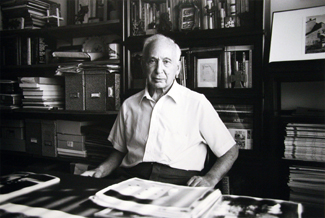
Throughout most of his career, Kertész was depicted as the “unknown soldier” who worked behind the scenes of photography, yet was rarely cited for his work, even into his death in the 1980s. His work itself is often described as predominantly utilizing light and even Kertész himself said that “I write with light”. He was never considered to “comment” on his subjects, but rather capture them – this is often cited as why his work is often overlooked; he stuck to no political agenda and offered no deeper thought to his photographs other than the simplicity of life. With his art’s intimate feeling and nostalgic tone, Kertész’s images alluded to a sense of timelessness that was inevitably only recognized after his death. Unlike other photographers, Kertész’s work gave an insight into his life, showing a chronological order of where he spent his time; for example, many of his French photographs were from cafés where he spent the majority of his time waiting for artistic inspiration. Although Kertész rarely received bad reviews, it was the lack of them that lead to the photographer feeling distant from recognition. Now however, he is often considered to be the father of photojournalism. Even other photographs cite Kertész and his photographs as being inspirational; Henri Cartier-Bresson once said of him in the early 1930s, “We all owe him a great deal”.
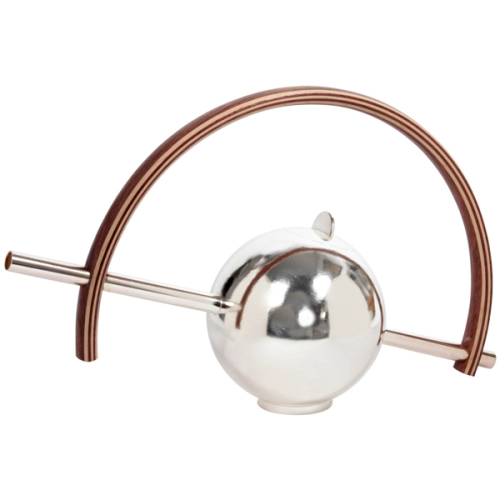
Wolfgang Gessl / Scandinavian Modern Sterling silver teapot with arching handle 1990
WOLFGANG GESSL (b. 1949) Austria / Sweden
Teapot 1990
Hand wrought and hand hammered spherical silver teapot with cylindrical handle and spout elements, maple and padouk wood layered arching handle
This is No. 2 out of the edition of 3 models.
Marks: Wolfgang Gessl (script impressed signature), 2/3, WO.GE (in a rectangle), Swedish assay mark for Stockholm, 925 (silver guarantee in a rectangle), E11 (in a rectangle), LF
Exhibited: Glänsande Geometri, Mettalum, Stockholm, Sweden
Illustrated: Gold and Silversmith Wolfgang Gessl: Exceeding Geometry, Kerstin Wickman, p. 16.
H: 10” x W: 16 ½” x D: 5 ½”
Price: $32,000
Wolfgang Gessl was born in 1949 in Vienna, Austria and trained as a goldsmith with Professor Hans Angerbauer. Upon moving to Sweden, Gessl studied under the eminent silversmith Sigurd Persson at Konstfack, the National University of Art, Craft and Design in Stockholm, Sweden.
Wolfgang Gessl has had fifteen solo exhibitions including shows at The National Museum, Stockholm and The Royal College of Art in London. His metalwork has been widely exhibited in Sweden, Europe and the U.S and his pieces can be found in many private collections throughout the world. He has taught at Konstfack for more than twenty-four years, and continues to live and work in Stockholm.
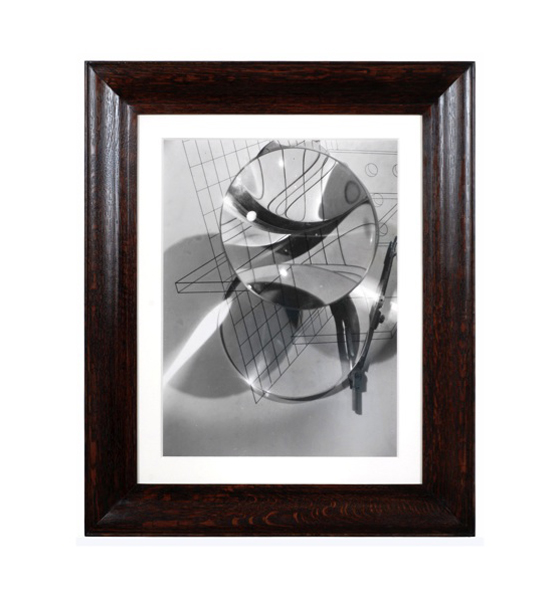
György Kepes, Lens Refraction, Gelatin silver print, 1939
GYÖRGY KEPES (1906-2001) Hungary/USA
Lens Refraction 1939
Signed: 6 (in a circle, on back); Gyorgy Kepes 1939 (in pencil on back)
Illustrated: New Bauhaus, 50 Jahre: Bauhausnachfolge in Chicago (Berlin: Bauhaus-Archiv and Argon Verlag GmbH: 1987), p. 185
Framed size: H: 27 1/8” x W: 22 ¼”
György Kepes was a Hungarian-born painter, designer, educator and art theorist. After emigrating to the U.S. in 1937, he taught design at the New Bauhaus (later the School of Design, then Institute of Design, then Illinois Institute of Design or IIT) in Chicago. In 1947 He founded the Center for Advanced Visual Studies at the Massachusetts Institute of Technology (MIT) where he taught until his retirement in 1974.




 @hd_jewels