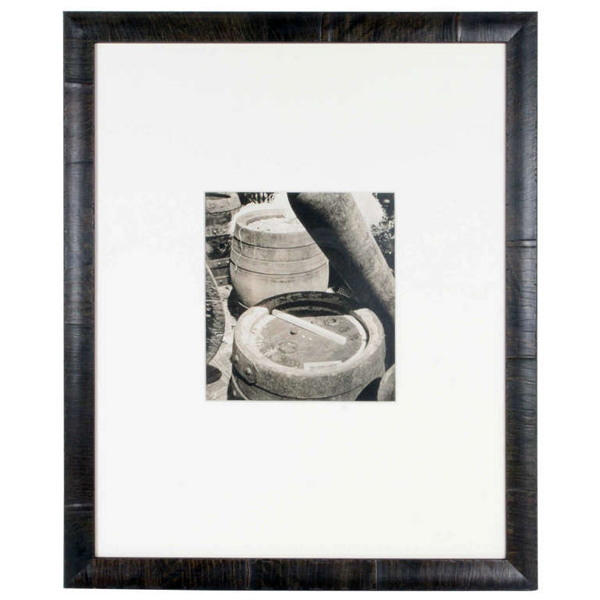
Signed: Paris 1927, A.Kertesz, Page 150 (in pencil on back); ANDRÈ KÈRTESZ (stamped on back).
Framed size: H: 16 5/8” x W: 17 13/16”
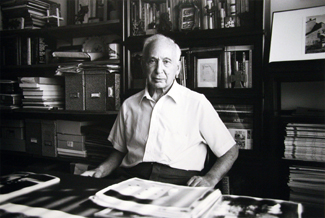
Throughout most of his career, Kertész was depicted as the “unknown soldier” who worked behind the scenes of photography, yet was rarely cited for his work, even into his death in the 1980s. His work itself is often described as predominantly utilizing light and even Kertész himself said that “I write with light”. He was never considered to “comment” on his subjects, but rather capture them – this is often cited as why his work is often overlooked; he stuck to no political agenda and offered no deeper thought to his photographs other than the simplicity of life. With his art’s intimate feeling and nostalgic tone, Kertész’s images alluded to a sense of timelessness that was inevitably only recognized after his death. Unlike other photographers, Kertész’s work gave an insight into his life, showing a chronological order of where he spent his time; for example, many of his French photographs were from cafés where he spent the majority of his time waiting for artistic inspiration. Although Kertész rarely received bad reviews, it was the lack of them that lead to the photographer feeling distant from recognition. Now however, he is often considered to be the father of photojournalism. Even other photographs cite Kertész and his photographs as being inspirational; Henri Cartier-Bresson once said of him in the early 1930s, “We all owe him a great deal”.
Donald Deskey was a native of Blue Earth, Minnesota. He studied architecture at the University of California, but did not follow that profession, becoming instead an artist and a pioneer in the field of Industrial design. In Paris he attended the 1925 Exposition Internationale des Arts Décoratifs et Industriels Modernes, which influenced his approach to design. He established a design consulting firm in New York City, and later the firm of Deskey-Vollmer (in partnership with Phillip Vollmer) which specialized in furniture and textile design. His designs in this era progressed from Art Deco to Streamline Moderne.
He first gained note as a designer when he created window displays for the Franklin Simon Department Store in Manhattan in 1926. In the 1930's, he won the competition to design the interiors for Radio City Music Hall. In the 1940's he started the graphic design firm Donald Deskey Associates and made some of the most recognizable icons of the day. He designed the Crest toothpaste packaging, as well as the Tide bullseye. His company is still in operation in Cincinnati. A collection of his work is held by the Cooper-Hewitt, National Design Museum. He is regarded the American pioneer of industrial design, and contemporary American graphic design.
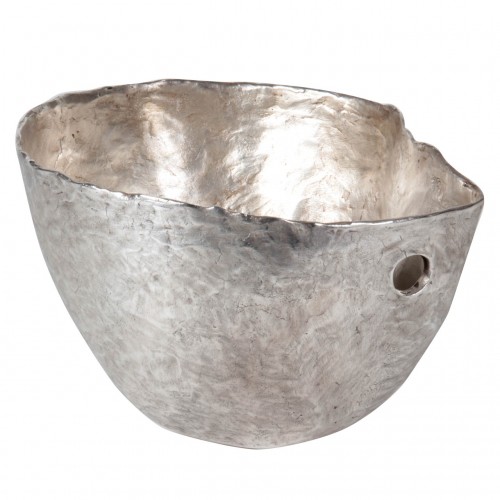
Linda Lee Johnson, Organic Shaped Sculpted Silver bird bowl Vessel XII c. 2004
LINDA LEE JOHNSON (1944-2018) Washington, DC
Sculpted silver bowl “Vessel XII” c. 2004
Irregular organic shaped lost wax cast silver bowl with an irregular shaped top and one pierced hole (3/4 inch). Approx. silver weight is 80 troy ounces.
Marks: Logo monogram, 5/20, initial monogram
H: 5 1/4″ x W: 8 1/2″ x D: 7 1/4″
At the age of three Linda Lee Johnson was given a handmade Native American bracelet from her father, a naval aviator, and subsequently another every time they crossed the country. By the time she was seven, she had seven bracelets which she never removed. She was an American field service exchange student to Greece in high school. It was here that she developed her love of theater, sculpture and ancient
jewelry. She graduated from the University of California, Berkeley, in English literature and dramatic art and immediately began to study sculpture making.
She was a founding member of the Berkeley Repertory Theatre, and a professional actress for nineteen years with many major roles in New York city and regional theaters around the country and abroad.
She studied jewelry making in New York City 1984-88.
In 1986, she was asked to place her pieces in Tiffany & Co. in all major stores. At the same time she had many featured pieces of jewelry, small sculpture and functional objects in the Museum of Modern Art design store.
Barney’s New York began to represent her in l989, where her jewelry and limited edition decorative art work are still found today.
She lived in Washington DC and the Adirondack Mountains where she continued to craft and sculpt her jewelry and decorative works of art until her passing in 2018.
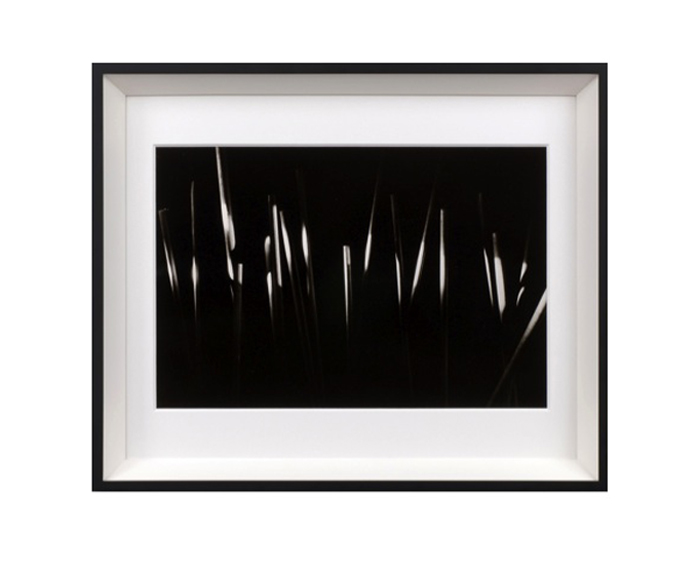
Illustrated: New Bauhaus, 50 Jahre: Bauhausnachfolge in Chicago (Berlin: Bauhaus-Archiv and Argon Verlag GmbH: 1987), p. 177
H: 18 5/8” x 22 ½” (framed)
Nathan Lerner’s long career was inextricably bound up in the history of visual culture in Chicago. Born in 1913 to immigrants from Ukraine, he began studying painting at the Art Institute of Chicago at the age of 16, taking up the camera to perfect his compositional skills. At 22 he began doing a kind of photojournalism, developing his well-known series on ”Maxwell Street,” an immigrant neighborhood hit hard by the Depression, and also photographing the southern Illinois mining area. In 1936 when the New Bauhaus was established in Chicago by Lazlo Moholy-Nagy, Lerner became one of its first scholarship students and turned increasingly to photographic experimentation. He began making semi-abstract, strongly Constructivist images involving luminous projections, solarization, photograms and other methods, and his interest in manipulating light led him to invent the first ”light box.” In 1939 he became the assistant of Gyorgy Kepes, head of the school’s light workshop; together, they wrote ”The Creative Use of Light” (1941). With Charles Niedringhaus in 1942 he developed a machine for forming plywood that was used in making most of the school’s furniture. After working as a civilian light expert for the Navy in New York during World War II, Lerner returned to the school, now called the Institute of Design, and was named education director after Moholy-Nagy’s death in 1946. He left in 1949, opening a design office that became nationally known for its furniture, building systems and glass and plastic containers (including bottles for Revlon and Neutrogena and the Honeybear honey container). In 1968 Lerner married Kiyoko Asia, a classical pianist from Japan, and over the next two decades made numerous trips to Japan, where he took his first color photographs, as well as Mexico. He had his first solo exhibition of photography in 1973 and thereafter exhibited regularly in galleries and museums in the United States, Europe and Japan. His work is included in photography and design collections around the world. (Roberta Smith, New York Times, February 15, 1997).
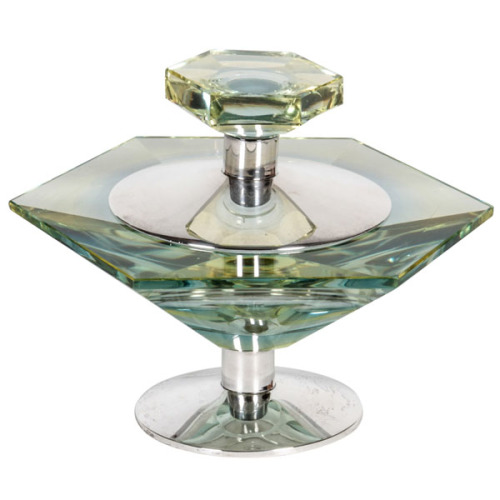
Hexagonal green-tinted lead crystal covered dish / tazza with lid in a stepped jewel-like form mounted with a silver lid and footed base silver
Marks: WMF logo, moon, crown, 800
For more information see: Wilhelm Wagenfeld und die Moderne Glasindustrie,Walter Scheiffele (Stuttgart: Verlag Gerd Hatje, 1994); WMF Ikora Metall / Metalwork, Carlo Burschel and Heinz Scheiffele (Stuttgart, Germany: ARNOLDSCHE, 2006).




 @hd_jewels