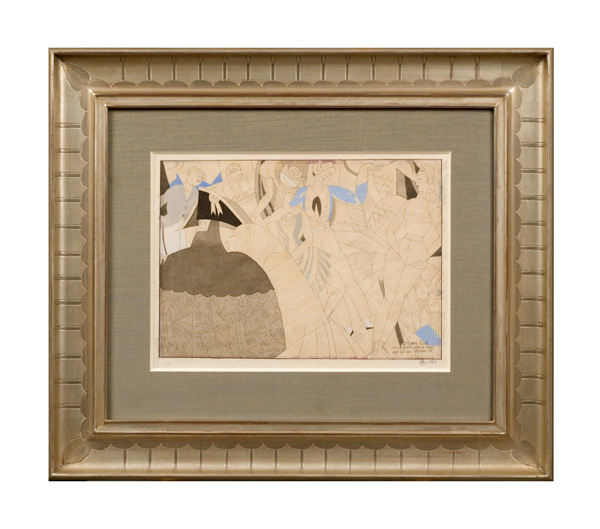
Charles Martin, "Feu d’Artifice", Pencil, ink, gouache and watercolor on paper 1927
More Information
Charles Martin, “Feu d’Artifice”, Pencil, ink, gouache and watercolor on paper 1927
CHARLES MARTIN (1884-1934) France
Feu d’Artifice 1927
Pencil, ink, gouache and watercolor on paper.
Signed: Martin, A L’Ami Koval (dedication on lower right corner)
H: 8” x W: 11 7/16”
Price: $12,500
Charles Martin was a notable French illustrator, graphic artist, posterist, fashion and costume designer. His drawings are charming, amusing and sophisticated. The artist studied at the Montpelier Ecole des Beaux Arts, Academie Julian and Ecole Des Beaux Arts, Paris. Throughout his career, Martin was also a contributor to the French fashion journals Gazette du Bon Ton, Modes et Manieres d’Aujourd’hui, Journal Des Dames et Des Modes, and Vogue. His illustrated books include the hat catalogue “Les Modes en 1912,” the erotic “Mascarades et Amusettes” 1920, and “Sports et Divertissements” 1919, written in collaboration with composer Erik Satie.
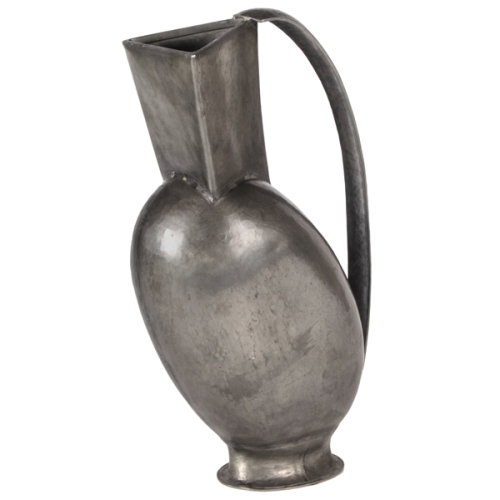
Italian Futurist 1950’s “Auntie Mame” Handwrought Pewter Pitcher c.1950
1950’s ITALIAN DESIGN
Futurist pitcher c. 1950
Handwrought and hand hammered pewter in an overall footed ovoid form with a traingle form spout body and an elongated arching contoured handle
Marked: PELTRO with lion, MADE ITALIA
H: 15″ x W: 9″ x D: 4″
Price: $6,000
The 1958 classic film, Auntie Mame, starring Rosalind Russell, features this sculptural pitcher on the coffee table in the surrealist interior of Mame Dennis’ penthouse on Beekman Place #3, New York City.
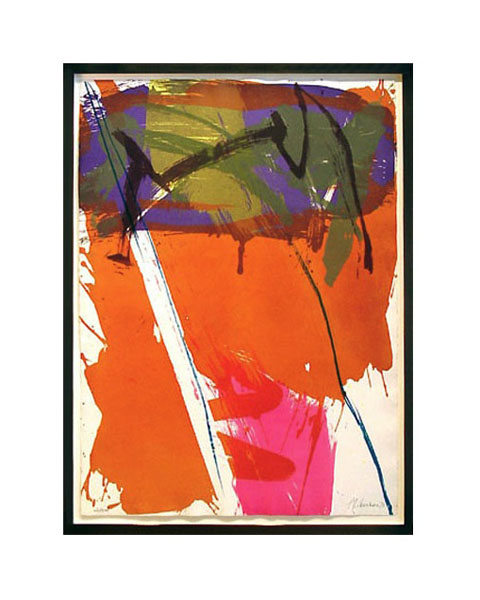
Alexander Liberman / Meyer Schapiro Portfolio Untitled 1973
ALEXANDER LIBERMAN (1912-1999) USA
MEYER SCHAPIRO PORTFOLIO 1974
Untitled 1973
Silkscreen, patinated bronze frame
Signed: A. Liberman 1973, Artist’s proof, 2RC (embossed on paper)
Canvas: H: 33” x W: 25 1/2”
Frame: H: 42 1/2” x W 33 1/2”
Portfolio of 12 works, Edition of 100
Price: $
Alexander Liberman’s family left the Soviet Union for London as exiles in 1921. Liberman studied there briefly before moving to Paris where he undertook philosophy and mathematics at the Sorbonne and architecture at the École des Beaux-Arts. In the 1930s Liberman designed stage sets, and worked on the staff of Vu, the first magazine illustrated with photographs. Although Liberman quickly earned the title of managing director, he left the magazine in 1936, and devoted himself to painting and writing. In 1941, he left Paris for New York. Again, he became involved in publishing after gaining employment at Vogue magazine. Twenty years later, in 1962, he became Editorial Director of all Condé Nast Publications, a position he held until he retired in 1994. During his time at Vogue, Liberman introduced 20th-century art to readers by using it as a backdrop for fashion shoots, as well as by profiling living artists in the magazine. As a painter, Liberman exhibited geometric circle paintings in galleries and museums around New York in the 1950s. Liberman also had an interest in sculpture, and began welding steel into public works in the late 1950s. These monochrome geometric sculptures are featured in over 40 cities worldwide.
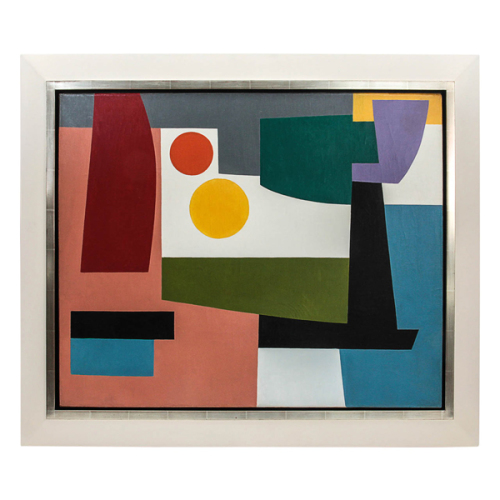
Marks: Untitled, 1950, Robert Breer, 26×32, No. 29 in a circle (paper label)
Provenance: Robert Breer, Private Collection, Chicago
Canvas: H: 25 3/4” x W: 32”
Framed: H: 32 1/4” x W: 39″
“Breer acknowledges his respect for this purist, “cubist” cinema, which uses geometric shapes moving in time and space”
Robert Breer’s career as an artist and animator spans 50 years and his creative explorations have made him an international figure. He began his artistic pursuits as a painter while living in Paris from 1949-59. Using an old Bolex 16mm camera, his first films, such as “Form Phases”, were simple stop-motion studies based on his abstract paintings.
Breer has always been fascinated by the mechanics of film. Perhaps it was his father’s fascination with 3-D work that inspired Breer to tinker with early mechanical cinematic devices. His father was an engineer and designer of the legendary Chrysler Airflow automobile in 1934 and built a 3-D camera to film all the family vacations. After studying engineering at Stanford, Breer changed his focus toward handcrafted arts and began experimenting with flip books. These animations, done on ordinary 4″ by 6″ file cards have become the standard for all of Breer’s work in fim.
Like many of his generation, Breer did early work influenced by the various European modern art movements of the early 20th century, ranging from the abstract forms of the Russian Constructivists and the structuralist formulas of the Bauhaus, to the nonsensical universe of the Dadaists. As a result of his association with the Denise René Gallery, which specialized in geometric art, he saw the abstract films of such pioneers as Hans Richter, Viking Eggeling, Walter Ruttmann and Fernand Léger. Breer acknowledges his respect for this purist, “cubist” cinema, which uses geometric shapes moving in time and space.
In 1955, he helped organize and exhibited in a show in Paris entitled “Le Mouvement” (The Movement), which paved the way for new cinema aesthetics. During this period, Breer also met the poet Allen Ginsberg and introduced him to his film “Recreation” (1956), which made use of frame-by-frame experiments in a non-narrative structure. Although Breer resisted being labeled a beatnik, the film does capture some aspects of beat poetry and music.
When Breer returned to the United States in the late 1950s, the American avant-garde was thriving and films by Kenneth Anger, Stan Brakhage, Peter Kubelka and Maria Menken were creating a new visionary movement. Breer found kindred spirits within the New York experimental scene. As Pop Art emerged as a phenomenon in the 1960s, Breer befriended Claes Oldenburg and others. He worked on the TV show, “David Brinkley’s Journal”, filming pieces on art shows in Europe; at the same time, he made his debut documentary on the sculptor Jean Tinguely in 1961.


 @hd_jewels