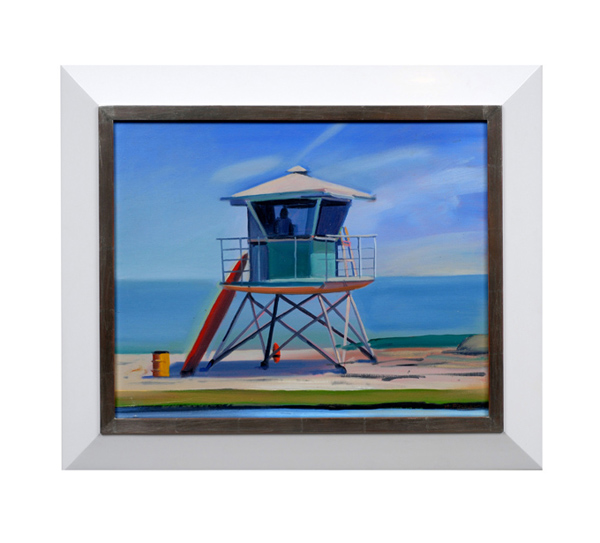
Hank Pitcher, "Life Guard Tower", Oil on canvas c. 2002
More Information
Hank Pitcher, “Life Guard Tower”, Oil on canvas c. 2002
HANK PITCHER (b. 1949) U.S.A.
“Life Guard Tower” c. 2002
Oil on canvas
Signed (on back)
For more information see: Hank Pitcher Surf, exhibit. cat. (Santa Barbara: Sullivan Goss Gallery, 2003); Surfboard Wax – A History, Jefferson “Zuma Jay” Wagner (Atglen, PA: Schiffer Publishing Ltd., 2005).
Canvas H: 15 7/8” x W: 19 7/8”
Framed: H: 21 3/8” x W: 25 3/8”
Pitcher’s surfboard paintings are the symbol of California beach culture…strong, definite, positive and euphoric statements about life in California. The surfboard’s power as totem is seen in its power to convey identity: surfer, Californian, Hank Pitcher. All are identifiable from this symbolic representation. Hank Pitcher is the voice of California culture. At the beach, in the surf, approaching the foothills, in the mountains, on the spit of Point Conception, in the crags of Big Sur, at a beach campfire in Santa Barbara, Pitcher paints the icons of California’s culture.
Hank Pitcher’s paintings are grounded in a particular sense of place. He was born in Pasadena, California on July 20, 1949, but his family moved to Isla Vista, near Santa Barbara, when he was two years old. When they came to Isla Vista it was an outpost on the beach, and Goleta was a farm town where kids rode their horses down the avenue to buy candy at the store. He was a football star at San Marcos High School and was recruited by big-name universities. Instead of football, he chose to attend the College of Creative Studies, an alternative program within the University of California at Santa Barbara (UCSB) where he now teaches painting. He splits his time between painting and surfing, pursuing each with the commitment and energy of a linebacker.
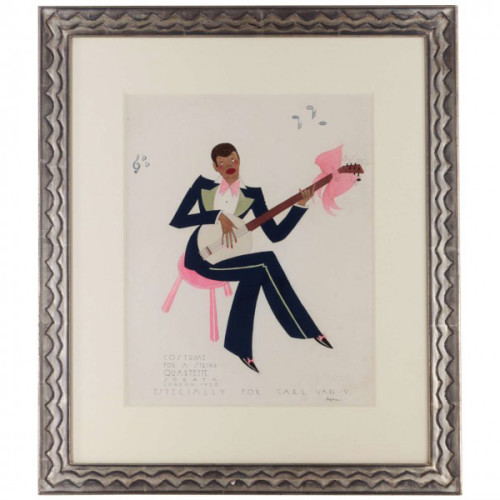
S O G A T A New York, NY, “Costume for a String Quartette” Watercolor and pencil on paper 1930
S O G A T A New York, NY
“Costume for a String Quartette” 1930
Watercolor and pencil on paper
Signed: COSTUME FOR A STRING QUARTETTE. SOGATA. LONDON: 1930. ESPECIALLY FOR CARL VAN V. with script signature (in pencil on lower left and beneath image)
For contextual history and similar art see: Rhapsodies in Black : Art of the Harlem Renaissance,(Berkeley: University of California Press, 1997); Harlem Renaissance Artists. Jordan, Denise (Chicago: Heinemann Library, 2003).
Paper H: 14 7/8″ x W: 10 7/8 ”
Image H: 14″ x W: 10 1/2″
Frame H: 20 1/2” x W: 17 1/4”
*This SOGATA New York Watercolor and pencil on paper has been gifted to The Wolfsonian – FIU, Miami Beach, FL.
Carl van Vechten (1880-1964), to whom this artwork is dedicated, was an influential novelist, critic, and photographer in New York during the 1920s, 30s, and 40s. His role in the Harlem Renaissance is well-documented. Van Vechten also introduced Miguel Covarrubias, a caricaturist and contemporary of Sogata, to prominent Manhattan artistic and society circles.
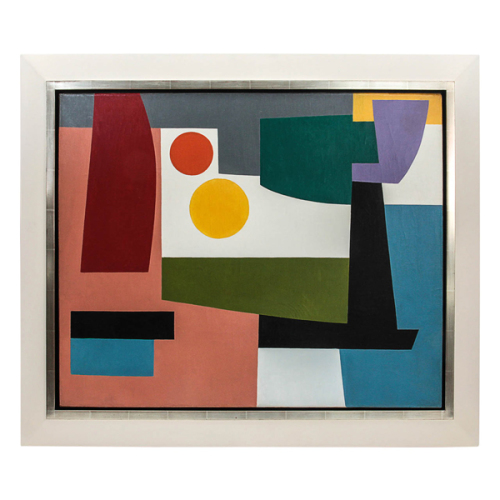
Marks: Untitled, 1950, Robert Breer, 26×32, No. 29 in a circle (paper label)
Provenance: Robert Breer, Private Collection, Chicago
Canvas: H: 25 3/4” x W: 32”
Framed: H: 32 1/4” x W: 39″
“Breer acknowledges his respect for this purist, “cubist” cinema, which uses geometric shapes moving in time and space”
Robert Breer’s career as an artist and animator spans 50 years and his creative explorations have made him an international figure. He began his artistic pursuits as a painter while living in Paris from 1949-59. Using an old Bolex 16mm camera, his first films, such as “Form Phases”, were simple stop-motion studies based on his abstract paintings.
Breer has always been fascinated by the mechanics of film. Perhaps it was his father’s fascination with 3-D work that inspired Breer to tinker with early mechanical cinematic devices. His father was an engineer and designer of the legendary Chrysler Airflow automobile in 1934 and built a 3-D camera to film all the family vacations. After studying engineering at Stanford, Breer changed his focus toward handcrafted arts and began experimenting with flip books. These animations, done on ordinary 4″ by 6″ file cards have become the standard for all of Breer’s work in fim.
Like many of his generation, Breer did early work influenced by the various European modern art movements of the early 20th century, ranging from the abstract forms of the Russian Constructivists and the structuralist formulas of the Bauhaus, to the nonsensical universe of the Dadaists. As a result of his association with the Denise René Gallery, which specialized in geometric art, he saw the abstract films of such pioneers as Hans Richter, Viking Eggeling, Walter Ruttmann and Fernand Léger. Breer acknowledges his respect for this purist, “cubist” cinema, which uses geometric shapes moving in time and space.
In 1955, he helped organize and exhibited in a show in Paris entitled “Le Mouvement” (The Movement), which paved the way for new cinema aesthetics. During this period, Breer also met the poet Allen Ginsberg and introduced him to his film “Recreation” (1956), which made use of frame-by-frame experiments in a non-narrative structure. Although Breer resisted being labeled a beatnik, the film does capture some aspects of beat poetry and music.
When Breer returned to the United States in the late 1950s, the American avant-garde was thriving and films by Kenneth Anger, Stan Brakhage, Peter Kubelka and Maria Menken were creating a new visionary movement. Breer found kindred spirits within the New York experimental scene. As Pop Art emerged as a phenomenon in the 1960s, Breer befriended Claes Oldenburg and others. He worked on the TV show, “David Brinkley’s Journal”, filming pieces on art shows in Europe; at the same time, he made his debut documentary on the sculptor Jean Tinguely in 1961.
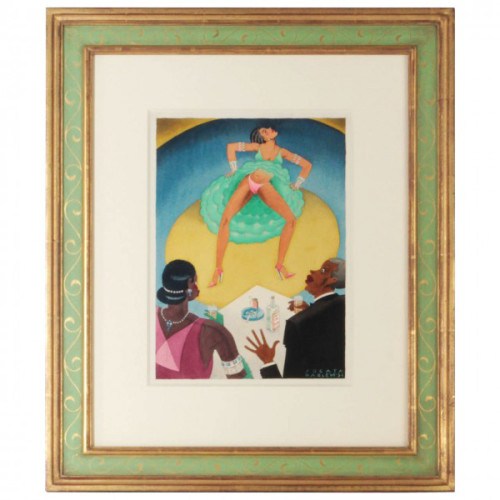
S O G A T A New York, NY “Harlem: Concert” Watercolor and pencil on paper 1931
S O G A T A New York, NY
“Harlem: Concert” 1931
Watercolor and pencil on paper
Signed: SOGATA · HARLEM 1931 (in pencil, lower left corner of image); HARLEM: CONCERT. (in pencil beneath image on left)
For contextual history and similar art see: Rhapsodies in black : art of the Harlem Renaissance, (Berkeley: University of California Press, 1997); Harlem Renaissance Artists. Jordan, Denise (Chicago: Heinemann Library, 2003).
Paper H: 14 7/8″ x W: 10 7/8″
Image H: 11″ x W: 7 1/2″
Frame H: 19 1/4” x W: 16”
*This SOGATA New York Watercolor and pencil on paper has been gifted to The Wolfsonian – FIU, Miami Beach, FL.



 @hd_jewels