Product Description
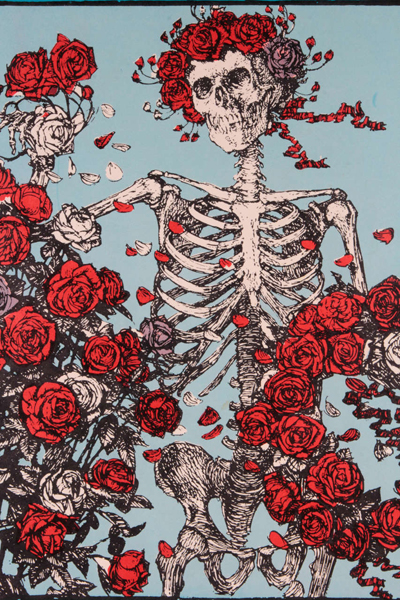
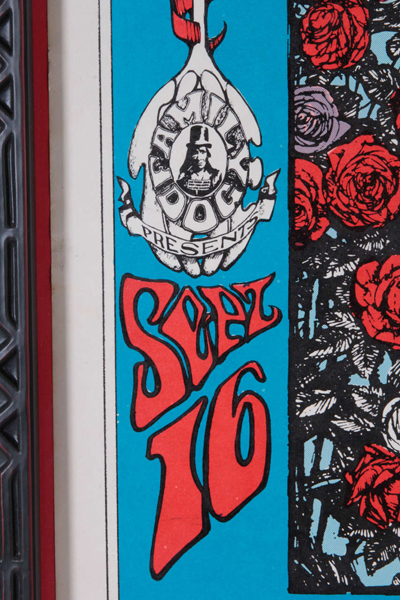
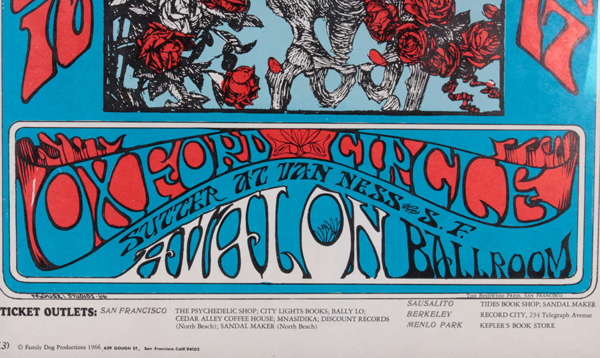
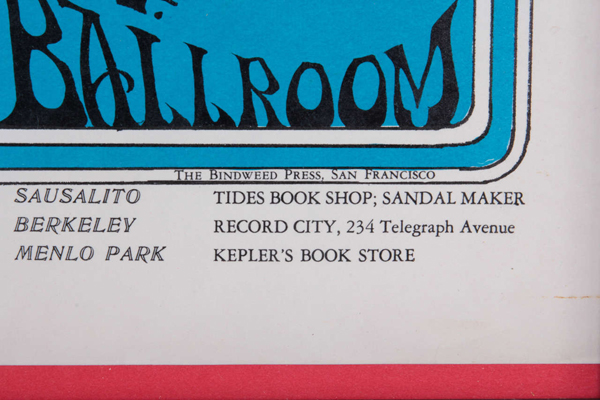
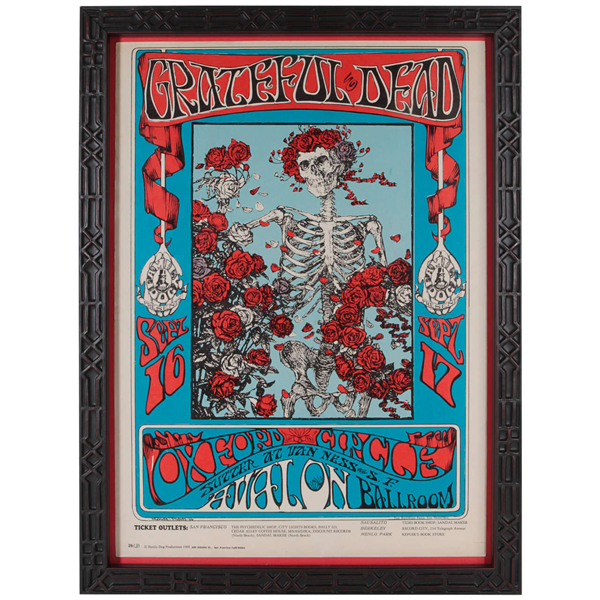
Stanley Mouse / Alton Kelley, Grateful Dead & Oxford Circle at the Avalon Ballroom September 16 -17, 1966

STANLEY MOUSE USA
ALTON KELLEY USA
Grateful Dead & Oxford Circle at the Avalon Ballroom September 16 -17, 1966
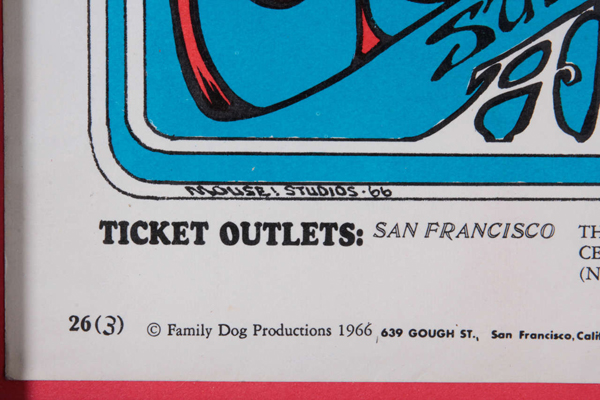
Marked: Mouse Studios 66, 26(3), (c) Family Dog Productions 1966 639 Gough St., San Francisco, Calif. 94102
H: 20″ x W: 14″
Born in Detroit, Stanley Miller became known as “Mouse” after illustrating countless notebooks with his signature rodent sketch. Miller found an outlet for his creativity in pin-striping cars and airbrushing hot rod designs on posters and T-shirts. Mouse migrated to San Francisco in 1964, where he first met the artists associated with Family Dog, the organization producing dance concerts at the Avalon Ballroom. With collaborator Alton Kelley, Mouse experimented broadly with composition, lettering and imagery: Kelley came up with the ideas and Mouse executed the designs. Mouse and Kelley helped to establish the psychedelic style of expression under the name Mouse Studios.
Stanley Mouse / Alton Kelley, Grateful Dead & Oxford Circle at the Avalon Ballroom September 16 -17, 1966
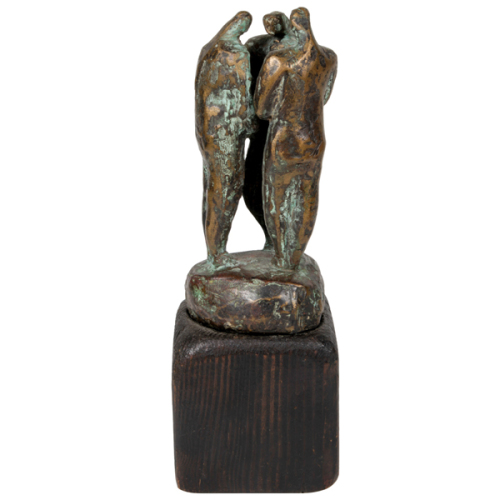
Mayo Martin Johnson (b. 1904) USA
“Summit Conference” 1960
Patinated bronze with a verdigris patina in the recessed areas and natural bronze highlights, original wooden plinth / base.
Marks: Red painted museum accession marks
For more information see: American Art, ed. Peter Hastings Falk (Madison, Conn.: Sound View Press, 1985) p. 317.
H: 10 ¼” on plinth
Price: $6,000
S O G A T A New York, NY
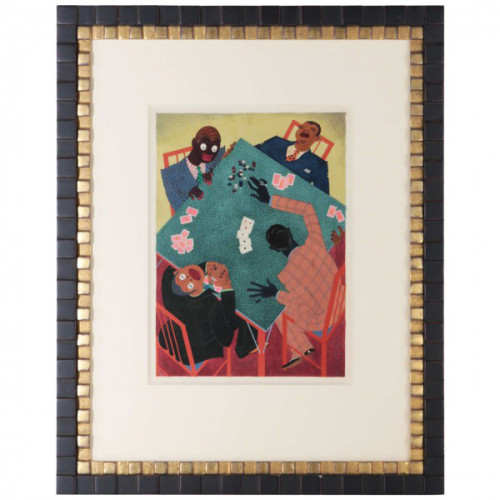
“Harlem: Five Aces” 1931
Watercolor and pencil on paper
Signed: SOGATA, HARLEM 1931 (painted, lower right corner of image); HARLEM: FIVE ACES. (in pencil beneath image on left)
For contextual history and similar art see: Rhapsodies in black : art of the Harlem Renaissance, (Berkeley: University of California Press, 1997); Harlem Renaissance Artists. Jordan, Denise (Chicago: Heinemann Library, 2003).
Paper H: 14 7/8″ x W: 10 7/8 ”
Image H: 11″ x W: 7 1/2″
Frame H: 19” x W: 15 1/4”
*This SOGATA New York Watercolor and pencil on paper has been gifted to The Wolfsonian – FIU, Miami Beach, FL.
FORREST (FROSTY) MYERS (1941- ) USA
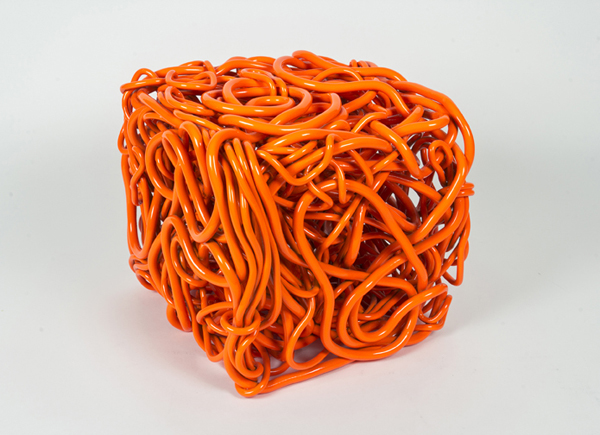
Orange cube 2008
Orange anodized and contoured aluminum wire manipulated into a cube form
Signed: Orange Cube, 08, Forrest Myers (on plaque)
For more information see: Who Was Who in American Art (Madison, Conn.: Sound View Press, 2003-2004 25th Edition), Dictionary of American Sculptors: 18th Century to the Present, Glen Opitz (Poughkeepsie, NY: Apollo, 1984).
Dimension: 10 1/2″ cube
Price: $15,000
A sculptor and art teacher born in Long Beach, California, Forrest Myers settled in Brooklyn, New York. Myers studied at the San Francisco Art Institute. His teaching venues include the San Francisco Art Institute, School of Visual Arts in New York, Kent State University, and the Parsons School of Design. His studio is in Brooklyn.
In the early 1980s, Forrest Myers was applying Buckminster Fuller's principles of tensegrity and repeated tetrahedrons into his designs for furniture. This exploration culminated in the use of aluminum wire that becomes structural when bent and pressed into a dense tangle.
S O G A T A New York, NY
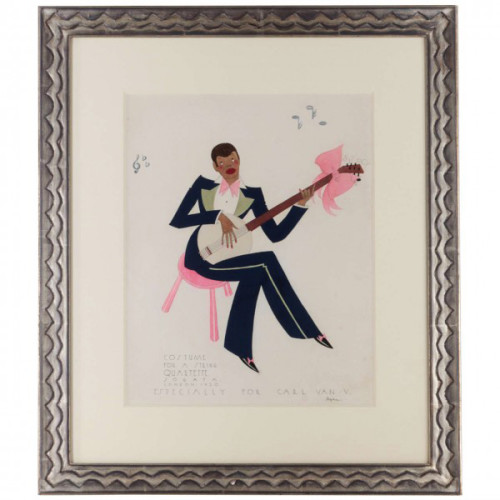
“Costume for a String Quartette” 1930
Watercolor and pencil on paper
Signed: COSTUME FOR A STRING QUARTETTE. SOGATA. LONDON: 1930. ESPECIALLY FOR CARL VAN V. with script signature (in pencil on lower left and beneath image)
For contextual history and similar art see: Rhapsodies in Black : Art of the Harlem Renaissance,(Berkeley: University of California Press, 1997); Harlem Renaissance Artists. Jordan, Denise (Chicago: Heinemann Library, 2003).
Paper H: 14 7/8″ x W: 10 7/8 ”
Image H: 14″ x W: 10 1/2″
Frame H: 20 1/2” x W: 17 1/4”
*This SOGATA New York Watercolor and pencil on paper has been gifted to The Wolfsonian – FIU, Miami Beach, FL.
Carl van Vechten (1880-1964), to whom this artwork is dedicated, was an influential novelist, critic, and photographer in New York during the 1920s, 30s, and 40s. His role in the Harlem Renaissance is well-documented. Van Vechten also introduced Miguel Covarrubias, a caricaturist and contemporary of Sogata, to prominent Manhattan artistic and society circles.