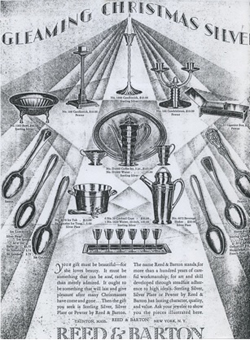
American Art Deco Reed & Barton Sterling candlesticks 1928
More Information
American Art Deco Reed & Barton Sterling candlesticks 1928
REED & BARTON (active 1824 – present) Taunton, MA
Candlesticks 1928
Sterling silver with Hoffmann-like fluted base and bobêches with undulating stem and palm leaf like terminating detail.
Marks: eagle R (in a shield) lion, Sterling, 1000, cement reinforced, eagle (date mark for 1928).
Model illustrated: Vanity Fair (Dec. 1928, Vol. 31), p. 120., Reed & Barton Vintage Catalog, p. 10, plate number 1000.
For more information on Reed & Barton see: Encyclopedia of American Silver Manufacturers, Dorothy T. Rainwater (West Chester, PA: Schiffer Publishing Ltd., 1986), p. 156-160.
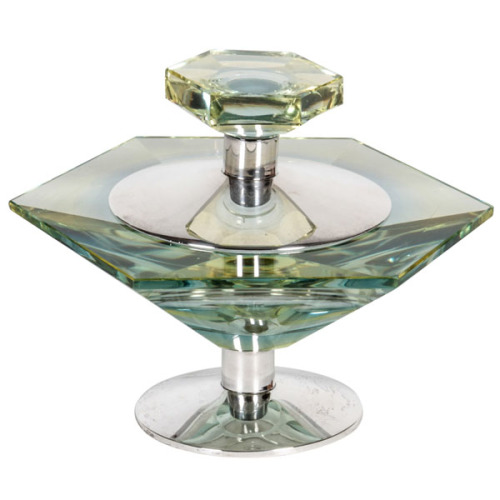
Hexagonal green-tinted lead crystal covered dish / tazza with lid in a stepped jewel-like form mounted with a silver lid and footed base silver
Marks: WMF logo, moon, crown, 800
For more information see: Wilhelm Wagenfeld und die Moderne Glasindustrie,Walter Scheiffele (Stuttgart: Verlag Gerd Hatje, 1994); WMF Ikora Metall / Metalwork, Carlo Burschel and Heinz Scheiffele (Stuttgart, Germany: ARNOLDSCHE, 2006).
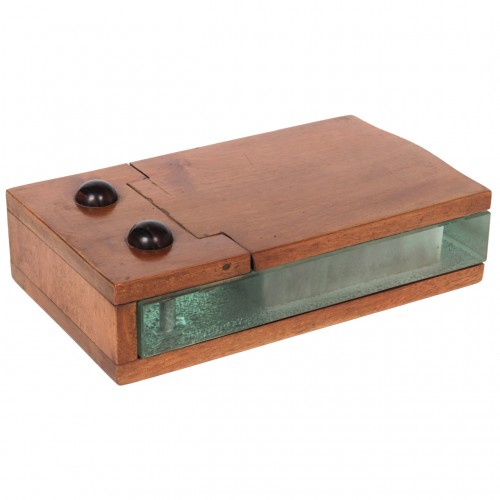
Alexandre Noll rare and early Art Deco mahogany and glass box c. 1930
ALEXANDRE NOLL (1890-1970) France
Covered box c. 1930
Mahogany with ebony peg details and 1 ¼ inch thick Saint-Gobain glass.
Marks: ANoll
Provenance: Private Collection New York, Galerie de Beyrie Paris, Odile Noll (A. Noll’s daughter), Alexandre Noll Estate
For more information see: Alexandre Noll, Olivier Jean-Elie, Pierre Passebon (Paris:Edition du Regard, 1999); Alexandre Noll: Les Matres de L’ Art Decoratif Contemporain, Collection dirigée par R. Moutard-Uldry edited by (Geneve: Pierre Cailler, 1954); Le Mobilier du Xxe Siécle: Dictionnaire des
Créateurs, Pierre Kjellberg (Paris: Les Éditons de l’Amateur, 1994) p. 455-456.
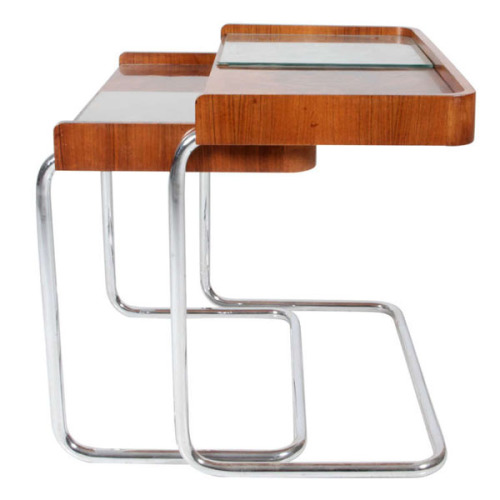
Tubular chrome base with exotic wood and burl, glass inset half tops.
For more information see: Deutsche Stahlrohr Möbel, Alexander von Vegesack (München: Bangert Verlag, 1986), Bauhaus Furniture: A Legend Reviewed, exhibit. cat., Bauhaus-Archiv Museum für Gestaltung, Berlin, 2002.
Smaller table: 22″ H x 17″ D x 26 1/4″ W.
Larger table: 24 1/2″ H x 17 1/2″ D x 29 3/4″ W.
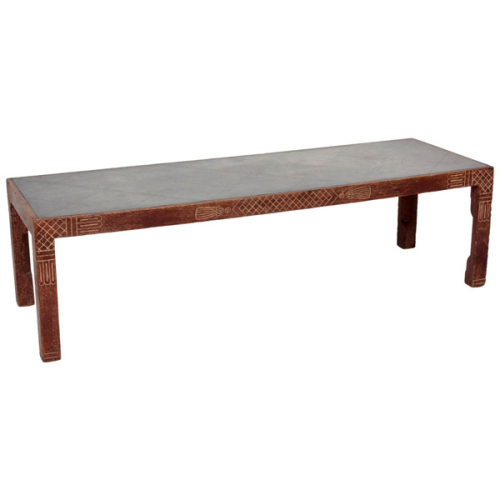
Tommi Parzinger / American Art Deco Coffee Table circa 1939
TOMMI PARZINGER (1903-1981) Germany/USA
PARZINGER, INC. New York
Coffee table c.1939
Carved and ceruse oak with an incised diamond pattern pewter top
Illustrated: Arts and Decoration, June 1940
***This table was originally priced at $80 during the period, as it appears in the Arts and Decoration vintage illustration from 1940.
For other examples of Parzinger’s work see: Town & Country, Vol. 54, “Counter Points”, December 1939, p. 31; Town & Country, Vol. 95, “Counter Points”, June 1940, p. 19; The Studio, 1938, “For the Table”, p.107-09; The Studio, 1942, “Tommi Parzinger, Designer of Modern Interiors and Silver”, p.37; Decorative Art, Studio Yearbook (London & New York: The Studio Publications, 1952-53), p. 98; Craft in the Machine Age, ed. Janet Kardon (New York: American Craft Museum, 1995) p.128, 134, 183, 241.
H: 12” x L: 42” x D: 14”
Price: $34,500
This is a wonderful and rare coffee table by Tommi Parzinger in beautifully detailed ceruse oak with a diamond pattern pewter inset top. This table was
completely handmade and dates from 1940, shortly after Parzinger opened his first eponymous gallery on East 57th Street. It is low and lean with exquisite Neoclassical Revival carved details and a silhouette that calls to mind an American take on Jean Michel Frank’s sober and refined elegance of the same time period. The cross-hatch carving with tassels on the two long sides and the related top corner details also have a charm reminiscent of Parzinger’s affable personality and effervescent design sensibility.




 @hd_jewels