Product Description
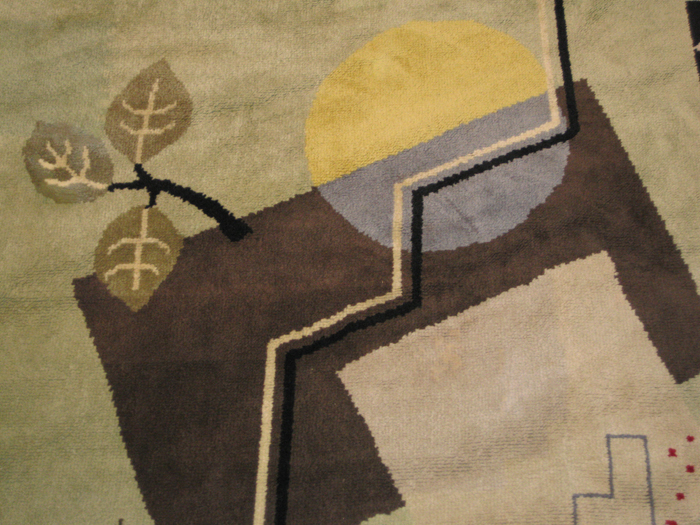
Ingegerd Torhamn Art Deco / Modernist rug c. 1930 (Exhibited: Stockholm Exhibition 1930)

INGEGERD TORHAMN (1898-1994) Sweden
Modernist rug c. 1930
Hand-knotted wool
Signed: it (Ingegerd Torhamn) lower left
Exhibited: Stockholm Exhibition 1930, Stockholmsutställningen 1930, Villa 42; V.I.P. in Swedish Design, Kalmar Konstmuseum 1996.
Illustrated: Katalog Över Bostadsavdelningen: Stockholms Utställningen 1930 (illustrated in situ) Stockholm Exhibition1930 (Stockholm: Tryckt Hos Bröderna Lagerström, Boktryckare, 1930) p. 149
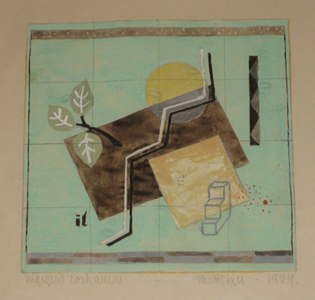
Drawing illustrated: V.I.P. in Swedish Design: Axel Larsso, Ingegerd Torhamn, Inga Linden & Paula Sokolow, Arkiv for Svensk Formgivning, Kalmar Konstmuseum
For more information see: Svenska Textilier 1930, Stockholm 1930, Nils G. Wollin, plate nr. 50
Dimensions: 7’2” square
One of the ten rugs of her designs (including this rug as part of the music room) exhibited at the important Stockholm Exhibition of 1930 is now in the permanent collection of the Nationalmuseum in Stockholm.
Ingegerd Torhamn Art Deco / Modernist rug c. 1930 (Exhibited: Stockholm Exhibition 1930)
HAYNO FOCKEN (1905-1968) Germany
Round covered box c. 1935
Hand-wrought and hand-hammered copper with brass details
Marks under the foot: HF (conjoined monogram)
For other works by Hayno Focken see: Metallkunst: Vom Jugendstil zur Moderne (1889-1939), ed. Karl H. Bröhan (Berlin: Bröhan Museum, 1990), illus. 177, p. 183; Avantgarde Design 1880=1930,Torsten Bröhan & Thomas Berg (Köln, Benedict Taschen, 1994) p. 116; , (Berlin 1937) S. 43f, Abb. 37, Abb. S 128, S 146, Sl 243; Die Schaulade 15 Ausg. A (1939) Abb. S. 197, S. 204, S. 213; Die Schaulade 16 Ausg. A (1940) Abb. S. 44, S. 51., S. 54, S. 71, S. 83. S. 89; Die Kunst 84 (1941) S. 136, S. 139-39; Die Schaulade 17 (1941) Abb. S. 13, S. 41, S. 82, S. 229;
H: 4 ¼” x Dia: 4 7/8”
Hayno Focken (1905-1968) was an eminent German metal artist. He completed his training under Professor Karl Müller (1888-1972) at the design and arts school on Giebichenstein Castle in Halle (Saale), which was strongly tied to the ideals of the Deutsche Werkbund and the Bauhaus. In 1932 he established his own workshop in Lahr/Schwarzwald and continued his work until shortly before his death. His artistic work always stood out with a strong preference for large, organic forms, a similar manner of surface design and the same adherence to the principle of handicraft. Even his artist signet was modelled on the simple, square castle mark. In the 1950s he became one of those significant artists who had a major impact on contemporary metal design. The foundation of his creative work was a masterful understanding of proportions.
WALTER NICHOLS China
Art Deco / Modernist rug c. 1935
106” x 137”
Walter Abner Burns Nichols was one of the most colorful of the American adventurer/entrepreneurs in 1920s China. The Nichols name has come to be used almost synonymously with the ‘Chinese deco’ rugs manufactured in Tientsin, China in the 1920s and 1930s. Nichols did not originate the Chinese deco style, but he did a great deal to popularize it and to maintain its high standards of manufacture.
Nichols began in his youth as a first-class wool grader who went to Tientsin around 1920 to work for the Elbrook family of wool merchants. Nichols started his own business a couple of years later. In a brochure he produced in the late ’20s, with the assistance of Pande-Cameron, he announced: “In 1924 W.A.B. Nichols of Tientsin, North China, introduced the Super Chinese Rug which has become world famous. It is known in every market as the most durable and beautiful product of the modern Chinese weavers art and adorns the homes of people all over the earth.”
RICHARD HAROLD REDVERS TAYLOR (1900-1975) United Kingdom
Modernist building staircase c. 1949
Gouache on paper, metal and wood frame
Signed: RHRT (lower left)
Marks: Gimpel Fils exhibition label (on back)
Exhibited: “An Exhibition in the Kettle’s Yard Loan Gallery: Sculpture & Painter,
14 February – 10 March, 1972” Gimpel Fils, London
Framed: H: 41 7/16” x W: 30 5/16”
Richard Harold Redvers Taylor (1900-1975) was born in Brighton on March 14th, 1900 and educated at Brighton College and Heatherleys School of Fine Art, Chelsea. His father, Harold Taylor, was a headmaster. Redvers Taylor retired from the Army (where he specialized in topographical surveying in Africa) in 1937 but was recalled for war service. In 1946 he began a new career as a professional painter. Between 1948 and 1958 Taylor was given a series of six one-man shows by Lefevre and Gimple Fils in London. In the 1960’s he turned to sculpture, and in 1972 an exhibition of his sculpture and paintings was held at the Kettle’s Yard Loan Gallery in Cambridge. His work is held in the permanent collection at the Beith Uri V Rami Museum in Israel. Louise Taylor (née Hayden), his wife, was an American and the adopted daughter and heiress of Alice B. Toklas, the companion of Gertrude Stein. Louise Taylor died on 21 July 1977.
Purism, otherwise known as l’esprit nouveau was directly inspired by a spare, functionalist aesthetic and is closely associated with the work of Le Corbusier and his circle in Paris in the second quarter of the 20th Century. In America this purist style was known as Precisionism, which explored similar imaginary during the late 1920’s and 30’s with artists like Charles Sheeler, Charles Demuth and Ralston Crawford at the forefront of this movement. In England, the Vorticist movement (1912-1915) was founded by Wyndham Lewis and others and was the precursor to the Purist movement in Great Britain in the 1930’s and 1940’s. Redvers Taylor created geometrical landscapes while reducing volumes to colored planes and outlines to ridges. His artwork combines depth and perspective with flattened cubist fields of color. Architecture of industrial buildings was his favorite subject, whereas people and nature were usually absent from his compositions.
SEVARD France (active 1920’s/1930’s)
Dinanderie vase with fish fins c. 1925
Hand wrought and hand hammered copper with a rich chocolate-brown
patination and bronze fin-like handles, gilt detailing
Marks: Sevard (inscribed signature), “France”
H: 7 7/8” x W: 8 3/4”