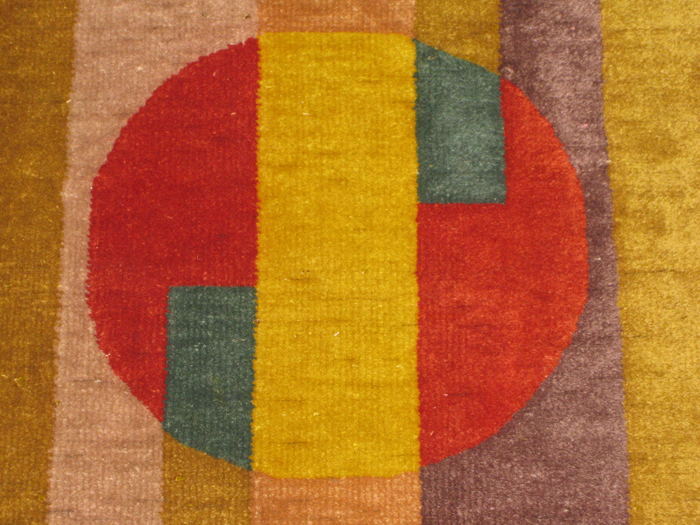
Walter Nichols Chinese Art Deco rug with circle motif c. 1935
More Information
Walter Nichols Chinese Art Deco rug with circle motif c. 1935
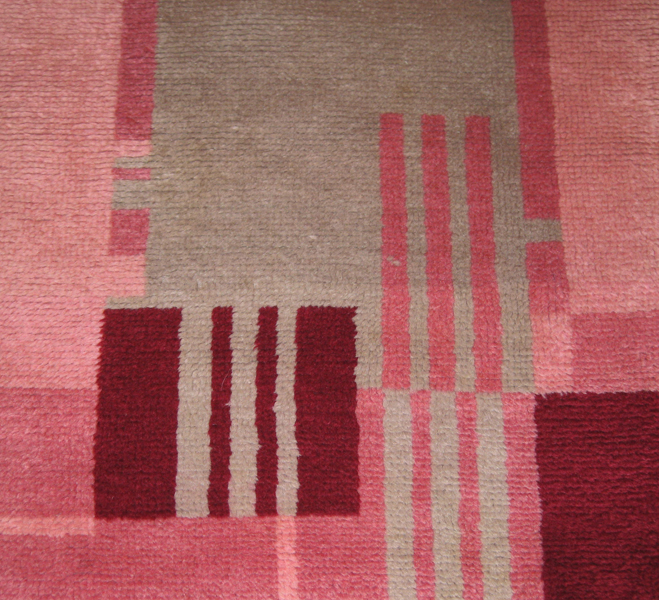
Walter Nichols Chinese Art Deco rug c. 1935
WALTER NICHOLS China
Chinese Art Deco rug c. 1935
Walter Abner Burns Nichols was one of the most colorful of the American adventurer/entrepreneurs in 1920s China. The Nichols name has come to be used almost synonymously with the ‘Chinese deco’ rugs manufactured in Tientsin, China in the 1920s and 1930s. Nichols did not originate the Chinese deco style, but he did a great deal to popularize it and to maintain its high standards of manufacture.
Nichols began in his youth as a first-class wool grader who went to Tientsin around 1920 to work for the Elbrook family of wool merchants. Nichols started his own business a couple of years later. In a brochure he produced in the late ’20s, with the assistance of Pande-Cameron, he announced: “In 1924 W.A.B. Nichols of Tientsin, North China, introduced the Super Chinese Rug which has become world famous. It is known in every market as the most durable and beautiful product of the modern Chinese weavers art and adorns the homes of people all over the earth.”
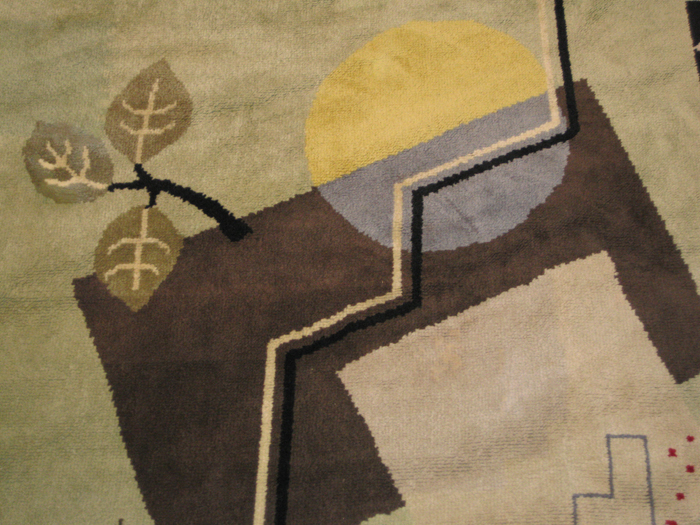
Ingegerd Torhamn Art Deco / Modernist rug c. 1930 (Exhibited: Stockholm Exhibition 1930)
INGEGERD TORHAMN (1898-1994) Sweden
Modernist rug c. 1930
Hand-knotted wool
Signed: it (Ingegerd Torhamn) lower left
Exhibited: Stockholm Exhibition 1930, Stockholmsutställningen 1930, Villa 42; V.I.P. in Swedish Design, Kalmar Konstmuseum 1996.
Illustrated: Katalog Över Bostadsavdelningen: Stockholms Utställningen 1930 (illustrated in situ) Stockholm Exhibition1930 (Stockholm: Tryckt Hos Bröderna Lagerström, Boktryckare, 1930) p. 149
Drawing illustrated: V.I.P. in Swedish Design: Axel Larsso, Ingegerd Torhamn, Inga Linden & Paula Sokolow, Arkiv for Svensk Formgivning, Kalmar Konstmuseum
For more information see: Svenska Textilier 1930, Stockholm 1930, Nils G. Wollin, plate nr. 50
Dimensions: 7’2” square
One of the ten rugs of her designs (including this rug as part of the music room) exhibited at the important Stockholm Exhibition of 1930 is now in the permanent collection of the Nationalmuseum in Stockholm.
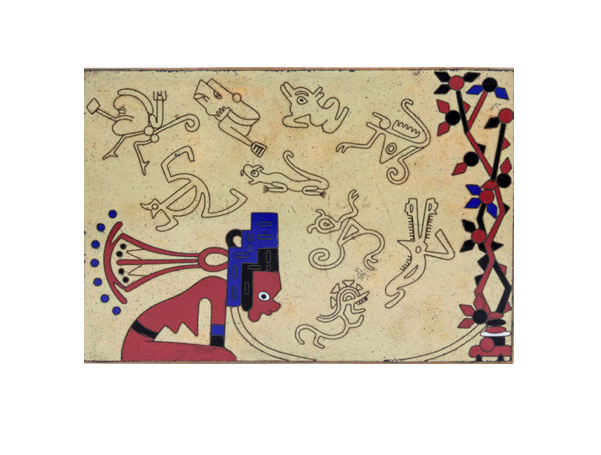
Cloisonne enamel in a fantasy of archaic Chinese motifs in red, royal blue, black white and sand colored abstract designs on a bronze body with a turquoise enameled underside and interior.
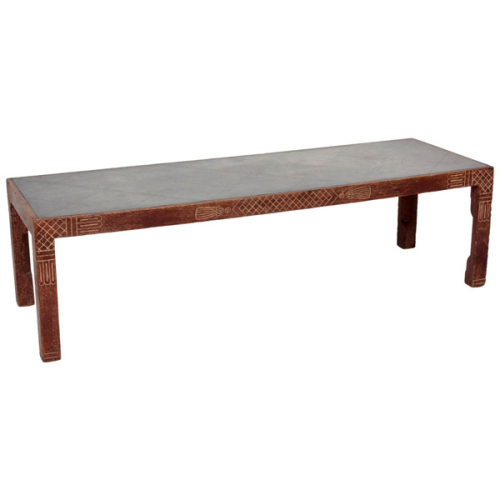
Tommi Parzinger / American Art Deco Coffee Table circa 1939
TOMMI PARZINGER (1903-1981) Germany/USA
PARZINGER, INC. New York
Coffee table c.1939
Carved and ceruse oak with an incised diamond pattern pewter top
Illustrated: Arts and Decoration, June 1940
***This table was originally priced at $80 during the period, as it appears in the Arts and Decoration vintage illustration from 1940.
For other examples of Parzinger’s work see: Town & Country, Vol. 54, “Counter Points”, December 1939, p. 31; Town & Country, Vol. 95, “Counter Points”, June 1940, p. 19; The Studio, 1938, “For the Table”, p.107-09; The Studio, 1942, “Tommi Parzinger, Designer of Modern Interiors and Silver”, p.37; Decorative Art, Studio Yearbook (London & New York: The Studio Publications, 1952-53), p. 98; Craft in the Machine Age, ed. Janet Kardon (New York: American Craft Museum, 1995) p.128, 134, 183, 241.
H: 12” x L: 42” x D: 14”
Price: $34,500
This is a wonderful and rare coffee table by Tommi Parzinger in beautifully detailed ceruse oak with a diamond pattern pewter inset top. This table was
completely handmade and dates from 1940, shortly after Parzinger opened his first eponymous gallery on East 57th Street. It is low and lean with exquisite Neoclassical Revival carved details and a silhouette that calls to mind an American take on Jean Michel Frank’s sober and refined elegance of the same time period. The cross-hatch carving with tassels on the two long sides and the related top corner details also have a charm reminiscent of Parzinger’s affable personality and effervescent design sensibility.




 @hd_jewels