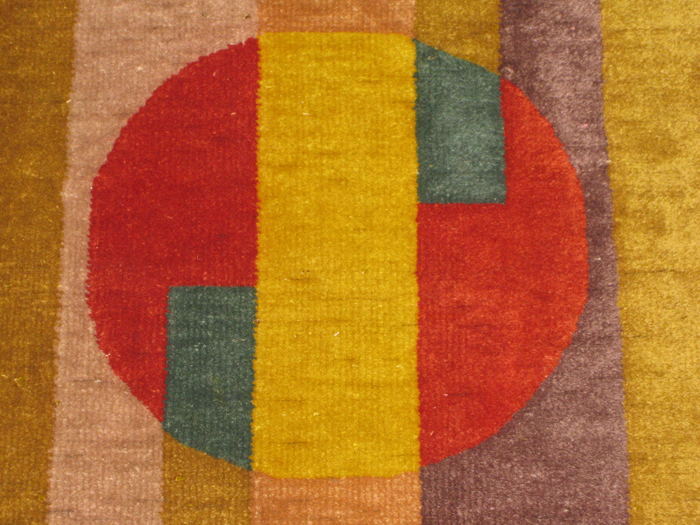
Walter Nichols Chinese Art Deco rug with circle motif c. 1935
More Information
Walter Nichols Chinese Art Deco rug with circle motif c. 1935
Walter Nichols Chinese Art Deco rug c. 1935
WALTER NICHOLS China
Chinese Art Deco rug c. 1935
Walter Abner Burns Nichols was one of the most colorful of the American adventurer/entrepreneurs in 1920s China. The Nichols name has come to be used almost synonymously with the ‘Chinese deco’ rugs manufactured in Tientsin, China in the 1920s and 1930s. Nichols did not originate the Chinese deco style, but he did a great deal to popularize it and to maintain its high standards of manufacture.
Nichols began in his youth as a first-class wool grader who went to Tientsin around 1920 to work for the Elbrook family of wool merchants. Nichols started his own business a couple of years later. In a brochure he produced in the late ’20s, with the assistance of Pande-Cameron, he announced: “In 1924 W.A.B. Nichols of Tientsin, North China, introduced the Super Chinese Rug which has become world famous. It is known in every market as the most durable and beautiful product of the modern Chinese weavers art and adorns the homes of people all over the earth.”
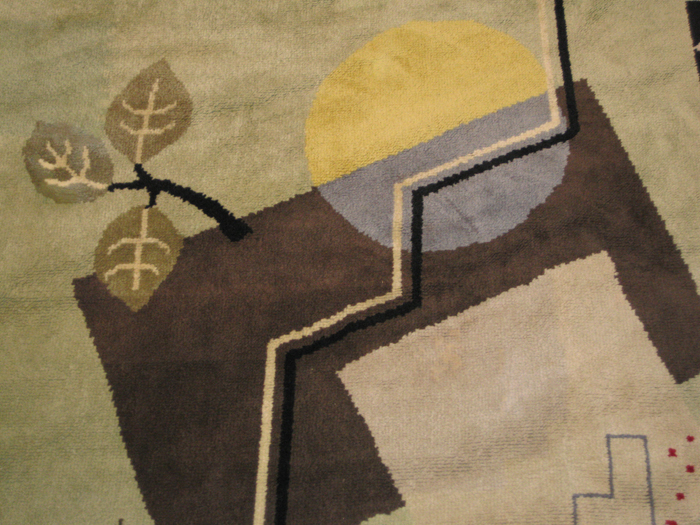
Ingegerd Torhamn Art Deco / Modernist rug c. 1930 (Exhibited: Stockholm Exhibition 1930)
INGEGERD TORHAMN (1898-1994) Sweden
Modernist rug c. 1930
Hand-knotted wool
Signed: it (Ingegerd Torhamn) lower left
Exhibited: Stockholm Exhibition 1930, Stockholmsutställningen 1930, Villa 42; V.I.P. in Swedish Design, Kalmar Konstmuseum 1996.
Illustrated: Katalog Över Bostadsavdelningen: Stockholms Utställningen 1930 (illustrated in situ) Stockholm Exhibition1930 (Stockholm: Tryckt Hos Bröderna Lagerström, Boktryckare, 1930) p. 149
Drawing illustrated: V.I.P. in Swedish Design: Axel Larsso, Ingegerd Torhamn, Inga Linden & Paula Sokolow, Arkiv for Svensk Formgivning, Kalmar Konstmuseum
For more information see: Svenska Textilier 1930, Stockholm 1930, Nils G. Wollin, plate nr. 50
Dimensions: 7’2” square
One of the ten rugs of her designs (including this rug as part of the music room) exhibited at the important Stockholm Exhibition of 1930 is now in the permanent collection of the Nationalmuseum in Stockholm.
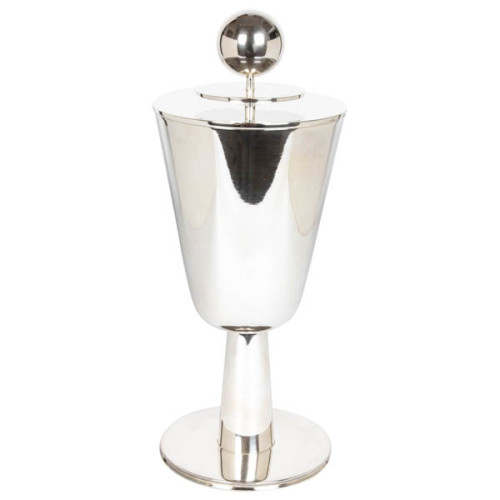
Breuhaus de Groot / WMF Ikora Germany Art Deco Rare “Pokal” Covered Footed Cup 1928
FRITZ AUGUST BREUHAUS DE GROOT (1883-1960) Germany
WMF [WÜRTTEMBERGISCHE METALLWARENFABRIK] Geislingen
“Pokal” Covered footed cup ( model no. Br 6 )1928
Silverplated brass, model no. Br 6
Marks: WMF insignia (touchmark), x/o
Illustrated: Goldschmiedekunst 49, (1928) m. Abb; Deutsche Kunst und Dekoration 63, (1928/29) Abb S 353; Metallkunst: Kunst vom Jugendstil zur Moderne (1889-1939), Karl H. Bröhan, Band IV (Berlin: Bröhan-Museum, 1990) n. 610, p. 571; WMF Ikora Metall / Metalwork, Carlo Burschel and Heinz Scheiffele (Stuttgart, Germany: ARNOLDSCHE, 2006) pp.12,19,34.
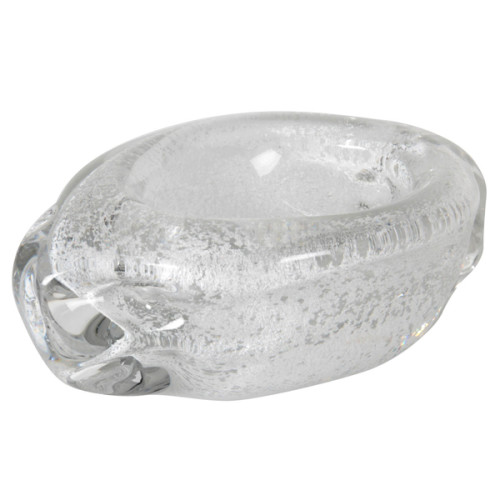
Andre Thuret French Art Deco Rare Handblown Art Glass Vase c. 1930
ANDRÉ THURET (1898-1965) France
“Organic” vase/bowl c. 1930
Handblown and formed clear glass with bubble technique encapsulating a frosty white oxide.
Signed: ANDRÉ THURET
H: 2 3/8″ x D: 4″ x W: 6 1/4″
Andre Thuret was one of the first modern French studio glass artists and a contemporary of Maurice Marinot. He was born on November 3, 1898 in Paris. It is by science that Andre Thuret came to art. It is in Thuret the engineer and the chemist who serve Thuret the vase artist. The scientist places at the disposal of the creator of forms, rates/rhythms and colors the fluid and transparent beauty of glass and the reactions of metallic oxides. He worked in a traditional glass blowing technique at a temperature often exceeding 1,000 degrees. Thuret exhibited at the Salon d’Automne in 1928 and 1932 and obtained his first plate of the Company of Encouragement to Art. He was invited to exhibit in the United States in 1929-1930. Andre Thuret received his Chevalier of the Legion of Honor in 1947.
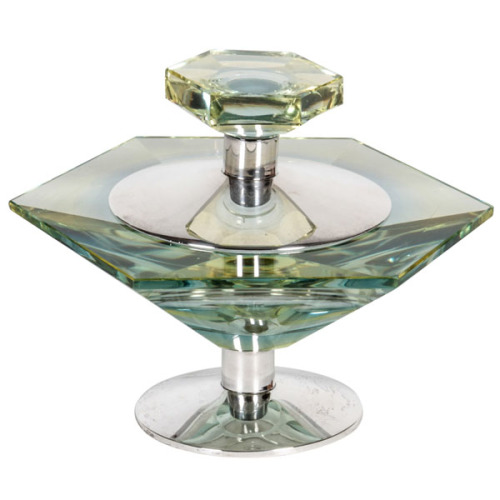
Hexagonal green-tinted lead crystal covered dish / tazza with lid in a stepped jewel-like form mounted with a silver lid and footed base silver
Marks: WMF logo, moon, crown, 800
For more information see: Wilhelm Wagenfeld und die Moderne Glasindustrie,Walter Scheiffele (Stuttgart: Verlag Gerd Hatje, 1994); WMF Ikora Metall / Metalwork, Carlo Burschel and Heinz Scheiffele (Stuttgart, Germany: ARNOLDSCHE, 2006).



 @hd_jewels