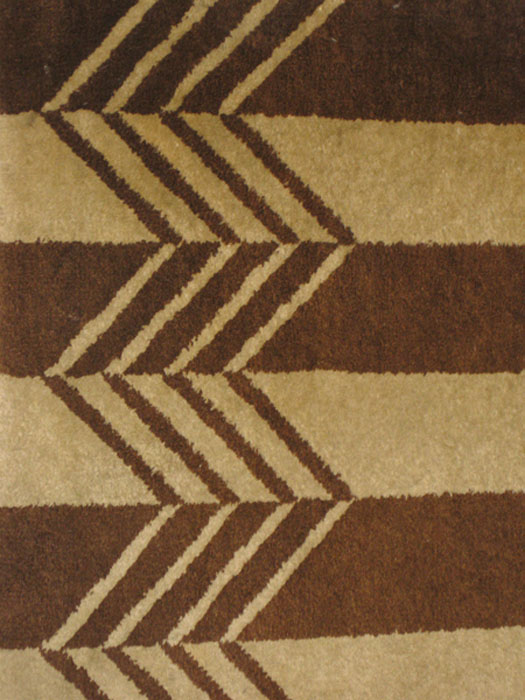
Walter Abner Burns Nichols was one of the most colorful of the American adventurer/entrepreneurs in 1920s China. The Nichols name has come to be used almost synonymously with the ‘Chinese deco’ rugs manufactured in Tientsin, China in the 1920s and 1930s. Nichols did not originate the Chinese deco style, but he did a great deal to popularize it and to maintain its high standards of manufacture.
Nichols began in his youth as a first-class wool grader who went to Tientsin around 1920 to work for the Elbrook family of wool merchants. Nichols started his own business a couple of years later. In a brochure he produced in the late ’20s, with the assistance of Pande-Cameron, he announced: “In 1924 W.A.B. Nichols of Tientsin, North China, introduced the Super Chinese Rug which has become world famous. It is known in every market as the most durable and beautiful product of the modern Chinese weavers art and adorns the homes of people all over the earth.”
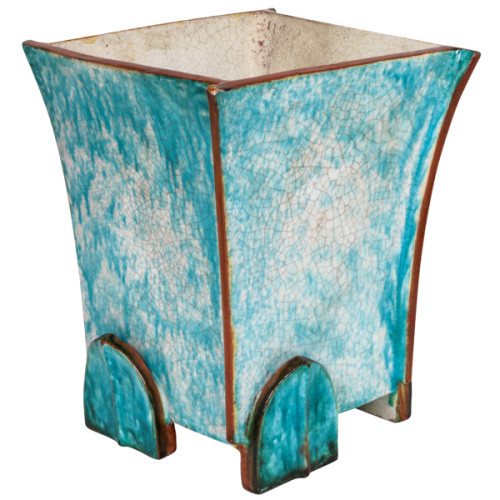
Münchner Werkstätten / Art Deco Large Glazed Pottery Vase c. 1928
MÜNCHNER WERKSTÄTTEN Germany
Vase c. 1928
Blue and white modeled glazed earthenware with orange red outlines
Marks: “M” over “W” mark, Germany
Provenance: Mr. Ernest L. King (Watkins) “Rockledge” Commission, Winona, MN c.1930’s Phillip Brooks Maher (interior architect), descended in the King Family to Bud (E. L. King Jr.) and Betty King, Winona, MN, Hollander Gallery, Milwaukee, WI, Private Collection, New York, NY
H: 9 ¾” x W: 8 ¼” x D: 8 ¼”
Price: $5,450
ROCKLEDGE, the summer home of Ernest and Grace King (the Watkins Family Company fortune was made from door-to-door sales of health potions and hygiene related products) was built and designed in its entirety from the expansive main home building with all of the furnishings to the custom silver service all the way down to the hand woven carpets and lace curtain designs, is arguably the most famous American Arts and Crafts commissioned home in America and was built and meticulously designed by George Washington Maher. It was finished in 1912, and was used by the Kings for the month of August only for a couple of decades before the interior was completely redone in the fashionable Art Deco design of the 1930’s. George Washington Maher’s son Phillip Brooks Maher, was hired for the project and went shopping for the best of the design of the period in both New York and Paris. He assembled a legendary collection of Art Deco design that comprised many important examples of both American and European Art Deco including the famous Donald Deskey square form telescope table, a Gilbert Rohde “Z” clock, a pair of Mies van der Rohe red lacquer and wicker armchairs, DIM furniture and rugs from Paris and rare Paolo Venini floor lamps and sculptural glass pieces among many other major 20th Century design works. This rare vase was indicative of the avant-garde furnishings throughout the King Home as well as the exquisite quality and attention to the detail of every single object that the Kings surrounded themselves with and became accustomed to enjoying and living with whether they were at their Daytona Beach resort, their lakeside property at Lake Tahoe or their plantation in Hawaii!
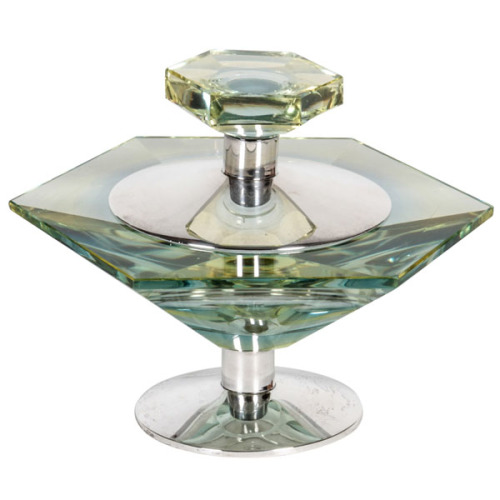
Hexagonal green-tinted lead crystal covered dish / tazza with lid in a stepped jewel-like form mounted with a silver lid and footed base silver
Marks: WMF logo, moon, crown, 800
For more information see: Wilhelm Wagenfeld und die Moderne Glasindustrie,Walter Scheiffele (Stuttgart: Verlag Gerd Hatje, 1994); WMF Ikora Metall / Metalwork, Carlo Burschel and Heinz Scheiffele (Stuttgart, Germany: ARNOLDSCHE, 2006).
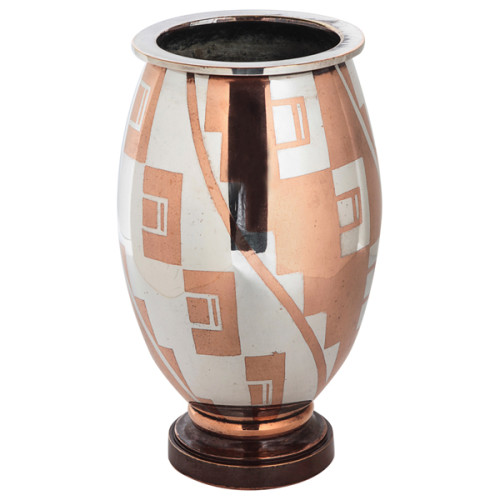
Christofle / Luc Lanel French Art Deco Dinanderie Vase c.1930
LUC LANEL (1893-1965) France
ORFÈVRERIE CHRISTOFLE Paris
Ovoid form with a foot and flared lip design with a polished copper body with an overall stepped rectangular and square motif geometric design
Marks: CHRISTOFLE (large script with wave lines below), B 173, G
For more information see: Mobilier et Décoration d’Interieur ( 1924-25), p. 10; Les Arts Décoratifs Modernes (France), Gaston Quènioux (Paris: Librairie Larousse, 1925), p. 176; 150 Ans d’Ofèvrerie Christofle, Henri Bouilhet ([Paris]: Chêne/Hachette: 1981), pp. 241 and 230.
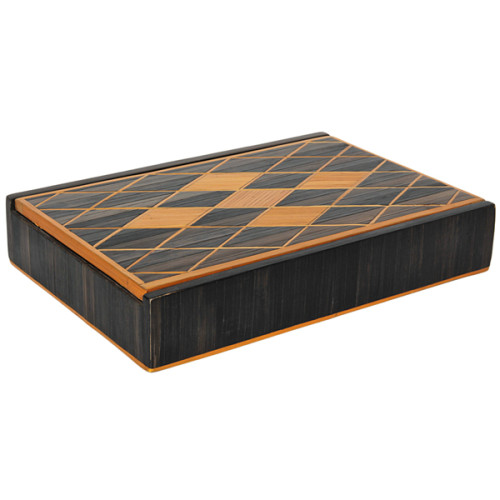
Andre Arbus (attr.) French Art Deco Straw Marquetry Box c. 1940
ANDRÉ ARBUS (attr.) (1903-1969) France
Straw marquetry box c. 1940
Natural gold and ebony stained straw inlaid in a design of a window pane diamond pattern on the hinged lid, original suede cloth/paper interior, wood frame
For more information see: André Arbus: architecture-décorateur des années 40, Yvonne Brunhammer (Paris: l’Editions NORMA, 1996).




 @hd_jewels