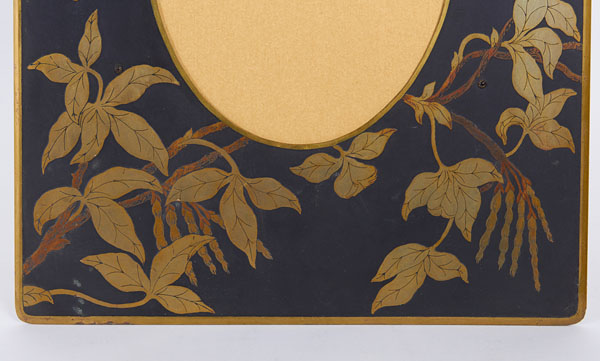
Scandinavian Art Nouveau "Wisteria" bronze photo frame c.1910
More Information
Scandinavian Art Nouveau “Wisteria” bronze photo frame c.1910
SCANDINAVIAN ART NOUVEAU
“Wisteria” bronze photo frame c.1910
Elaborately detailed, acid etched and multi-patinated bronze table top photo frame with gilt details of a cascade of wisteria blossoms, leaves and vines.
Overall Frame: H: 12” x W: 7 ½”
Oval photo window opening H: 5 ½” x W: 4”
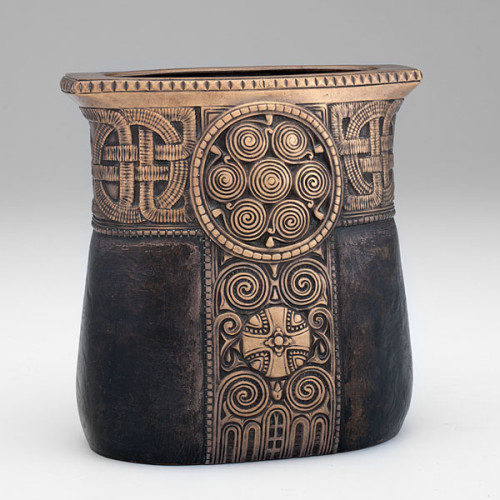
Gustav Gurschner, Secessionist / Byzantine Revival bronze vase c. 1905
GUSTAV GURSCHNER (1873-1970) Austria
Vase c. 1905
Cast bronze ovoid shaped vase with decorative Celtic motif, lightly gilded, the body of the vase simulating leather with a rich brown patina
Signed: GURSCHNER, M180 (stamped in the bronze)
Related works illustrated: The Studio, Special Summer Number 1906: The Art Revival in Austria, ill. no. D6; Studio Yearbook (London, 1909), pp. 139-140; Vienna Turn of the Century: Art and Design, Fischer Fine Art, exhib. cat. (London 1979), p. 23, illus. 1; Bronzes, sculptors & Founders, H. Berman, (Atglen 1994 III) p. 781, cat. nos. 2893, 2894; Decorative Art 1880-1980, Dan Klein & Margaret Bishop (Oxford, England: Phaidon and Christie’s Limited, 1986) p. 84, illus. 1
H: 7 1/4″ x D: 7″ x D: 4″
Price: $14,500
Gustav Gurschner was born in Tirol, Austria. He attended the Fachschule für Holzindustrie in Bozen from 1885-1888. After three years, his instructors encouraged him to attend the Austrian Museum for Applied Arts’ Kunstgewerbeschule in Vienna. After finishing his formal training, Gurschner pursued a career as a sculptor of monumental works. It was while he was in Paris in 1897, that he first turned his energies from the application of small-scale, sculptural works to the aesthetic design of household objects. Shortly thereafter, he returned to Vienna to join the Secessionists whose ideals he shared. By the turn-of-the-century, Gurschner was not only one of the better known artists working in Vienna but enjoyed a reputation that extended into other European countries as well.
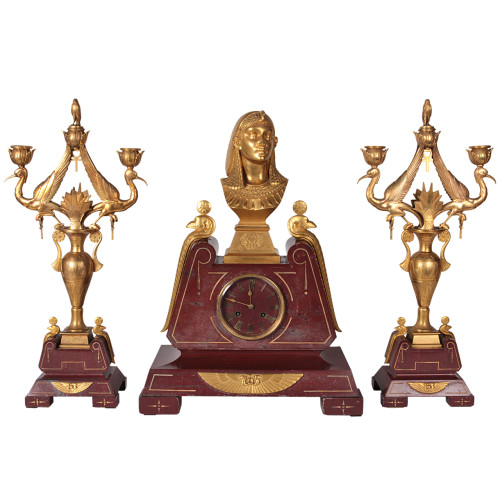
Paul-Auguste Gagné, French Egyptian Revival Gilt Bronze Garniture Set c. 1875
Paul-Auguste Gagné (Sculptor) France
Egyptian Revival garniture set, circa 1875
Gilt bronze and carved rouge marble mantle clock and candelabra in a high Egyptian Revival style
Marks: P.A. Gagne (elaborate incised scroll signature on the back of the portrait bust)
For more information on Gagné see: Dictionnaire des peintres, sculpteurs, dessinateurs et graveurs, vol. 4, E. Bénézit (Paris: Librairie Gründ, 1976) p. 579.
For other related Egyptian Revival garniture sets see: Egyptomania: Egypt in Western Art, 1730-1930 (Paris: Éditions de la Réunion des Musées Nationaux and Ottawa: National Gallery of Canada, 1994)
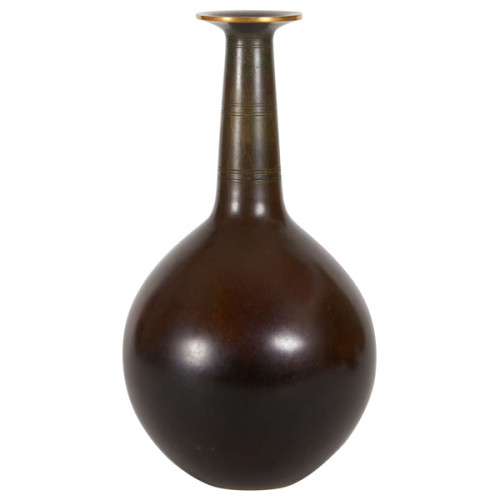
Just Andersen Denmark Art Deco Grand bronze vase c. 1935-40
JUST ANDERSEN (1884-1943) Denmark
Grand vase c. 1935-40
Rich deep brown patinated bronze, neck with three sets of four incised lines, with flaring rim and gilt edge
Marks: DENMARK, JUST (in a triangular cartouche), No. B 2055
For more information see: “Just Andersen: Manden og Vaerket” by Svend Rindholt in Samleren: Tidskrift for Kunst og Kunstindustri (Attende Aargang, 1941) pp. 171-194; Dansk Biografisk Leksikon. Første Bind (Copenhagen: Gyldendal, 1979) p. 199. The Design Encyclopedia. Mel Byars (New York: John Wiley & Sons, Inc., 1994) p. 23.
H: 13 1/2″ x Dia: 8″
Designer Just Andersen trained with Peter Hertz and Mogens Ballin, the premier silversmith in Copenhagen. He was also employed as a designer for Georg Jensen before he decided to open his own silver and metal studio in 1918. The elegant, simple forms and richly-patinated surfaces are highly characteristic of Andersen’s high level of design and superlative craftsmanship.
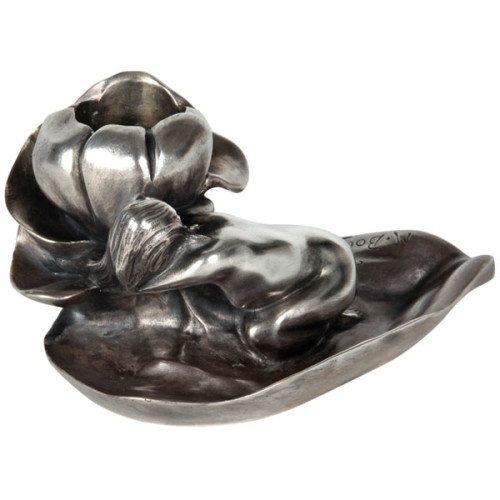
Maurice Bouval French Art Nouveau Nymph Silvered Bronze Candleholder c. 1900
MAURICE BOUVAL (born Toulouse, died 1920) France
M. COLIN France
“Nymph Embracing a Blossom” candle holder c.1900
Silvered cast bronze in the form of a nymph on a leaf embracing a blossom
Marks: M. Bouval (script signature) and COLIN, (Foundry) written above
For other examples of Bouval’s work see: The Paris Salons 1895-1914, Vol. V: Objets d’Art & Metalware, Alastair Duncan (Woodbridge, Suffolk: Antique Collectors’ Club, 1999), p. 127; Ecole to Deco, Small Sculptures from a Private Collection, Stephen C. McGough ed. (Oberlin, Ohio: Allen Memorial Art Museum, 1979) pp. 33-4; Art Nouveau Sculpture, Alastair Duncan (New York: Rizzoli, 1978) pp. 30-1.




 @hd_jewels