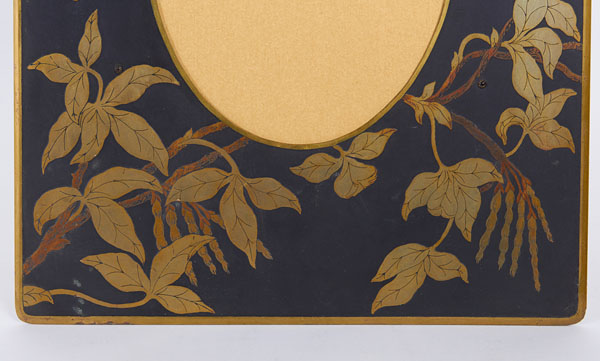
Scandinavian Art Nouveau "Wisteria" bronze photo frame c.1910
More Information
Scandinavian Art Nouveau “Wisteria” bronze photo frame c.1910
SCANDINAVIAN ART NOUVEAU
“Wisteria” bronze photo frame c.1910
Elaborately detailed, acid etched and multi-patinated bronze table top photo frame with gilt details of a cascade of wisteria blossoms, leaves and vines.
Overall Frame: H: 12” x W: 7 ½”
Oval photo window opening H: 5 ½” x W: 4”
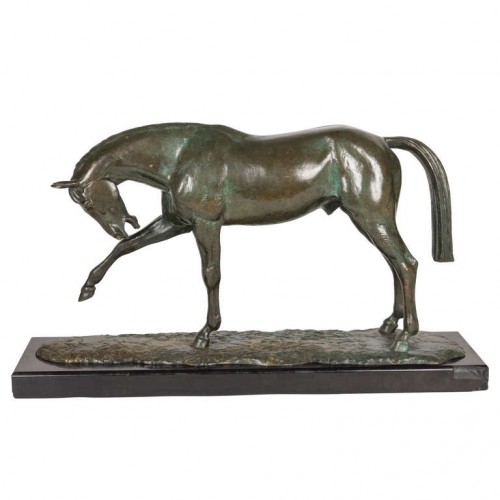
Andre Vincent Becquerel Arabian Horse bronze sculpture c. 1930
ANDRE VINCENT BECQUEREL (1893-1981) France
Arabian Horse sculpture c. 1930
Bronze with overall rich green/brown patina with intricate sculpting and details, black Belgian marble plinth base
Signed: A. Becquerel (inscribed in the bronze)
H: 12” x W: 21” x D: 6”
Price: $27,500
Andre Vincent Becquerel was born in St. Andre-Farivilliers. He studied at the l’Ecole des Beaux Arts in Paris under Hector Lemaire and Prosper Lecourtier. He specialized in fine animal sculpture and regularly exhibited at the Salon des Artistes Francais from 1914 to 1922. Becquerel worked for the Editeur Parisiens Edmond Etling in Paris and created a monumental sculpture in patinated plaster for the “Pavillon international” at the Exposition Internationale in Paris in 1937.
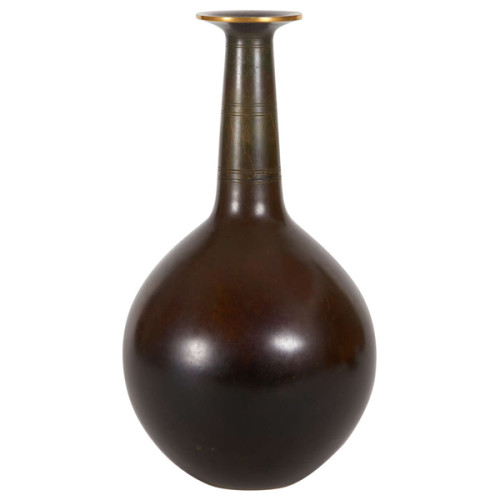
Just Andersen Denmark Art Deco Grand bronze vase c. 1935-40
JUST ANDERSEN (1884-1943) Denmark
Grand vase c. 1935-40
Rich deep brown patinated bronze, neck with three sets of four incised lines, with flaring rim and gilt edge
Marks: DENMARK, JUST (in a triangular cartouche), No. B 2055
For more information see: “Just Andersen: Manden og Vaerket” by Svend Rindholt in Samleren: Tidskrift for Kunst og Kunstindustri (Attende Aargang, 1941) pp. 171-194; Dansk Biografisk Leksikon. Første Bind (Copenhagen: Gyldendal, 1979) p. 199. The Design Encyclopedia. Mel Byars (New York: John Wiley & Sons, Inc., 1994) p. 23.
H: 13 1/2″ x Dia: 8″
Designer Just Andersen trained with Peter Hertz and Mogens Ballin, the premier silversmith in Copenhagen. He was also employed as a designer for Georg Jensen before he decided to open his own silver and metal studio in 1918. The elegant, simple forms and richly-patinated surfaces are highly characteristic of Andersen’s high level of design and superlative craftsmanship.
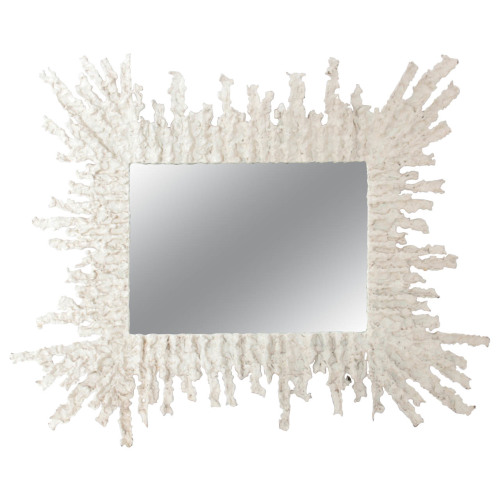
Marcello Fantoni Torched bronze and white plaster painted mirror 1950’s
MARCELLO FANTONI (1915-2011) Italy
Starburst mirror 1950’s
Torched bronze and original white plaster painted finish.
Marks: Fantoni, Firenze, Italy (hand script)
***This mirror has great style and character.
Overall dimension: H: 26″ x L: 33″ x D: 4″
Mirror dimension: H: 12″ x L: 17″
Price: $17,500
Born in Florence on October 1, 1915, Marcello Fantoni registered at the Institute of Art at Porta Romana in 1927 to attend the course The Art of Ceramics, which at that time was taught by the ceramist Carlo Guerrini, artistic director of the Cantagalli factory. Other teachers also contributed to his artistic formation including Libero Andreotti and Bruno Innocenti in sculpture and Gianni Vagnetti in the figure. He graduated in ’34 as a ‘maestro’ of art, and began working as a ceramist. In 1936, after having worked for a few months as the artistic director of a factory in Perugia, he established himself at Villa Fabbricotti in Florence and founded the Fantoni Ceramic studio. It’s production of serial and unique pieces had remarkable success at the Florentine Arts and Crafts Exhibit in ’37, revealing itself in line with the most recent tendencies, so much so that at the beginning of hostilities his production had already received notable artistic and commercial attention in Italy and abroad. After the war years, when Fantoni was involved in the resistance, in ’46 he began the creative and productive fervor that will allow him to enlarge his company, reaching at the beginning of the next decade the impressive size of over fifty collaborators. Among his employees were many students who, in ceramics and other fields, would become excellent artisans and even famous artists. In the following decades, especially between 1950 and the 70’s, the success of his work continued to increase, his unique pieces of sculpture and sculptural work, characterized by a design in step with the contemporary artistic currents, like archaic stylization inspired by Etruscan models, rendered modern because of their modern handling of materials, glazes and colors. For this original spirit of modernity, his works are in many private collections and in some of the most important museums of the world: in the United States his works can be seen at the Metropolitan Museum of Art of New York, the Brooklyn Museum, the Museum of Fine Art of Boston, the Currier Gallery, the Syracuse Museum. In Britain they are in the Victoria and Albert Museum of London, the City Art Gallery of Manchester, at Royal Scottish Museum of Edinburg. In Japan they are present at the Museum of Modern Art of Tokyo and Kyoto. In Italy they are represented at the International Museum of Ceramics in Faenza, the National Bargello Museum and at the Gabinetto Disegni e Stampe of the Uffizi. In his long and versatile career, Fantoni has completed works for churches, public and private buildings, schools, cinemas, theaters and ships cementing himself in both figurative and abstract ceramics and various metals, and qualifying himself also in the field of medalism. In 1970 he founded the International School of Ceramic Arts at his laboratory in via Bolognese in Florence. Fantoni died at the age of 95 in 2011.




 @hd_jewels