Product Description
Paul-Auguste Gagné, French Egyptian Revival Gilt Bronze Garniture Set c. 1875

Paul-Auguste Gagné (Sculptor) France
Egyptian Revival garniture set, circa 1875
Gilt bronze and carved rouge marble mantle clock and candelabra in a high Egyptian Revival style
Marks: P.A. Gagne (elaborate incised scroll signature on the back of the portrait bust)
For more information on Gagné see: Dictionnaire des peintres, sculpteurs, dessinateurs et graveurs, vol. 4, E. Bénézit (Paris: Librairie Gründ, 1976) p. 579.
For other related Egyptian Revival garniture sets see: Egyptomania: Egypt in Western Art, 1730-1930 (Paris: Éditions de la Réunion des Musées Nationaux and Ottawa: National Gallery of Canada, 1994)
H: 20 3/4″ x D: 6 3/4″ x W: 14 1/2″
Paul-Auguste Gagné, French Egyptian Revival Gilt Bronze Garniture Set c. 1875
MARCELLO FANTONI (1915-2011) Italy
Starburst mirror 1950’s
Torched bronze and original white plaster painted finish.
Marks: Fantoni, Firenze, Italy (hand script)
***This mirror has great style and character.
Overall dimension: H: 26″ x L: 33″ x D: 4″
Mirror dimension: H: 12″ x L: 17″
Price: $17,500
Born in Florence on October 1, 1915, Marcello Fantoni registered at the Institute of Art at Porta Romana in 1927 to attend the course The Art of Ceramics, which at that time was taught by the ceramist Carlo Guerrini, artistic director of the Cantagalli factory. Other teachers also contributed to his artistic formation including Libero Andreotti and Bruno Innocenti in sculpture and Gianni Vagnetti in the figure. He graduated in ’34 as a ‘maestro’ of art, and began working as a ceramist. In 1936, after having worked for a few months as the artistic director of a factory in Perugia, he established himself at Villa Fabbricotti in Florence and founded the Fantoni Ceramic studio. It’s production of serial and unique pieces had remarkable success at the Florentine Arts and Crafts Exhibit in ’37, revealing itself in line with the most recent tendencies, so much so that at the beginning of hostilities his production had already received notable artistic and commercial attention in Italy and abroad. After the war years, when Fantoni was involved in the resistance, in ’46 he began the creative and productive fervor that will allow him to enlarge his company, reaching at the beginning of the next decade the impressive size of over fifty collaborators. Among his employees were many students who, in ceramics and other fields, would become excellent artisans and even famous artists. In the following decades, especially between 1950 and the 70’s, the success of his work continued to increase, his unique pieces of sculpture and sculptural work, characterized by a design in step with the contemporary artistic currents, like archaic stylization inspired by Etruscan models, rendered modern because of their modern handling of materials, glazes and colors. For this original spirit of modernity, his works are in many private collections and in some of the most important museums of the world: in the United States his works can be seen at the Metropolitan Museum of Art of New York, the Brooklyn Museum, the Museum of Fine Art of Boston, the Currier Gallery, the Syracuse Museum. In Britain they are in the Victoria and Albert Museum of London, the City Art Gallery of Manchester, at Royal Scottish Museum of Edinburg. In Japan they are present at the Museum of Modern Art of Tokyo and Kyoto. In Italy they are represented at the International Museum of Ceramics in Faenza, the National Bargello Museum and at the Gabinetto Disegni e Stampe of the Uffizi. In his long and versatile career, Fantoni has completed works for churches, public and private buildings, schools, cinemas, theaters and ships cementing himself in both figurative and abstract ceramics and various metals, and qualifying himself also in the field of medalism. In 1970 he founded the International School of Ceramic Arts at his laboratory in via Bolognese in Florence. Fantoni died at the age of 95 in 2011.
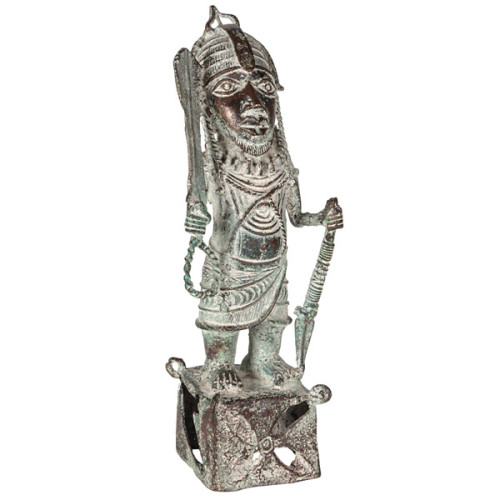
NIGERIA
Benin Head of King Oba, c. early to mid-20th Century
Lost wax cast bronze with a rich brown and black patina with light desert sand patina in some of the recessed areas.
The art of Benin is the product of an urban royal court, and is meant to symbolize and to extol the power, mystique, grandeur, continuity, and endurance of the ruling dynasty and its governing institutions. From the 14th century until its fall in 1897, Benin was ruled by the Oba, a divine ruler at the head of the political system of titled chiefs. Under royal support, a number of craftsman’s guilds produced bronze, brass, and wood sculptures and embroidered cloth, all of which have become prized by museums and collectors.
These heads were typically placed on altars dedicated to each of the past Oba’s of Benin. The altars are semicircular mud platforms that have been packed hard and rubbed smooth and are located in open courtyards of the palace. The royal altars are the settings for one of the two most important rites of divine kingship in Benin, Ugie Erha Oba, when the Oba honors the spirit of his late father and performs sacrifices to the royal ancestors and to the earth in which they are buried. Acknowledging his role as his fathers’ successor, the chiefs pay homage to the king and greet him in order of seniority. The rite expresses the continuity of divine kingship, and the altar before which it takes place provides the means by which the connection between the living king and his predecessors was established and made.
H: 14 1/2″ x D: 7 1/2″ x W: 8 1/2″
ANDRE VINCENT BECQUEREL (1893-1981) France
Arabian Horse sculpture c. 1930
Bronze with overall rich green/brown patina with intricate sculpting and details, black Belgian marble plinth base
Signed: A. Becquerel (inscribed in the bronze)
H: 12” x W: 21” x D: 6”
Price: $27,500
Andre Vincent Becquerel was born in St. Andre-Farivilliers. He studied at the l’Ecole des Beaux Arts in Paris under Hector Lemaire and Prosper Lecourtier. He specialized in fine animal sculpture and regularly exhibited at the Salon des Artistes Francais from 1914 to 1922. Becquerel worked for the Editeur Parisiens Edmond Etling in Paris and created a monumental sculpture in patinated plaster for the “Pavillon international” at the Exposition Internationale in Paris in 1937.
Franz Xaver Bergman (1861–1936) (attr.) Vienna, Austria.
Bull pen wipe c. 1900
Cold painted bronze, boar’s hair bristles, horn.
For information see: Art Bronzes, Mich. Forrest (Schiffer, 1988).
H: 5 1/4” x L: 11”
Franz Xaver Bergman (1861–1936) was the owner of a Viennese foundry who produced numerous patinated and cold-painted bronze Oriental, erotic and animal figures, the latter often humanized or whimsical, humorous objects d’art.
A well-known anamalier at the turn-of-the century, the sculptor Franz Bergman created a number of small bronzes in a variety of subject matter. Other figurative works were informed by the Jugendstil/Art Nouveau style and the European taste for the exotic as is found in his figures of rug merchants and camels. His animal sculptures, however, capture the Viennese tradition of naturalistic bronzes. The quality of the bronze casting shows tremendous detail, which was carefully brought out through the applied patination process known as cold painting.