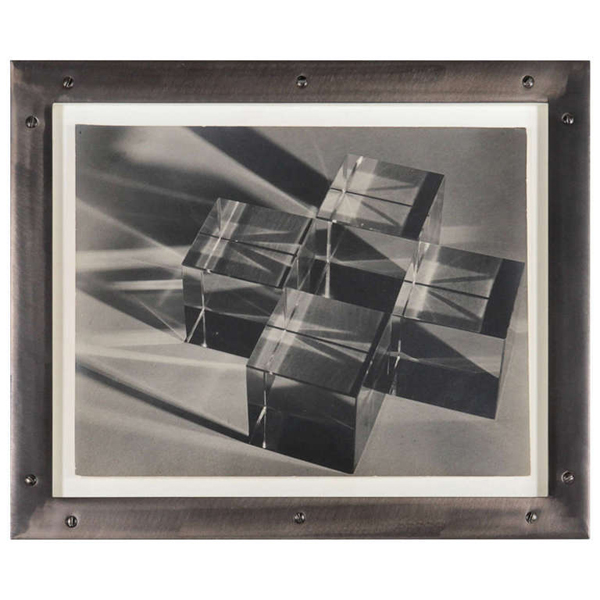
Carlotta Corpron, Light Cubes, Silver gelatin print c. 1947
More Information
Carlotta Corpron, Light Cubes, Gelatin silver print c. 1947
CARLOTTA CORPRON (1901-1988) USA
Light Cubes c. 1947
Silver gelatin print, patinated steel frame
Signed: Carlotta M. Corpron, Denton, Texas, RM6 #1081.47 (stamped on back)
Framed size: H: 13 ¾” x W: 16 ¾”
Price: $40,000
Corpron became a teacher at Texas Woman’s University in 1935 and in 1942 she led a light workshop at Texas Woman’s University for photographer Laszlo Moholy-Nagy. Although he praised her rapport with her students, Moholy-Nagy did not encourage Corpron’s independent photography. More influential on her work was the arrival of Gyorgy Kepes, who came to Denton to write a book in 1944. His interest in Corpron’s work prompted her to produce several series of photographs that were the most original of her career. At his suggestion Corpron experimented by placing white paper cut in simple shapes within a perforated box that was open at one end. When flashlights were shined through the holes onto the paper shapes, interesting patterns of light and shadow were reflected. The resulting abstract photographs comprised Corpron’s “Light Patterns” series.
In her “Light Follows Form” series she extended her exploration of the modeling properties of light to three-dimensional form. In this series, she used light filtered through Venetian blinds or glass to dramatize a plaster cast of a Greek head. She also experimented with solarization, a process in which already exposed negatives are exposed. Works such as Solarized Calla Lilies (1948) convey a surreal elegance, but Corpron favored more original methods of expression. She regarded her “Space Compositions” and “Fluid Light Designs” series as her best work. In the former she used still-lifes composed of eggs, nautilus shells, or glass paperweights, usually combined with a curving reflective surface, to produce an illusion of receding three-dimensional space. She emphasized distortions of form that occurred in her egg photographs by experimentation during the development process. Her work is included in the collections of the Museum of Modern Art in New York City, the Art Institute of Chicago, the New Orleans Museum of Art, the Dallas Museum of Art, and the Amon Carter Museum in Fort Worth.
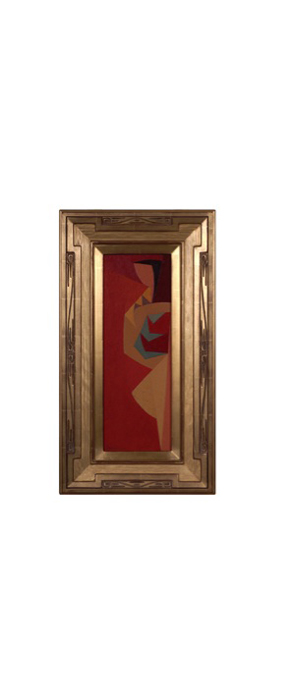
Karl Benjamin, “Geo-metricized figure”, Oil on canvas 1954
KARL BENJAMIN (1925-2012) USA
Geometricized figure 1954
Oil on canvas
Signed: Benjamin 54 (lower left)
For more information see: Dictionnaire des Peintres, Sculpteurs, Dessinateurs et Graveurs, Vol. 1 to 10, E. Bénézit (Paris: Librairie Gründ, 1976).
Canvas: H: 17″ x W: 6″
Framed: H: 24 1/2″ x W: 13 1/2″
Karl Benjamin was born in Chicago, IL in 1925. He received his BA from the University of Redlands, CA and his MFA at Claremont Graduate School, CA. Benjamin belonged to the Hard Edge group of West Coast painters led by John McLaughlin during the 1950s, 60s and early 70s. He was awarded the National Endowment for the Arts Grant for Visual Arts in both 1983 and 1989. His work has been featured in numerous museum exhibitions and is included in the public collections of the Los Angeles County Museum of Art; Museum of Contemporary Art, Los Angeles; Museum of Modern Art, Israel; Oakland Museum, Oakland, CA; San Francisco Museum of Modern Art, CA; Seattle Art Museum, WA; and the Whitney Museum of American Art, NY, among others. For many years, Benjamin taught painting at Pomona College and Claremont Graduate School, and currently is Professor Emeritus. He lived in Claremont, CA.
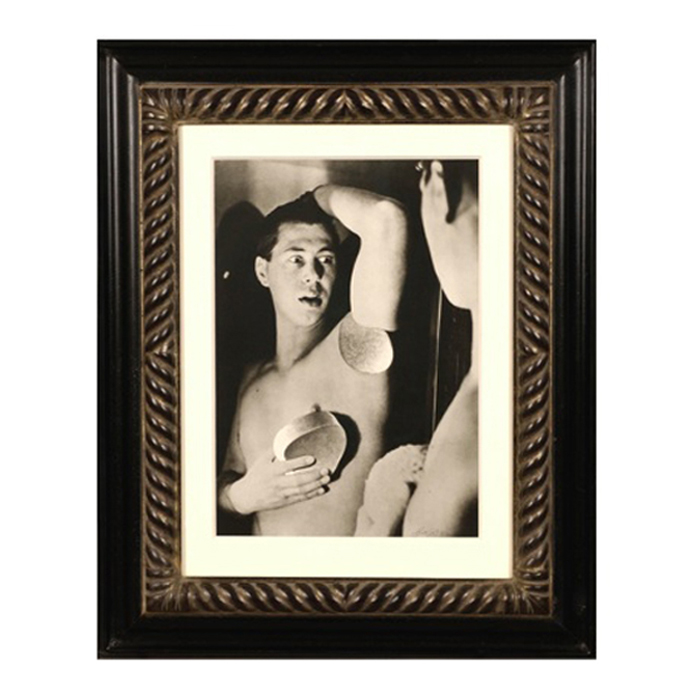
Herbert Bayer, Self Portrait, Gelatin silver print , 1932, printed later
HERBERT BAYER (1900-1985) Austria
Self portrait 1932 (printed later)
Silver gelatin print
Edition: 28/40
Signed: bayer 32 (in ink on bottom right corner)
Provenance: Kennedy Gallery, New York
H: 13 7/16” x W: 9 ½”
Framed size: H: 21 ½” x W: 17 ½”
Price: $16,000
Herbert Bayer (1900 – 1985) was an Austrian graphic designer, painter, photographer, and architect. Bayer apprenticed under the artist Georg Schmidthammer in Linz. Leaving the workshop to study at the Darmstadt Artists’ Colony, he became interested in Walter Gropius’s Bauhaus manifesto. After Bayer had studied for four years at the Bauhaus under such teachers as Wassily Kandinsky and László Moholy-Nagy, Gropius appointed Bayer director of printing and advertising. In the spirit of reductive minimalism, Bayer developed a crisp visual style and adopted use of all-lowercase, sans serif typefaces for most Bauhaus publications. Bayer is one of several typographers of the period including Kurt Schwitters and Jan Tschichold who experimented with the creation of a simplified more phonetic-based alphabet. Bayer designed the 1925 geometric sans-serif typeface, universal, now issued in digital form as Architype Bayer that bears comparison with the stylistically related typeface Architype Schwitters.
In 1928, Bayer left the Bauhaus to become art director of Vogue magazine’s Berlin office. He remained in Germany far later than most other progressives. In 1936 he designed a brochure for the Deutschland Ausstellung, an exhibition for tourists in Berlin during the 1936 Olympic Games. In 1938 he left Germany and settled in New York City where he had a long and distinguished career in nearly every aspect of the graphic arts. In 1946 Bayer relocated again. Hired by industrialist and visionary Walter Paepcke, Bayer moved to Aspen, Colorado as Paepcke promoted skiing as a popular sport. Bayer’s architectural work in the town included co-designing the Aspen Institute and restoring the Wheeler Opera House, but his production of promotional posters identified skiing with wit, excitement, and glamour. Bayer would remain associated with Aspen until the mid-1970s. Bayer gave the Denver Art Museum a collection of around 8,000 of his works. In 1959, he designed his “fonetik alfabet”, a phonetic alphabet, for English. It was sans-serif and without capital letters. He had special symbols for the endings -ed, -ory, -ing, and -ion, as well as the digraphs “ch”, “sh”, and “ng”. An underline indicated the doubling of a consonant in traditional orthography.
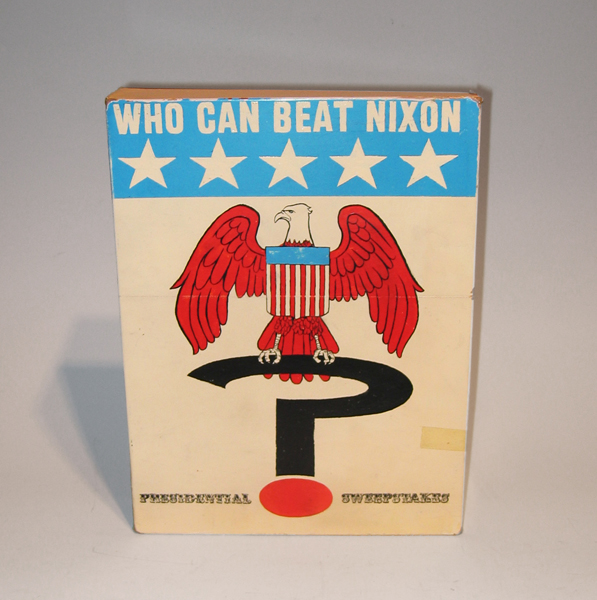
Tim Liddy Who Can Beat Nixon (1970) Presidential Sweepstakes 2006 Oil and enamel on copper, plywood back
TIM LIDDY
“Who Can Beat Nixon” (1970) Presidential Sweepstakes 2006
Oil and enamel on copper, plywood back
Signed in script: Tim Liddy “circa 1970” 2006, red circular ring
Provenance: William Shearburn Gallery (St. Louis, MO)
H: 11 ¾” x W: 9” x D: 2”
With his recent paintings, Liddy has both reasserted the construct of hyperrealist painting and developed a thoroughly unique advancement of that mode by extending the cultural reality of the indexed original. Based on the illustrated box lids of vintage board games, Liddy has recontextualized a subject, which evokes the underlying rules of life. Painted on copper or steel in the precise dimensions of the original, the metal is then manipulated to demonstrate the exact rips and tears from years of usage and includes trompe-l’oeil renditions of the scotch tape that might be holding the cardboard box together, the assorted stains, or the various graffiti of time. Liddy leaves no possibility of ambivalence, these works speak to a concurrent understanding of their original object identity and to themselves as works of art engaged in historical and psychological dialogue.




 @hd_jewels
Reviews
There are no reviews yet, would you like to submit yours?