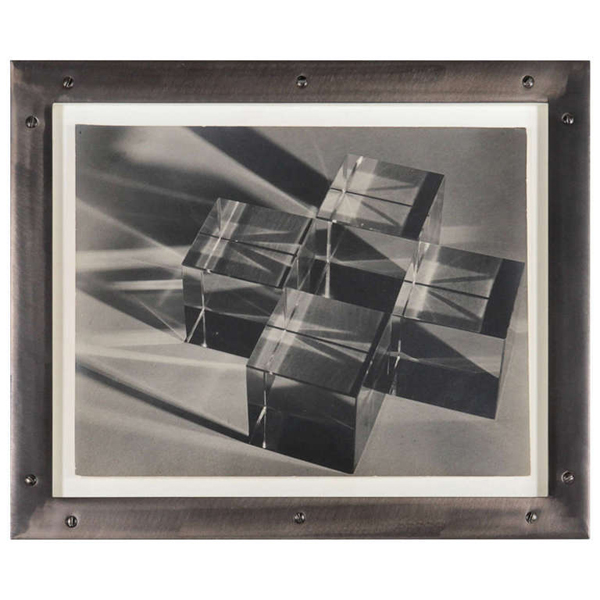
Carlotta Corpron, Light Cubes, Silver gelatin print c. 1947
More Information
Carlotta Corpron, Light Cubes, Gelatin silver print c. 1947
CARLOTTA CORPRON (1901-1988) USA
Light Cubes c. 1947
Silver gelatin print, patinated steel frame
Signed: Carlotta M. Corpron, Denton, Texas, RM6 #1081.47 (stamped on back)
Framed size: H: 13 ¾” x W: 16 ¾”
Price: $40,000
Corpron became a teacher at Texas Woman’s University in 1935 and in 1942 she led a light workshop at Texas Woman’s University for photographer Laszlo Moholy-Nagy. Although he praised her rapport with her students, Moholy-Nagy did not encourage Corpron’s independent photography. More influential on her work was the arrival of Gyorgy Kepes, who came to Denton to write a book in 1944. His interest in Corpron’s work prompted her to produce several series of photographs that were the most original of her career. At his suggestion Corpron experimented by placing white paper cut in simple shapes within a perforated box that was open at one end. When flashlights were shined through the holes onto the paper shapes, interesting patterns of light and shadow were reflected. The resulting abstract photographs comprised Corpron’s “Light Patterns” series.
In her “Light Follows Form” series she extended her exploration of the modeling properties of light to three-dimensional form. In this series, she used light filtered through Venetian blinds or glass to dramatize a plaster cast of a Greek head. She also experimented with solarization, a process in which already exposed negatives are exposed. Works such as Solarized Calla Lilies (1948) convey a surreal elegance, but Corpron favored more original methods of expression. She regarded her “Space Compositions” and “Fluid Light Designs” series as her best work. In the former she used still-lifes composed of eggs, nautilus shells, or glass paperweights, usually combined with a curving reflective surface, to produce an illusion of receding three-dimensional space. She emphasized distortions of form that occurred in her egg photographs by experimentation during the development process. Her work is included in the collections of the Museum of Modern Art in New York City, the Art Institute of Chicago, the New Orleans Museum of Art, the Dallas Museum of Art, and the Amon Carter Museum in Fort Worth.
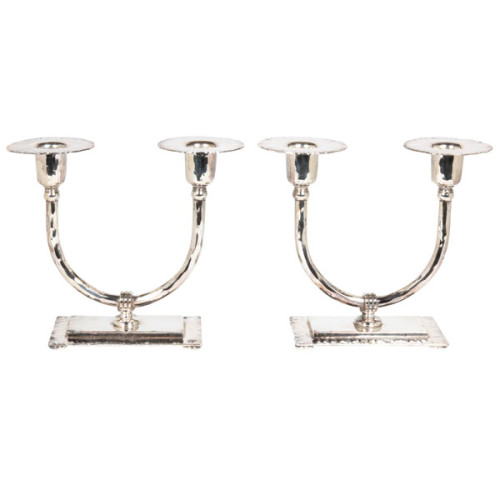
Roycroft / American Arts & Crafts Pair of Candlesticks c. 1915
ROYCROFT COPPER SHOP East Aurora, N.Y.
Pair of candlesticks c. 1915.
Hand wrought and textured copper, silver-plated.
Marks: impressed R, in orb with cross, ROYCROFT
For more information see: The American Arts & Crafts Movement in Western New York 1900-1928, Bruce A. Austin (Rochester Institute of Technology, 1992); Arts & Crafts Movement in New York State 1890’s – 1920’s, Coy Ludwig (Hamilton, N.Y.: Gallery Association of New York, 1983).
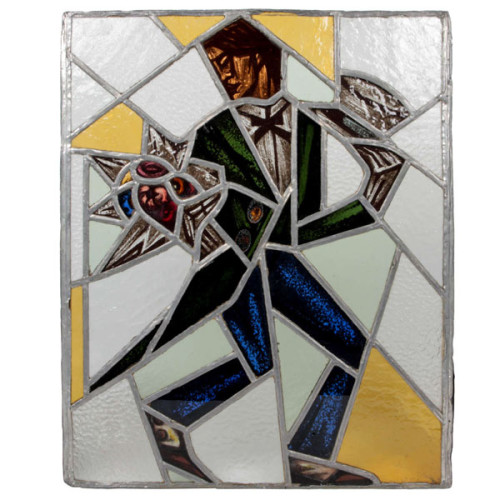
Reinhold Klaus / Carl Geyling Atelier Vienna “Cubist Man with top hat and flowers” stained glass window c. 1930
REINHOLD KLAUS (1881-1963) Vienna, Austria
CARL GEYLING ATELIER (founded 1841) Vienna, Austria
Man with tophat and flowers c. 1930
Window of stained and hand-painted leaded glass
Provenance: Estate of Carl Geyling (1814-1880), Vienna
H: 17 3/4″ x W: 14 1/2″
Reinhold Klaus studied from 1898-1902 with Alfred Roller at the Kaiserlich-Königliche Kunstgewerbeschule in Vienna. In 1914 Klaus married into the Carl Geyling family and became extensively involved with with stained glass painting. As early as 1918 Klaus worked on a stained glass window for the Siegestempel am Bisamberg in Vienna. In 1934 he became a professor of stained glass painting at the Kunstgewerbeschule, as well as creative director of the C. Geylings Erben glass painting company. Reinhold Klaus, a member of the Künstlerhaus since 1924 received many prizes and honors. He worked on commissions for the St. Veits cathedral in Prague, the St. Stephan cathedral in Vienna and many others.
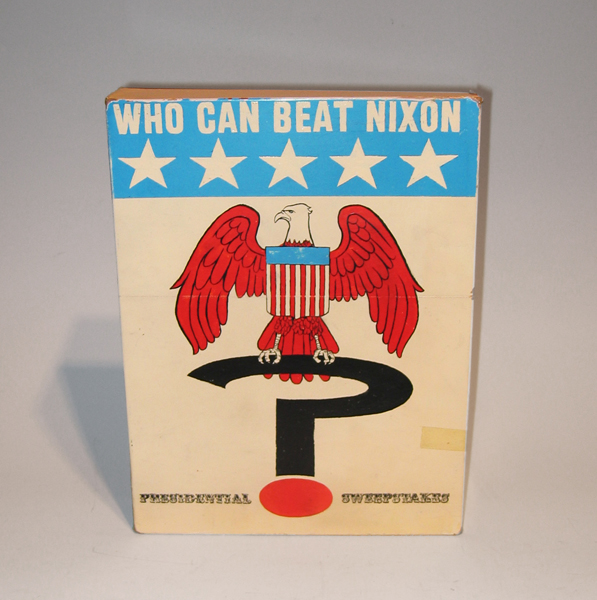
Tim Liddy Who Can Beat Nixon (1970) Presidential Sweepstakes 2006 Oil and enamel on copper, plywood back
TIM LIDDY
“Who Can Beat Nixon” (1970) Presidential Sweepstakes 2006
Oil and enamel on copper, plywood back
Signed in script: Tim Liddy “circa 1970” 2006, red circular ring
Provenance: William Shearburn Gallery (St. Louis, MO)
H: 11 ¾” x W: 9” x D: 2”
With his recent paintings, Liddy has both reasserted the construct of hyperrealist painting and developed a thoroughly unique advancement of that mode by extending the cultural reality of the indexed original. Based on the illustrated box lids of vintage board games, Liddy has recontextualized a subject, which evokes the underlying rules of life. Painted on copper or steel in the precise dimensions of the original, the metal is then manipulated to demonstrate the exact rips and tears from years of usage and includes trompe-l’oeil renditions of the scotch tape that might be holding the cardboard box together, the assorted stains, or the various graffiti of time. Liddy leaves no possibility of ambivalence, these works speak to a concurrent understanding of their original object identity and to themselves as works of art engaged in historical and psychological dialogue.






 @hd_jewels
Reviews
There are no reviews yet, would you like to submit yours?