Lucien Lelong / French Art Deco Handpainted Porcelain Vase circa 1935
More Information
Lucien Lelong / French Art Deco Handpainted Porcelain Vase circa 1935
LUCIEN LELONG (1889 – 1958) Paris, France
“Metaphysical” vase c. 1935
Hand painted and glazed porcelain with aqua, black and silver tones.
Marks: LL monogram, AB
H: 13 3/4″
Lucien Lelong was born in Paris, France on October 11, 1889. Lucien learned his trade from his father, Arthur Lelong, who owned a textile factory in 1896, and his mother Eleanore, a dressmaker. He discovered his vocation in the family business and as soon as World War I was over, he expanded the family business by creating his own fashion house in the late 1918.
He became immediately famous due to the neat tailoring of his designs and his skill in choosing and manufacturing fabrics. He did not actually create his own designs but hired the most prominent designers of the moment to design his collections such as Christian Dior, Pierre Balmain and Hubert Givenchy. Lelong was one of the first designers to diversify into lingerie and stockings. He introduced a line of ready-to-wear in 1934 which he labeled “editions.” In 1939, Lelong’s collections showed tightly waisted, full skirts; a style which became the “new Look” in Dior’s collection in 1947. After the war, in 1947, Lelong showed pencil-slim dresses; pleated, tiered, harem hemlines; and suits with wasp waists, cutaway fronts and square shoulders.
After a trip to the United States where he learned everything pertaining to the working methods in the mass production of clothes, he returns to France and creates a line of pret-a-porter (ready-to-wear) collection, branded “LL” Edition. Lelong used his double” LL” logo to influence his designs as well as refining the packaging design of his perfumes and cosmetics. He was a master of the use of knits and bias to shape the body in the most complementary way. His house’s trademark was their unique ability in designing with fur.
He was married to Natalie Paley who was the daughter of the Grand Duke Paul of Russia that assisted him with his business. Lelong was an active member of high society; socialized with the women he dressed, and did not miss the opportunity to capitalize on his name. From 1937 until the end of the war in 1948, Lelong was President of the Chambre Syndicale de la Couture Parisienne, in which role he was able to fight and hinder the transfer of the Parisian fashion houses to Berlin during the German occupation. It was largely due to his efforts that ninety-two houses stayed opened during the war.
Poor health caused the end of his career; Lelong retired in 1952, and died in 1958 of a heart attack.
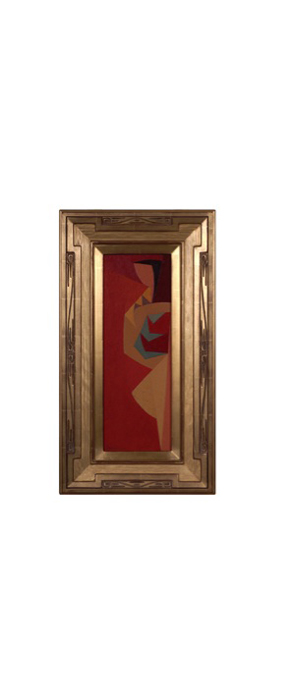
Karl Benjamin, “Geo-metricized figure”, Oil on canvas 1954
KARL BENJAMIN (1925-2012) USA
Geometricized figure 1954
Oil on canvas
Signed: Benjamin 54 (lower left)
For more information see: Dictionnaire des Peintres, Sculpteurs, Dessinateurs et Graveurs, Vol. 1 to 10, E. Bénézit (Paris: Librairie Gründ, 1976).
Canvas: H: 17″ x W: 6″
Framed: H: 24 1/2″ x W: 13 1/2″
Karl Benjamin was born in Chicago, IL in 1925. He received his BA from the University of Redlands, CA and his MFA at Claremont Graduate School, CA. Benjamin belonged to the Hard Edge group of West Coast painters led by John McLaughlin during the 1950s, 60s and early 70s. He was awarded the National Endowment for the Arts Grant for Visual Arts in both 1983 and 1989. His work has been featured in numerous museum exhibitions and is included in the public collections of the Los Angeles County Museum of Art; Museum of Contemporary Art, Los Angeles; Museum of Modern Art, Israel; Oakland Museum, Oakland, CA; San Francisco Museum of Modern Art, CA; Seattle Art Museum, WA; and the Whitney Museum of American Art, NY, among others. For many years, Benjamin taught painting at Pomona College and Claremont Graduate School, and currently is Professor Emeritus. He lived in Claremont, CA.
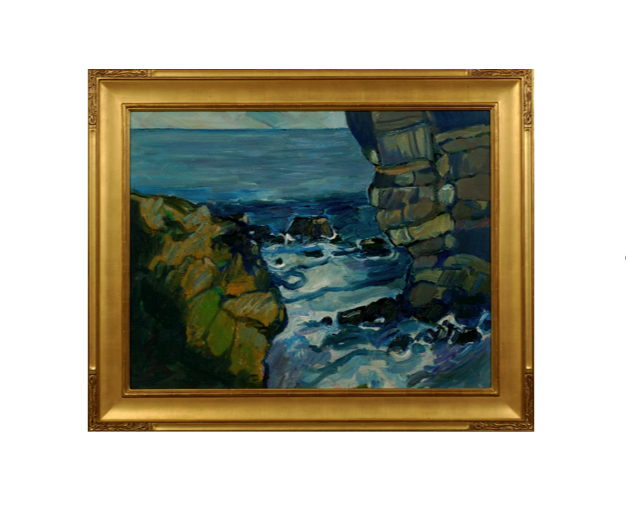
Peter Canty received his BA in art from the Chouniard Art Institute, Los Angeles (now California Institute of the Arts) and an MA from the University of California, Santa Cruz in 1969. Heavily influenced by the Post-Impressionist masters Van Gogh, Gauguin and Cezanne, in his own he words he describes his interest in landscapes, believing they are, “the best vehicle for motion, force, and color dynamics.” Although his work reference realistic subjects, Canty’s imagery is drawn strictly from his own imagination.
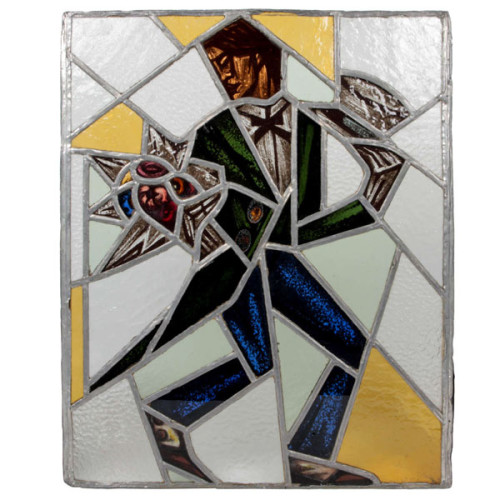
Reinhold Klaus / Carl Geyling Atelier Vienna “Cubist Man with top hat and flowers” stained glass window c. 1930
REINHOLD KLAUS (1881-1963) Vienna, Austria
CARL GEYLING ATELIER (founded 1841) Vienna, Austria
Man with tophat and flowers c. 1930
Window of stained and hand-painted leaded glass
Provenance: Estate of Carl Geyling (1814-1880), Vienna
H: 17 3/4″ x W: 14 1/2″
Reinhold Klaus studied from 1898-1902 with Alfred Roller at the Kaiserlich-Königliche Kunstgewerbeschule in Vienna. In 1914 Klaus married into the Carl Geyling family and became extensively involved with with stained glass painting. As early as 1918 Klaus worked on a stained glass window for the Siegestempel am Bisamberg in Vienna. In 1934 he became a professor of stained glass painting at the Kunstgewerbeschule, as well as creative director of the C. Geylings Erben glass painting company. Reinhold Klaus, a member of the Künstlerhaus since 1924 received many prizes and honors. He worked on commissions for the St. Veits cathedral in Prague, the St. Stephan cathedral in Vienna and many others.




 @hd_jewels