Product Description
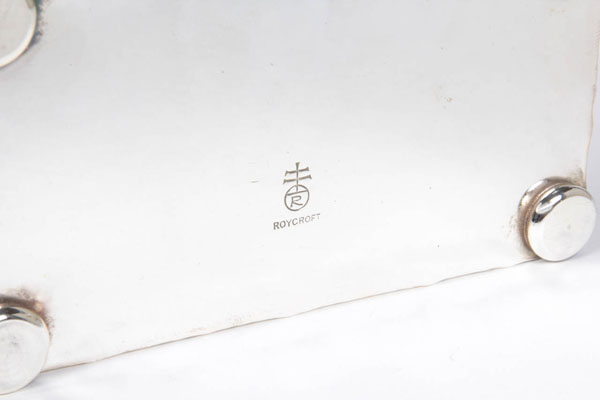
Roycroft / American Arts & Crafts Pair of Candlesticks c. 1915

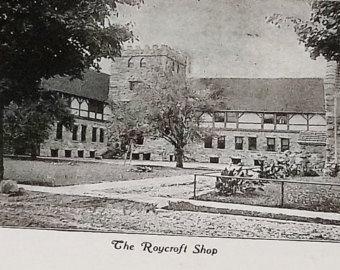
ROYCROFT COPPER SHOP East Aurora, N.Y.
Pair of candlesticks c. 1915.
Hand wrought and textured copper, silver-plated.
Marks: impressed R, in orb with cross, ROYCROFT
For more information see: The American Arts & Crafts Movement in Western New York 1900-1928, Bruce A. Austin (Rochester Institute of Technology, 1992); Arts & Crafts Movement in New York State 1890’s – 1920’s, Coy Ludwig (Hamilton, N.Y.: Gallery Association of New York, 1983).
H: 6″ x W: 6 7/8″ x D: 2 5/8″
Roycroft / American Arts & Crafts Pair of Candlesticks c. 1915
ARAM GESAR USA
Venetian Blinds 1979
Ciba-chrome print, maple frame
Signed: 790069, LXXIX (on back)
Framed size: H: 17 9/16” x W: 23 ½”
Price: $24,000
Aram Gesar has been published internationally and has exhibited his photographic work in New York, San Francisco, Zurich and Geneva since 1977. As a producer, art director and photographer, Gesar created advertising campaigns for major corporations in the U.S. and Europe focusing on the fields of travel, banking, financial services, aerospace and motion pictures. He also created and produced documentaries on travel, aviation and yachting for national cable networks and the home video markets and television commercials and corporate programs for various U.S. and European corporations.
Gesar is currently one of the leading international experts on travel and air transport, and the founder and CEO of The Pyramid Media Group, which includes several magazines, newsletters, web sites, books, eBooks and other publications integrating a spectrum of business, travel and aviation content.
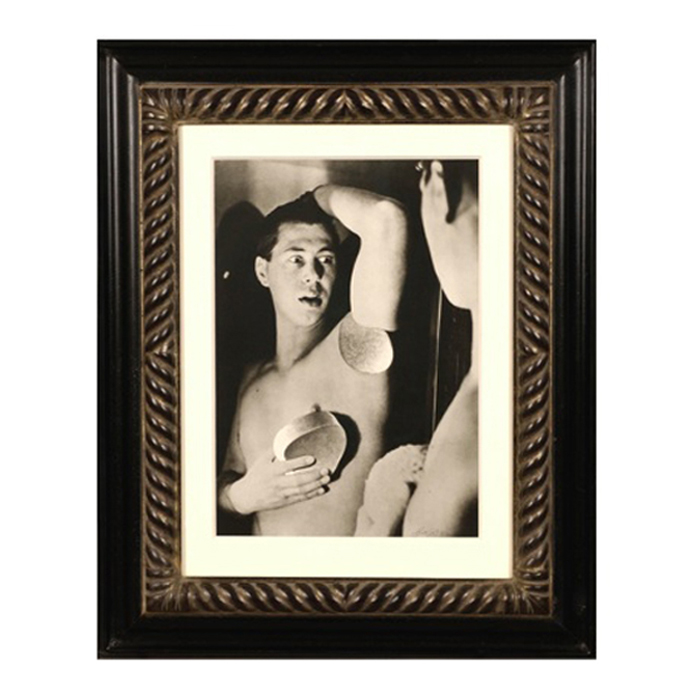
HERBERT BAYER (1900-1985) Austria
Self portrait 1932 (printed later)
Silver gelatin print
Edition: 28/40
Signed: bayer 32 (in ink on bottom right corner)
Provenance: Kennedy Gallery, New York
H: 13 7/16” x W: 9 ½”
Framed size: H: 21 ½” x W: 17 ½”
Price: $16,000
Herbert Bayer (1900 – 1985) was an Austrian graphic designer, painter, photographer, and architect. Bayer apprenticed under the artist Georg Schmidthammer in Linz. Leaving the workshop to study at the Darmstadt Artists’ Colony, he became interested in Walter Gropius’s Bauhaus manifesto. After Bayer had studied for four years at the Bauhaus under such teachers as Wassily Kandinsky and László Moholy-Nagy, Gropius appointed Bayer director of printing and advertising. In the spirit of reductive minimalism, Bayer developed a crisp visual style and adopted use of all-lowercase, sans serif typefaces for most Bauhaus publications. Bayer is one of several typographers of the period including Kurt Schwitters and Jan Tschichold who experimented with the creation of a simplified more phonetic-based alphabet. Bayer designed the 1925 geometric sans-serif typeface, universal, now issued in digital form as Architype Bayer that bears comparison with the stylistically related typeface Architype Schwitters.
In 1928, Bayer left the Bauhaus to become art director of Vogue magazine’s Berlin office. He remained in Germany far later than most other progressives. In 1936 he designed a brochure for the Deutschland Ausstellung, an exhibition for tourists in Berlin during the 1936 Olympic Games. In 1938 he left Germany and settled in New York City where he had a long and distinguished career in nearly every aspect of the graphic arts. In 1946 Bayer relocated again. Hired by industrialist and visionary Walter Paepcke, Bayer moved to Aspen, Colorado as Paepcke promoted skiing as a popular sport. Bayer’s architectural work in the town included co-designing the Aspen Institute and restoring the Wheeler Opera House, but his production of promotional posters identified skiing with wit, excitement, and glamour. Bayer would remain associated with Aspen until the mid-1970s. Bayer gave the Denver Art Museum a collection of around 8,000 of his works. In 1959, he designed his “fonetik alfabet”, a phonetic alphabet, for English. It was sans-serif and without capital letters. He had special symbols for the endings -ed, -ory, -ing, and -ion, as well as the digraphs “ch”, “sh”, and “ng”. An underline indicated the doubling of a consonant in traditional orthography.
REINHOLD KLAUS (1881-1963) Vienna, Austria
CARL GEYLING ATELIER (founded 1841) Vienna, Austria
Man with tophat and flowers c. 1930
Window of stained and hand-painted leaded glass
Provenance: Estate of Carl Geyling (1814-1880), Vienna
H: 17 3/4″ x W: 14 1/2″
Reinhold Klaus studied from 1898-1902 with Alfred Roller at the Kaiserlich-Königliche Kunstgewerbeschule in Vienna. In 1914 Klaus married into the Carl Geyling family and became extensively involved with with stained glass painting. As early as 1918 Klaus worked on a stained glass window for the Siegestempel am Bisamberg in Vienna. In 1934 he became a professor of stained glass painting at the Kunstgewerbeschule, as well as creative director of the C. Geylings Erben glass painting company. Reinhold Klaus, a member of the Künstlerhaus since 1924 received many prizes and honors. He worked on commissions for the St. Veits cathedral in Prague, the St. Stephan cathedral in Vienna and many others.
ROSE CABAT (1914-2015) USA
“Feelie” c. 1980-85
Thin walled porcelain vessel with a silky satiny matte drip glaze
Signed: incised CABAT on bottom
For more information on Rose Cabat see: Rose Erni Cabat Retrospective 1936-1986 (Tuscon, AZ: Tuscon Museum of Art, 1986)
H: 4 3/4″
Price: $2,500
Rose Cabat is an American studio ceramicist living in Tucson. Considered one of the most important ceramic artists of the Mid-century Modernist movement, Cabat is best known for her innovative glazes on small porcelain pots called “feelies” which she developed in the 1960s. Her organic forms often resemble the shape of onions and figs, and her glazes range from organic to jewel tones. Cabat was born in 1914 in the Bronx, New York, began to work in ceramics in the late 1930′s, and moved to Arizona in 1942, where she continued to make innovative ceramics.
Feelies:
Feelies are described as onion, fig, cucumber, and saucer-shaped ceramic vases terminating in an upward closed neck. Bruce Block, an avid collector, has described them as sensual and tactile with a very specific unforgettable texture, spiritual seeming to contain a type of energy. Rose Cabat had developed a silky satiny glaze, and it wasn’t until around 1960 that she had hit upon the first of the appropriate form, svelte and sleek to match the glaze. She exclaimed, “Now this one’s a feelie.”, coining the term. Upon developing the new glazes, she felt that she needed new forms to apply the glazes to, different from what she made before, “craft fair” style coiled heads and wind bells. She is quoted as saying, “The old things did not look good … I wanted simpler shapes that went with the glazes.”They are typically globular in shape, tightening down to a minuscule neck glazed to a satin surface. The tactile experience is most important. The nature of the neck is such that it is closed, so narrow that it cannot hold anything. Cabat would reply when asked why the necks of her feelies are so narrow, “A vase can hold weeds or flowers, but can’t it just be a spot of beauty?”