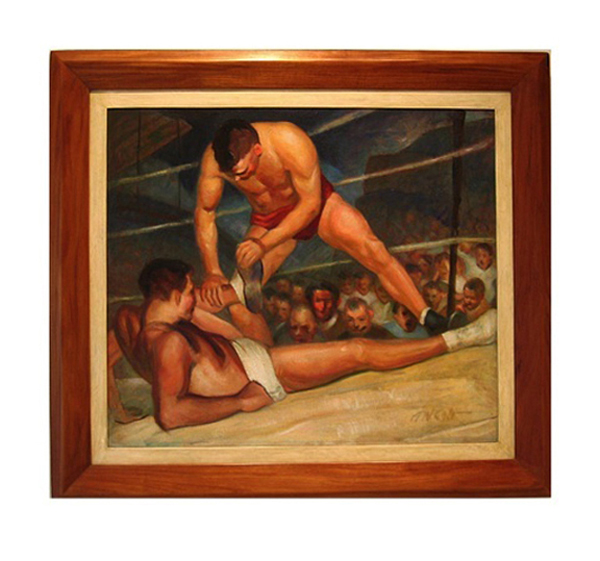
Arthur N. Colt, “The Wrestlers”, Oil on canvas c. 1938
ARTHUR N. COLT (1889-1972) USA
The Wrestlers c. 1938
Oil on canvas
Signed: A. N. Colt in lower right corner
For more information on Colt see: Who Was Who in American Art (Madison, Conn.: Sound View Press, 1985). p.125. Hove, Arthur, ed. Wisconsin Alumnus Vol. 61, No. 9 (January 1960), “Portrait Patterns” Art Digest v. 9 (December 15, 1934) p. 7
Canvas: H: 29 ½” x W: 34”
Framed: H: 38 ½” x W: 43”
Arthur Colt studied painting at the Art Institute of Chicago and in Paris. He was not only an important Wisconsin painter but also an influential teacher. He taught at the University of Wisconsin, Madison, founded a summer art colony at Black River and Devil’s Lake, WI and went on to form the Colt School of Art. Arthur Colt exhibited at the Madison Salon of Art Exhibition in 1934.
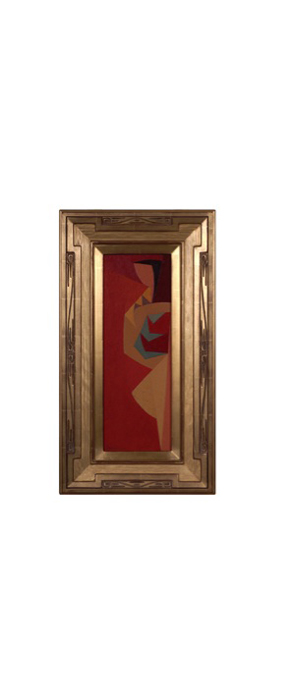
Karl Benjamin, “Geo-metricized figure”, Oil on canvas 1954
KARL BENJAMIN (1925-2012) USA
Geometricized figure 1954
Oil on canvas
Signed: Benjamin 54 (lower left)
For more information see: Dictionnaire des Peintres, Sculpteurs, Dessinateurs et Graveurs, Vol. 1 to 10, E. Bénézit (Paris: Librairie Gründ, 1976).
Canvas: H: 17″ x W: 6″
Framed: H: 24 1/2″ x W: 13 1/2″
Karl Benjamin was born in Chicago, IL in 1925. He received his BA from the University of Redlands, CA and his MFA at Claremont Graduate School, CA. Benjamin belonged to the Hard Edge group of West Coast painters led by John McLaughlin during the 1950s, 60s and early 70s. He was awarded the National Endowment for the Arts Grant for Visual Arts in both 1983 and 1989. His work has been featured in numerous museum exhibitions and is included in the public collections of the Los Angeles County Museum of Art; Museum of Contemporary Art, Los Angeles; Museum of Modern Art, Israel; Oakland Museum, Oakland, CA; San Francisco Museum of Modern Art, CA; Seattle Art Museum, WA; and the Whitney Museum of American Art, NY, among others. For many years, Benjamin taught painting at Pomona College and Claremont Graduate School, and currently is Professor Emeritus. He lived in Claremont, CA.
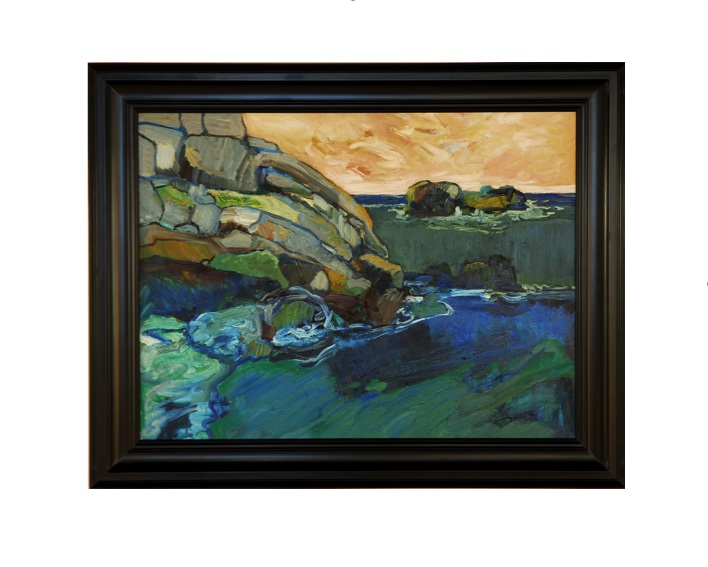
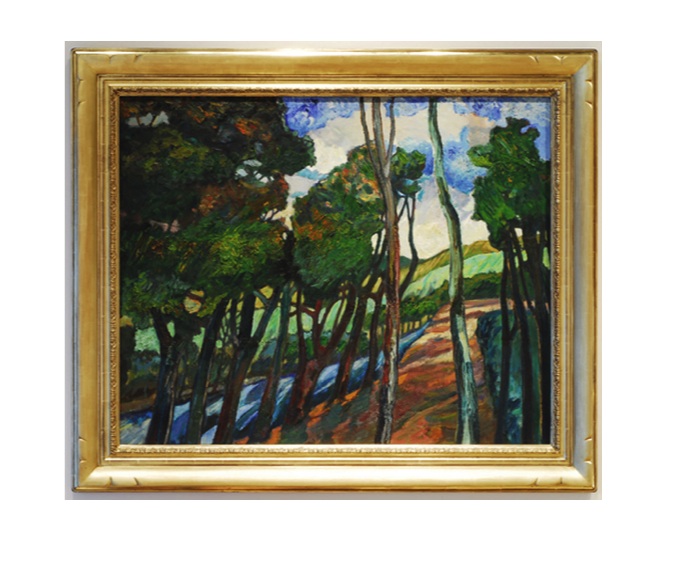
Signed: P. Canty 2001, Santa Cruz, CA 5 (in a circle on back)
Canvas size: H: 30” x L: 40”
Framed size: H: 38” x L: 48”
Peter Canty received his BA in art from the Chouniard Art Institute, Los Angeles (now California Institute of the Arts) and an MA from the University of California, Santa Cruz in 1969. Heavily influenced by the Post-Impressionist masters Van Gogh, Gauguin and Cezanne, in his own he words he describes his interest in landscapes, believing they are, “the best vehicle for motion, force, and color dynamics.” Although his work reference realistic subjects, Canty’s imagery is drawn strictly from his own imagination.
Peter Canty received his BA in art from the Chouniard Art Institute, Los Angeles (now California Institute of the Arts) and an MA from the University of California, Santa Cruz in 1969. Heavily influenced by the Post-Impressionist masters Van Gogh, Gauguin and Cezanne, in his own he words he describes his interest in landscapes, believing they are, “the best vehicle for motion, force, and color dynamics.” Although his work reference realistic subjects, Canty’s imagery is drawn strictly from his own imagination.



 @hd_jewels